Oligonucleotide Manufacturing: Scaling the Next Generation of Medicines
Lakshmi, Editorial Team, Pharma Focus Europe
Oligonucleotide therapeutics are moving from rare-disease niches into cardiovascular, metabolic and neurological markets where patient populations number in the millions. That shift is forcing a manufacturing reckoning. Synthesis routes built for grams must now deliver metric tons, with tighter impurity control and far smaller environmental footprints. This article examines the technical, regulatory and strategic levers European pharmaceutical leaders must pull to turn oligonucleotide promise into reliable, scalable supply.
When Pharma's Smallest Molecules Create Its Biggest Supply Question
For most of their history, oligonucleotides were manufactured the way specialty chemicals are made: small batches, high cost per gram, and patient populations small enough that supply was rarely the limiting factor. That era is ending. Antisense oligonucleotides (ASOs) and small interfering RNAs (siRNAs) now target conditions such as hypercholesterolaemia, hypertension and cardiometabolic disease, where dosing is chronic and demand could reach tonnes of active pharmaceutical ingredient each year.
For European C-suite leaders, this is more than a technical footnote. Manufacturing capacity, cost of goods and sustainability performance will decide which oligonucleotide programmes reach patients on time and which ones stall after approval. The companies that treat manufacturing as a strategic asset, rather than a downstream service, will set the pace for the decade ahead.
The Oligonucleotide Pipeline Has Outgrown Its Factories
The growth in approved oligonucleotide medicines has been steep. After roughly fifteen years with only a handful of approvals, the field reached an inflection point in the mid-2010s. Improved chemical modifications, such as phosphorothioate backbones and 2'-sugar modifications, and the breakthrough of GalNAc conjugation for targeted liver delivery transformed potency and dosing intervals.
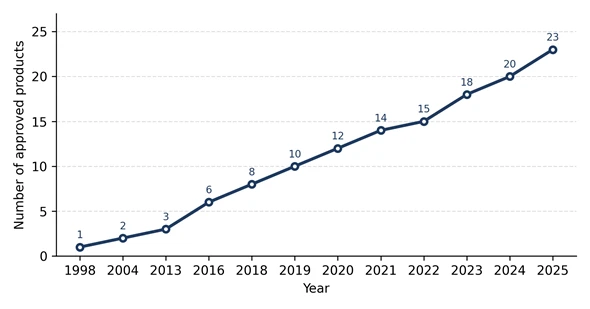
Figure 1: Cumulative approved oligonucleotide therapeutics (approximate, US/EU)
Behind these approvals sits a clinical pipeline of several hundred oligonucleotide candidates. The critical change is not only volume of products but volume per product. A rare-disease ASO might need a few kilograms a year; a twice-yearly siRNA for lipid lowering, given to large cardiovascular populations, can require hundreds of kilograms to tonnes. Legacy pharmaceutical infrastructure was never designed for that leap.
The Unforgiving Arithmetic of Oligonucleotide Synthesis
Most commercial oligonucleotides are still produced by solid-phase oligonucleotide synthesis (SPOS) using phosphoramidite chemistry. Each nucleotide is added in a repeated cycle of deblocking, coupling, oxidation or sulfurisation, and capping. The process is elegant and well understood, but it carries a mathematical penalty: small inefficiencies at each step compound across the entire chain.
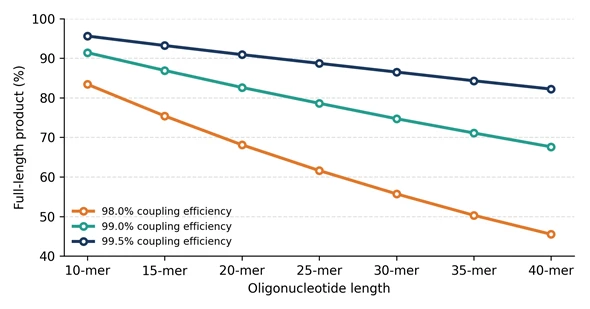
Figure 2: Theoretical full-length oligonucleotide yield vs chain length at different coupling efficiencies
A 20-mer made at 98% coupling efficiency yields only about two-thirds full-length product before purification; at 99.5%, that rises above 90%. Every lost percentage point becomes a shortmer or failure sequence that must be removed downstream, adding chromatography time, solvent and cost. siRNAs compound the challenge, because two strands must be synthesised, purified and annealed into a duplex.
The other scale constraint is physical. Solid-phase columns cannot be enlarged indefinitely without problems in fluid distribution, heat and reagent efficiency. Many manufacturers therefore scale out with multiple synthesisers rather than up, which raises capital intensity and adds complexity in batch-to-batch consistency.
Solvent, Waste and the Green Chemistry Reckoning for Pharma Oligonucleotides
Sustainability may become the decisive argument for manufacturing innovation. Industry assessments of oligonucleotide processes report process mass intensity (PMI) values running into the thousands of kilograms of material per kilogram of API, far higher than for typical small molecules or many biologics. Acetonitrile for washing, dichloromethane or toluene in deblocking, and large chromatography buffer volumes drive most of that footprint.
For European companies, this creates direct exposure. Corporate net-zero commitments, the EU's evolving chemicals and solvent policy, and investor scrutiny of Scope 3 emissions all converge on the same question: can an oligonucleotide portfolio grow tenfold without its environmental footprint growing tenfold too? Solvent recycling, reduced wash volumes, greener deblocking reagents and continuous purification are now board-level levers, not laboratory curiosities.
Beyond the Column: Liquid-Phase, Hybrid and Enzymatic Oligonucleotide Routes
Three emerging approaches are reshaping the oligonucleotide manufacturing roadmap.
Liquid-phase oligonucleotide synthesis (LPOS) grows the chain on a soluble support, allowing conventional reactor scale-up and potentially sharper reductions in reagent excess. Its challenge lies in efficient intermediate isolation at each step, though nanofiltration and precipitation methods are maturing quickly.
Hybrid or convergent strategies synthesise shorter fragments, purify them to high quality and ligate them into the full-length molecule. Because shorter fragments are made with higher fidelity, the compounding yield penalty shown in Figure 2 is reduced, and impurity profiles become easier to control. Chemical or enzymatic ligation of fragments is drawing particular attention for siRNA strands.
Enzymatic synthesis is the most disruptive prospect. Template-independent polymerases and ligase-based methods promise aqueous chemistry, fewer protecting groups and dramatically lower solvent use. The barrier has been compatibility with heavily modified nucleotides that commercial therapeutics depend on, but engineered enzymes are narrowing that gap. Leaders should view enzymatic routes as a five-to-ten-year strategic option worth funding today.
Purity, Impurities and Europe's Oligonucleotide Regulatory Lens
Oligonucleotides sit awkwardly between small molecules and biologics in regulatory terms. They are chemically synthesised, yet their impurity profiles are complex: shortmers, longmers, depurinated species, phosphodiester impurities in phosphorothioate drugs and diastereomeric mixtures at each modified linkage.
The European Medicines Agency has been developing dedicated guidance on the development and manufacture of synthetic oligonucleotides, reflecting the field's maturity and its unique control challenges. For manufacturers, this means analytical strategy must be planned as early as chemistry. High-resolution mass spectrometry, ion-pair reversed-phase chromatography and robust impurity grouping approaches need to be embedded from early development so that a process change at commercial scale does not trigger costly comparability questions.
Companies adopting new technologies such as LPOS or enzymatic routes face an additional burden: demonstrating that a novel process yields an equivalent or improved impurity profile. Early, structured dialogue with regulators is a competitive advantage.
Europe's Strategic Opening in Oligonucleotide Capacity
A recent industry pattern illustrates the opportunity. Several European contract development and manufacturing organisations have announced multi-hundred-million-euro investments in large-scale oligonucleotide plants, explicitly designed for cardiometabolic indications. These facilities pair larger synthesisers with integrated downstream purification, solvent recovery systems and in-line analytics. One recurring design principle stands out: building dedicated campaigns for single high-volume molecules rather than multipurpose suites, accepting lower flexibility in exchange for higher throughput and lower cost per kilogram.
The lesson for sponsors is clear. Capacity for tonne-scale oligonucleotide supply is finite and being reserved years ahead. Companies with late-stage cardiovascular or metabolic oligonucleotide assets that have not secured long-term manufacturing partnerships, or built their own capacity, risk commercial launches constrained by supply rather than demand. Europe's strengths in process chemistry, green manufacturing and regulatory rigour position the region well, provided investment keeps pace with pipeline growth.
Conclusion:
Boardroom Imperatives for the Oligonucleotide Decade
Oligonucleotides are becoming mainstream pharmaceutical products, and their manufacturing model must mature accordingly. The arithmetic of stepwise synthesis, the environmental cost of solvent-intensive processes and the complexity of impurity control mean that scaling is not simply a matter of building bigger columns.
European leaders who act now, by securing capacity, investing in hybrid and enzymatic technologies, embedding sustainability metrics into process design and engaging regulators early, will turn manufacturing from a bottleneck into a source of competitive advantage. The next generation of medicines will be defined not only by what science can design, but by what industry can reliably make.
Frequently Asked Questions
1. What makes oligonucleotide manufacturing harder to scale than small-molecule production?
Stepwise synthesis compounds small inefficiencies across every coupling cycle, and solid-phase columns have physical limits. The result is lower full-length yields, demanding purification and high solvent use as volumes rise.
2. Why is demand for oligonucleotide API rising so sharply?
Therapies are expanding from rare diseases into common chronic conditions such as hypercholesterolaemia and hypertension, where large patient populations require far greater annual API volumes.
3. What is process mass intensity, and why does it matter here?
PMI measures total material used per kilogram of product. Oligonucleotide processes have very high PMI, making solvent reduction central to both cost control and sustainability goals.
4. Will enzymatic synthesis replace solid-phase oligonucleotide synthesis?
Not immediately. Enzymatic routes are promising for sustainability and purity, but compatibility with heavily modified nucleotides is still being proven. A hybrid future combining several technologies is most likely.
5. How should European companies prepare for regulatory expectations?
By building advanced analytical control strategies early, anticipating EMA's dedicated oligonucleotide guidance, and engaging regulators before introducing novel manufacturing processes.

Lakshmi is a science writer with a foundation in the laboratory. She earned her master's in biotechnology and trained through research internships at ICGEB (JNU) and DIPAS, DRDO, with her work appearing in the Egyptian Journal of Veterinary Sciences. Now APCRM-certified and part of the editorial team at Pharma Focus America and Pharma Focus Europe, she reports on pharmaceutical technology, research, and innovation — giving complex science a clear and confident voice for industry leaders.