Manufacturing mRNA, Cell, and Gene Therapies at Commercial Scale
Lakshmi, Editorial Team, Pharma Focus Europe
Commercial scale means something different for mRNA, autologous cell therapy and in vivo gene therapy, and Europe adds a fourth dimension the science cannot solve: scaling across twenty-seven jurisdictions. This article sets out the three scaling geometries, identifies release testing rather than production as the binding constraint, examines what decentralised manufacturing and the EU pharmaceutical reform change, and defines the decisions that determine whether a therapy survives launch.
Introduction:
Why Cell and Gene Therapies Fail in Europe After the Science Has Already Worked
The uncomfortable statistic for anyone financing advanced therapies in Europe is not the clinical attrition rate. It is the withdrawal rate after approval. An analysis of advanced therapy medicinal products granted European marketing authorisation found that roughly one in five had subsequently been withdrawn — and of those withdrawals, all but one were driven by commercial rather than clinical reasons. Products that worked, that regulators had cleared, and that patients wanted were taken off the market because the supply chain and the reimbursement arithmetic could not be reconciled.
That is a manufacturing story disguised as a market access story. A therapy priced against a single-administration cure has to absorb the cost of a bespoke supply chain, a qualified treatment-centre network, and a release process designed for a batch of one. When cost of goods per dose stays high because volumes stay low, and volumes stay low because reimbursement stalls in individual member states, the loop closes against the manufacturer.
The strategic question for European executives is therefore not how to make more product. It is how to make each dose cheaper, faster to release, and portable across borders — and those three objectives pull on different levers for each modality.
Three Modalities, Three Definitions of Scale in mRNA, Cell and Gene Therapy Manufacturing
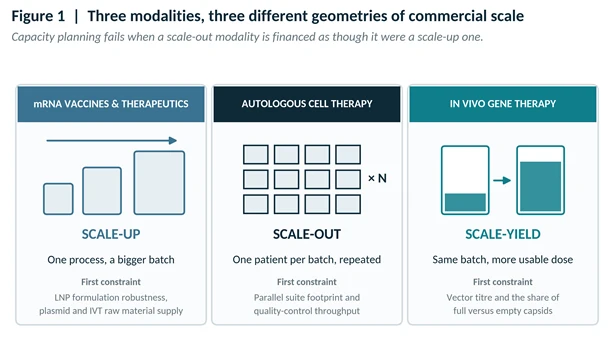
The single most expensive planning error in advanced therapy manufacturing is treating scale as one problem. It is three (Figure 1).
mRNA scales up: The unit process is chemical and cell-free, so volume increases largely by increasing batch size. The economics are conventional: fixed costs amortise across a larger output, and unit cost falls steeply. The constraints sit upstream and downstream rather than in the reaction itself — plasmid and enzyme supply security, and the reproducibility of lipid nanoparticle formulation at scale, where particle size distribution and encapsulation efficiency do not always survive a change in mixing geometry.
Autologous cell therapy scales out: There is no larger batch, because a batch is a patient. Doubling output means doubling the number of parallel runs, and with them the cleanroom footprint, the operator headcount, the scheduling complexity and the quality-control workload. Unit cost falls slowly and only through automation and closed processing, not through volume. Financing an autologous programme with a scale-up capital model is how organisations end up with a facility that cannot serve its own approved indication.
In vivo gene therapy scales by yield: The bioreactor may not need to be bigger; the batch needs to contain more usable product. Vector titre, and above all the proportion of full to empty capsids, determine how many doses come out of a fixed campaign. A percentage-point improvement in full-capsid ratio can move the cost per dose more than a doubling of suite capacity would.
Each geometry implies a different capital plan, a different automation priority and a different definition of a good quarter. Boards that ask a single portfolio-level question about capacity will get an answer that is wrong for at least two of the three.
Source: author analysis.
The Fourth Dimension: Scaling an Advanced Therapy Across Twenty-Seven Member States
Europe adds a scaling axis that has no biological solution. A centralised marketing authorisation grants the right to sell across the Union; it does not deliver a single market. Pricing and reimbursement remain national competences, so each member state negotiates independently, and access diverges sharply between the larger western European systems and much of the rest of the Union.
The Health Technology Assessment Regulation, with joint clinical assessment now applying to advanced therapies, removes some duplication at the evidence-appraisal stage. It does not remove national pricing negotiations, national managed-entry agreements, or the operational obligations that follow: qualified treatment centres in each territory, local-language labelling, national pharmacovigilance arrangements, and batch certification within the Union by a Qualified Person before product is placed on the market.
For a scale-out modality this multiplication is punishing. Every additional market adds fixed operational cost against a patient population that may be measured in dozens. Several therapies have been withdrawn precisely at this point — not because manufacturing failed, but because the manufacturing and access overhead of a country could not be justified by the volume that country would ever generate.
Release Testing, Not Production, Is the Real Commercial-Scale Constraint
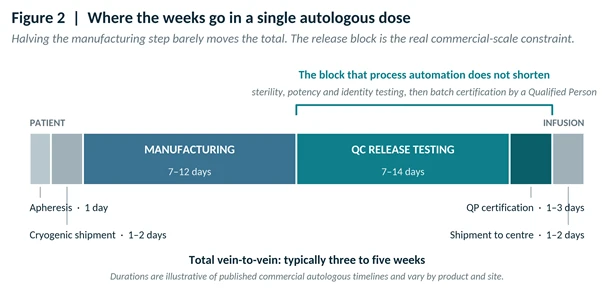
Ask most executives where the time goes in an autologous therapy and they will point at manufacturing. The arithmetic disagrees (Figure 2). Production is typically one of two comparable blocks; quality-control release testing is the other, and certification sits on top of it.
This matters because the two blocks respond to entirely different investments. Process automation, closed systems and shortened culture protocols compress the manufacturing block. They do nothing to the release block, which is governed by sterility test incubation periods, potency assay run times, and the sequential nature of certification. An organisation that spends heavily on automation and leaves its analytics untouched will find that its vein-to-vein time has barely moved.
The levers that do move it are less glamorous and more consequential: validated rapid microbiological methods to replace compendial sterility timelines, potency assays designed for speed rather than only for sensitivity, parametric and real-time release approaches supported by process analytical technology, and remote or delegated certification arrangements that stop the Qualified Person becoming a single-point queue. In a modality where product stability is measured in hours after thaw, days of release time are not an administrative detail. They determine whether a treatment centre can schedule the patient at all.
Source: author analysis.
Case in Point: Scaling One Autologous Therapy Across Three European Markets
The following pattern is generalised from publicly described European launches of autologous therapies. It is presented as an illustrative composite; no individual product or organisation is identified.
A developer with a centralised authorisation planned a phased launch across three western European markets, supplied from a single manufacturing site with capacity sized for the combined forecast. Capacity was never the binding constraint. Two other things were.
First, qualification of treatment centres proved slower than the reimbursement negotiations it was meant to run ahead of. Apheresis capability, cryogenic handling, and trained infusion teams had to be established at each site, and the qualification calendar rather than the production calendar set the pace of the launch.
Second, the release block dominated the operating rhythm. With certification concentrated in one Qualified Person function and sterility testing on compendial timelines, the site could manufacture more slots than it could release in a week. The fix that mattered was not a second suite; it was a validated rapid sterility method and a delegated certification structure, after which the same physical footprint supported materially more patients.
The commercial outcome turned on the third market. The forecast volume there never justified the fixed cost of a qualified centre network and local operational overhead, and the launch was deferred. That decision, made deliberately and early, is what distinguishes a sustainable European footprint from the withdrawals that fill the historical record.
Decentralised and Point-of-Care Manufacturing: Europe's Structural Bet
If the cost of moving a living product to a central site and moving it back is irreducible, the alternative is to move the process to the patient. Europe has been unusually deliberate about this. Regulatory text enabling decentralised manufacturing has been under development at Union level, aimed initially at products with short shelf lives that must be made or tested close to the patient, and the United Kingdom has already implemented a point-of-care framework for near-patient manufacture of personalised therapies.
The concept is compelling and the compliance implications are substantial. Decentralised manufacture replaces one validated site with a network of them, each requiring equivalent control, comparability evidence, and oversight from a central control site. Comparability across nodes becomes the core quality challenge, and the case for closed, automated, operator-independent platforms becomes overwhelming — a manual process that depends on operator skill cannot be replicated across twenty hospitals with any confidence.
Executives should also be clear-eyed about the hospital exemption, which allows non-routine preparation of advanced therapies within a member state under national supervision. It has provided genuine patient access, but it also creates an uneven competitive field alongside fully authorised products, and it has featured in at least one historical withdrawal from the authorised market.
What the EU Pharmaceutical Reform Changes for Advanced Therapy Manufacturing
The reform package moving through adoption reshapes several parameters that matter to advanced therapy manufacturers, with a transition period following entry into force. Expected changes include a restructuring of advanced therapy scientific assessment within the Agency's committee architecture, a rebalancing of the baseline regulatory data protection period with extensions tied to unmet need and comparative evidence, and — most relevant here — provisions for regulatory sandboxes intended to accommodate novel manufacturing modalities including decentralised and point-of-care production.
None of this changes the manufacturing science. What it changes is the sequencing of risk. Shorter baseline protection raises the value of getting to a sustainable cost of goods early rather than assuming a long exclusivity runway will absorb an expensive process. Sandbox provisions, if they land as drafted, reward organisations that have already built the comparability and control evidence a distributed network would require. Both point the same way: process and analytical maturity are becoming commercial assets rather than technical hygiene.
Six Commercial-Scale Decisions for European Advanced Therapy Manufacturers
- Name the scaling geometry before approving capital: Scale-up, scale-out and scale-yield need different facilities, different automation and different volume assumptions.
- Treat release time as a capacity metric: Slots released per week, not slots manufactured per week, is the number that governs revenue.
- Invest in analytics with the same seriousness as process: Rapid sterility, faster potency and real-time release move the timeline that automation cannot.
- Design the market map before the launch plan: Decide which member states will never repay their operational overhead, and decide it before qualifying centres there.
- Build for comparability now: Whether or not the site network decentralises, the evidence base that would permit it is the same evidence base that de-risks tech transfer.
- Model cost of goods per dose at realistic volumes: For scale-out modalities, the volume that makes the model work often does not exist in Europe.
Conclusion:
Commercial Scale in Advanced Therapies Is an Operating Discipline, Not a Facility
The European record is unambiguous. Approval has not been the hard part for advanced therapies, and neither, increasingly, has the biology. The therapies that disappeared from the market did so because a supply model designed for scientific proof was carried unchanged into commercial life, where it met twenty-seven pricing systems, a release process measured in weeks, and patient numbers too small to amortise any of it.
The organisations that will still be supplying these medicines in five years are making a different set of choices now. They are sizing capital to the right scaling geometry, treating the release block as the constraint it actually is, building comparability evidence ahead of any decision to distribute manufacture, and being disciplined about which European markets they enter at all.
Commercial scale, in this field, is not a building. It is the ability to release a compliant dose, on schedule, at a cost the health system will pay — repeatedly, and in more than one country.

Lakshmi is a science writer with a foundation in the laboratory. She earned her master's in biotechnology and trained through research internships at ICGEB (JNU) and DIPAS, DRDO, with her work appearing in the Egyptian Journal of Veterinary Sciences. Now APCRM-certified and part of the editorial team at Pharma Focus America and Pharma Focus Europe, she reports on pharmaceutical technology, research, and innovation — giving complex science a clear and confident voice for industry leaders.