

Impact of Continuous Manufacturing on Pharmaceutical Efficiency and Quality
Lakshmi, Editorial Team, Pharma Focus Europe
Continuous manufacturing is moving from pilot curiosity to boardroom priority in the pharmaceutical sector. By replacing stop-start batch operations with integrated, real-time production, it compresses cycle times, shrinks facility footprints and embeds quality into every minute of the process. With ICH Q13 now in force across Europe, this article examines the efficiency and quality case, the regulatory landscape and the strategic choices facing European pharmaceutical leaders.
Introduction
For most of its history, the pharmaceutical industry has made medicines the way a bakery makes bread: one batch at a time, with pauses between each step for holding, sampling and release testing. That model served the sector well when blockbuster volumes and generous margins could absorb its inefficiencies. Today, neither condition holds. European manufacturers face pricing pressure from payers, persistent medicine shortages, ambitious decarbonisation targets and a policy push to rebuild regional production capacity.
Continuous manufacturing offers a different operating logic. Raw materials enter the line, are transformed through connected unit operations and leave as finished product in an uninterrupted flow. The shift is not merely technical. It changes how plants are designed, how quality is assured, how regulators assess processes and how capital is deployed. For C-suite leaders, the question is no longer whether continuous pharmaceutical manufacturing works, but where it creates the most value in their portfolio and how quickly they should move.
The Batch Legacy: Why Pharmaceutical Production Stood Still
Batch processing persisted in pharmaceuticals long after continuous production became standard in petrochemicals, food and fine chemicals. The reasons were structural rather than scientific. Regulatory frameworks were written around discrete, traceable lots. Validation costs discouraged change to approved processes. And with the cost of goods representing a modest share of revenue for innovative medicines, manufacturing efficiency rarely reached the top of the executive agenda.
The hidden price of this inertia is substantial. In a typical oral solid dosage plant, material may spend more time waiting in drums and intermediate bulk containers than being processed. Each transfer between rooms introduces handling risk, cleaning requirements and opportunities for variability. Scale-up from development to commercial volumes often demands larger equipment and fresh validation, adding months to launch timelines. The result is an asset base that is large, slow to respond and expensive to keep running.
How Continuous Manufacturing Rewires Pharmaceutical Efficiency
The efficiency gains of continuous pharmaceutical manufacturing come from eliminating the gaps between steps rather than accelerating the steps themselves. When blending, granulation or direct compression and coating are physically and digitally linked, hold times disappear, intermediate testing shrinks and the total elapsed time from raw material to packaged product can fall from weeks to days.
Published engineering and economic studies point to the scale of the opportunity. Industry analyses of integrated solid dose lines describe footprint reductions of 60 to 70 percent, in one case replacing more than thirty pieces of batch equipment with two connected systems. Plantwide economic models of continuous active pharmaceutical ingredient (API) production have estimated capital savings of up to 57 percent and operating savings of up to 52 percent over batch equivalents, with projected lifetime cost savings exceeding half the batch baseline for favourable molecules. Even in less favourable scenarios, academic modelling has found that savings in labour, materials handling and capital can offset lower yields.
Scale-up is where continuous manufacturing becomes strategically distinctive. Rather than building bigger vessels, manufacturers produce more by running the same line for longer. The equipment used to make clinical supplies can often be the equipment used for launch, removing a major source of technology-transfer risk and shortening the path from approval to patient.
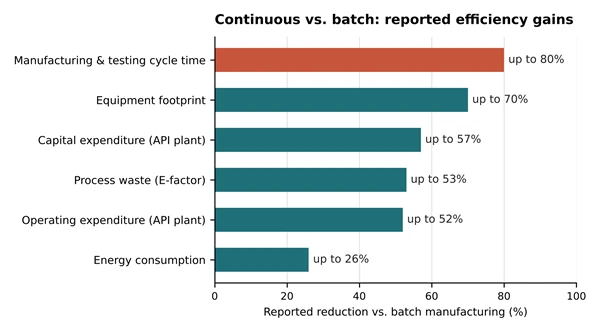
Figure 1: Upper-bound reductions reported for continuous versus batch pharmaceutical manufacturing across published economic models, pilot plant studies and industry analyses. Actual results depend on product, process and scale.
Quality by Design, Not by Inspection: Continuous Manufacturing and Product Quality
Efficiency attracts the first board conversation, but quality is where continuous manufacturing changes the industry's risk profile. Batch production relies heavily on testing samples at the end of each stage and inferring that the rest of the batch matches. Continuous production makes that approach impractical and, more importantly, unnecessary.
Continuous lines are monitored through process analytical technology, such as in-line spectroscopy that measures blend uniformity or API concentration as material moves through the system. These measurements feed control systems that adjust feed rates and process parameters in real time. Material that drifts outside acceptable limits can be identified and diverted automatically, rather than discovered days later when a whole batch fails release testing.
This creates the conditions for real-time release testing, where product quality is demonstrated through process data rather than end-product sampling alone. For European manufacturers, the implications extend beyond laboratory cost. Fewer batch failures mean fewer supply interruptions. Tighter process control reduces product variability. And the rich data stream generated by a continuous line provides the evidence base for faster investigations and stronger regulatory dialogue.
Continuous manufacturing also brings sustainability benefits that increasingly matter to investors and procurement bodies. Pilot plant research on end-to-end integrated continuous production has reported a reduction of roughly half in the E-factor, the ratio of waste to product, compared with the equivalent batch process. Smaller cleanrooms and fewer large vessels also mean lower demand for heating, ventilation and air conditioning, one of the largest energy loads in any pharmaceutical facility.
ICH Q13 and the European Regulatory Green Light for Continuous Manufacturing
Regulatory uncertainty was for years the most cited barrier to continuous pharmaceutical manufacturing. That barrier has largely fallen. ICH Q13, the first globally harmonised guideline dedicated to the continuous manufacturing of drug substances and drug products, was adopted in November 2022 and came into effect in the European Union in July 2023.
The guideline covers development, implementation, operation and lifecycle management, and applies to new products, generics and biosimilars, as well as to the conversion of existing batch processes. It clarifies concepts that previously caused hesitation, including how a batch is defined in a continuous context, how disturbances should be managed and how material traceability is maintained. Crucially, ICH Q13 focuses on what must be achieved rather than prescribing how, giving manufacturers flexibility to tailor control strategies to their products.
Gaps remain. Industry bodies have noted that the guideline offers limited direction on transferring continuous processes between sites and on harmonised expectations for process models. European leaders should anticipate further training material and annexes, and should engage early with assessors through scientific advice routes when planning first submissions.
Case Study: Measuring the Continuous Manufacturing Dividend on a Tablet Line
An academic-industry smart manufacturing programme offers a practical view of the gains. Working with a large innovative pharmaceutical manufacturer, researchers compared batch and continuous versions of a wet-granulation tablet process and integrated process models with plant data to optimise energy use.
Moving the process from batch to continuous operation cut energy consumption by 26 percent per line. The programme also reported that reduced material waste in the transition could raise yield by around a third, while manufacturing and testing cycle times fell by about 80 percent. The team highlighted a further benefit that rarely appears in conventional business cases: the same output could be delivered from considerably less floor space, freeing capacity without new construction. The lesson for executives is that the value of continuous manufacturing accumulates across energy, yield, time and space, and is best captured when digital modelling is built in from the start.
The Boardroom Calculus: Capital, Talent and Risk in Continuous Pharmaceutical Manufacturing
The economic case is compelling but not automatic. Continuous equipment can carry a capital premium, and process development requires deeper upfront investment in modelling, sensors and control strategy. Retrofitting an existing batch facility usually pays back more slowly than a greenfield build, and legacy products with low volumes or short remaining lifecycles may never justify conversion.
Talent is often the binding constraint. Continuous lines demand process engineers, data scientists and quality professionals who understand chemometrics, automation and statistical control. Europe has deep pools of chemical engineering expertise, but competition for these skills is intense across the life sciences sector.
Change management matters as much as technology. Quality units accustomed to batch release must become comfortable with model-based decision-making. Supply chain teams must adapt to production that can flex output by changing run time rather than scheduling discrete campaigns. Organisations that treat continuous manufacturing as an engineering project rather than an operating model transformation tend to see slower returns.
Strategic Priorities for European Pharmaceutical Leaders
The most successful adopters begin with portfolio selection. High-volume oral solid dose products and new molecules still in development, where a continuous process can be designed from the outset, typically offer the strongest returns. Direct compression has emerged as the most widely adopted route for drug products, while continuous API synthesis and continuous biomanufacturing are maturing rapidly.
Continuous manufacturing also aligns closely with European policy priorities. Compact, modular lines make regional and near-patient production more viable, strengthening supply resilience for critical medicines. Lower energy intensity and waste support corporate climate commitments and reporting under European sustainability rules. And the data infrastructure that continuous lines require lays the foundation for broader digital transformation across the manufacturing network.
Leaders should therefore frame investment decisions not as isolated equipment purchases but as platform choices: building standardised continuous capabilities that can be deployed across multiple products and sites, with shared models, control strategies and regulatory knowledge.
Conclusion
Continuous manufacturing is redefining what efficiency and quality mean in pharmaceutical production. It delivers faster throughput, smaller footprints and real-time quality assurance, and ICH Q13 has given European manufacturers a clear regulatory path. The organisations that will benefit most are those that treat it as a strategic operating model, invest early in talent and data, and choose their first products wisely.

Lakshmi is a science writer with a foundation in the laboratory. She earned her master's in biotechnology and trained through research internships at ICGEB (JNU) and DIPAS, DRDO, with her work appearing in the Egyptian Journal of Veterinary Sciences. Now APCRM-certified and part of the editorial team at Pharma Focus America and Pharma Focus Europe, she reports on pharmaceutical technology, research, and innovation — giving complex science a clear and confident voice for industry leaders.