

How Pharma Companies Can Strengthen Their GMP Compliance Strategies
Lakshmi, Editorial Team, Pharma Focus Europe
European GMP expectations are moving from documented procedure towards demonstrable control. With Annex 1 now embedded, drafts of Chapter 4, Annex 11 and a new AI-focused Annex 22 in the pipeline, and the EU pharmaceutical legislation reform entering its transition phase, compliance has become a boardroom issue. This article sets out how pharma leaders can turn GMP compliance strategy from a cost of doing business into a source of operational and regulatory advantage.
GMP Compliance Has Left the Quality Department
For most of the past two decades, Good Manufacturing Practice in Europe was treated as a specialist discipline. Quality heads owned it, site directors funded it, and the executive committee heard about it mainly when an inspection went wrong. That arrangement is no longer workable. The cost of a single serious GMP failure today extends well beyond a remediation budget: it can freeze a product launch, trigger supply interruptions across several member states, unsettle a partnership with a contract manufacturer and invite scrutiny from investors who now read inspection outcomes as a proxy for management quality.
At the same time, the regulatory ground is shifting. The revised Annex 1 for sterile medicinal products has raised expectations for contamination control. In July 2025, European and PIC/S inspectors released draft revisions of Chapter 4 on documentation and Annex 11 on computerised systems, alongside a first-ever Annex 22 on artificial intelligence. The wider EU pharmaceutical legislation reform, politically agreed in December 2025, is now moving through a multi-year transition. Each of these changes points in the same direction: European regulators want proof that quality is designed into operations, not inspected into them afterwards.
The question for European pharma executives is therefore not whether to invest in GMP compliance, but how to strengthen GMP compliance strategies so that they hold up under a more demanding, more digital and more data-driven inspection regime.
The New Cost Arithmetic of GMP Non-Compliance in European Pharma
Boards tend to see GMP spending as an insurance premium. A more accurate picture is that weak GMP compliance creates a hidden operating tax. It shows up as batches held in quarantine while investigations drag on, as qualified persons reluctant to certify without additional testing, as change controls that take months because no one trusts the underlying data, and as experienced staff spending their time on rework instead of improvement.
When an inspection does produce critical or major observations, the consequences compound. Non-compliance statements are visible across the European regulatory network, which means a problem at one site can affect marketing authorisations, variation approvals and tender eligibility in multiple countries. For companies that rely on a small number of high-value products, the commercial exposure can run to many times the cost of the original fix.
Framing GMP compliance in these terms changes the conversation in the boardroom. It moves the discussion from how little the company can spend while staying inspection-ready to how much value is currently leaking through avoidable quality friction.
Reading the Regulatory Signal: Where EU GMP Expectations Are Heading
Three themes run through the recent and proposed changes to the EU GMP framework, and each one has strategic implications.
From documents to data: The draft Chapter 4 extends documentation principles to every format a record can take and formally anchors data integrity principles, commonly summarised as ALCOA+, in the core GMP text. Inspectors are signalling that a tidy paper trail is not enough; the data behind it must be complete, attributable and trustworthy across its entire lifecycle, including hybrid paper-electronic systems.
From validation events to lifecycle control: The draft Annex 11 has grown from a short annex into a substantially more detailed document covering governance, supplier oversight, security, audit trail review and periodic evaluation of computerised systems. The message is that validating a system once at go-live is insufficient. Companies will be expected to show continuous control as systems are patched, migrated to the cloud and connected to other platforms.
From human judgement alone to governed algorithms: Draft Annex 22 sets out expectations for AI models used in GMP-critical applications, with an emphasis on defined intended use, representative test data, explainability and ongoing oversight. Although the annex is still in draft and the 2011 version of Annex 11 remains in force, organisations deploying machine learning in quality control or batch disposition decisions should assume that inspectors will soon ask how those models are governed.
Together with the risk-based thinking of ICH Q9(R1) and the pharmaceutical quality system model in ICH Q10, these developments describe a future in which GMP compliance is judged by the strength of a company's systems for detecting and controlling risk, not by the volume of its procedures.
Five Strategic Levers to Strengthen GMP Compliance
1. Make Senior Management Accountability for GMP Visible
EU GMP Chapter 1 already places ultimate responsibility for the pharmaceutical quality system on senior management. In practice, many executive teams discharge that duty through a quarterly slide deck. A stronger approach gives the executive committee a small set of forward-looking GMP indicators, such as the age profile of open deviations, the rate of repeat root causes, the proportion of CAPAs verified as effective and right-first-time batch release. When these measures sit next to financial and commercial metrics, quality issues are discussed early, resources follow risk and inspectors see evidence of genuine management review.
2. Build a Risk-Based GMP Compliance Architecture
Not every procedure carries equal weight. Leading organisations map their products, processes and sites against patient-safety and supply-continuity risk, then concentrate controls, monitoring and expert attention where failure would matter most. This is the practical expression of ICH Q9(R1), and it frees capacity in low-risk areas that can be redeployed to critical ones. It also produces a clear rationale that can be explained to inspectors, which is often more persuasive than exhaustive documentation.
3. Treat Data Integrity as GMP Infrastructure
Data integrity findings remain among the most frequent and most damaging observations in European inspections because they undermine confidence in everything else a site reports. Strengthening this area means harmonising electronic systems across sites, removing uncontrolled spreadsheets from GMP decisions, establishing proportionate audit trail review and assigning clear data ownership. Executives should view this as infrastructure spending with a long payback, comparable to investing in a new production line, rather than as a one-off remediation project.
4. Extend GMP Oversight Across the External Supply Network
A growing share of European medicines depends on contract development and manufacturing organisations, active substance suppliers and testing laboratories, many outside the EU. The marketing authorisation holder remains accountable for all of them. Strong GMP compliance strategies therefore include tiered supplier qualification, quality agreements that specify data access and notification duties, and shared performance metrics. Remote and hybrid audits can increase coverage, but they work best when combined with targeted on-site visits for the highest-risk partners.
5. Measure and Manage GMP Quality Culture
Procedures fail when people feel unable to raise concerns or when production targets quietly override quality decisions. Quality culture can be assessed through anonymous surveys, observation of shop-floor behaviour and analysis of how quickly deviations are reported. Organisations that reward early escalation, involve operators in root-cause analysis and train supervisors to coach rather than blame tend to see fewer repeat deviations. Culture is difficult to inspect directly, yet experienced inspectors detect it quickly in the way staff answer questions.
Benchmarking GMP Compliance Maturity
A simple maturity model helps leadership teams locate their current position and agree on a realistic destination. Most European pharma organisations operate between the second and third levels shown below, often with significant variation between sites.
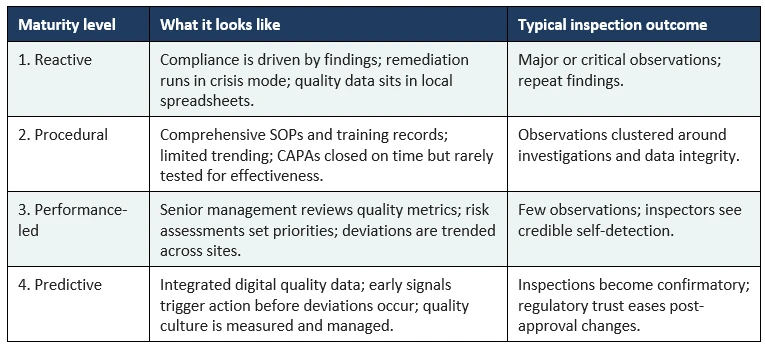
Table 1: A four-level view of GMP compliance maturity in pharma operations.
Moving from the procedural to the performance-led level usually delivers the largest return, because it converts existing compliance effort into management insight. The predictive level requires mature data infrastructure and is best pursued product line by product line rather than across the enterprise at once.
Case Study: Turning a GMP Warning Sign into a Compliance Advantage
This case study is an anonymised composite drawn from common patterns in European GMP remediation programmes. Details have been generalised to protect confidentiality, and figures are indicative.
The situation: A mid-sized European manufacturer of sterile injectables, operating two fill-finish sites, received a series of major observations during a routine inspection. Findings related to incomplete investigations of environmental monitoring excursions, inconsistent audit trail review on laboratory systems and CAPAs that were closed without checking whether they had worked. No product recall was required, but a planned capacity expansion and two variation filings were put at risk.
The response: Rather than treating the findings as a site problem, the chief executive appointed a cross-functional steering group chaired by the chief operating officer, with the head of quality as co-lead. The group commissioned an independent gap assessment against the revised Annex 1 and the draft Annex 11 and Chapter 4 expectations, not only against the specific observations. It then prioritised actions using a risk matrix weighted for patient impact and supply continuity.
Three workstreams followed. The first rebuilt the contamination control strategy so that environmental monitoring data were trended weekly and linked directly to investigation triggers. The second replaced locally configured laboratory software with a harmonised platform supporting automated audit trail flags, cutting manual review effort while improving coverage. The third introduced a CAPA effectiveness check at 90 days, with results reported monthly to the executive committee alongside a short quality culture pulse survey.
The outcome: Within eighteen months, the follow-up inspection closed out all major observations with no new critical or major findings. Internally, the average time to close deviations fell by roughly 40 per cent, repeat root causes declined markedly, and the capacity expansion proceeded with only a modest delay. Equally important, the board adopted the quality indicators developed during remediation as permanent fixtures of its performance reporting.
The lesson for leaders: The decisive factor was not the technology chosen but the decision to treat the inspection as an enterprise risk signal and to design the remediation around where EU GMP expectations were heading, not just where they had been.
Digital GMP Compliance: Investing Ahead of the Annexes
Although the revised Chapter 4 and Annex 11 and the new Annex 22 are not yet final, their direction is clear enough to guide investment decisions now. Electronic batch records, connected laboratory systems, validated cloud platforms and quality analytics all reduce the manual effort that makes compliance fragile. The key is to apply computer software assurance principles proportionately, focusing validation depth on functions that directly affect product quality and patient safety.
Executives should also be cautious. Digital tools amplify whatever governance surrounds them. A poorly configured system can generate thousands of unreviewed audit trail entries, and an AI model trained on unrepresentative data can introduce risk faster than any manual process. The strongest strategies pair each digital investment with a named business owner, a defined intended use and a plan for periodic review.
GMP Compliance as a Strategic Asset for European Pharma
European GMP regulation is entering a period of significant change, driven by sterile manufacturing standards, data integrity, digital systems, artificial intelligence and the broader reform of EU pharmaceutical legislation. Companies that respond only when an inspection forces their hand will find the cost rising with each cycle.
Those that strengthen their GMP compliance strategies deliberately, through visible senior accountability, risk-based priorities, robust data infrastructure, disciplined supplier oversight and an open quality culture, gain more than inspection readiness. They gain faster release, smoother regulatory change, more reliable supply and greater credibility with partners and payers. For European pharma leaders, GMP compliance is no longer a defensive obligation. Managed well, it is a competitive advantage that compounds over time.

Lakshmi is a science writer with a foundation in the laboratory. She earned her master's in biotechnology and trained through research internships at ICGEB (JNU) and DIPAS, DRDO, with her work appearing in the Egyptian Journal of Veterinary Sciences. Now APCRM-certified and part of the editorial team at Pharma Focus America and Pharma Focus Europe, she reports on pharmaceutical technology, research, and innovation — giving complex science a clear and confident voice for industry leaders.