How M&A Is Reshaping Europe’s Pharmaceutical Pipeline
Lakshmi, Editorial Team, Pharma Focus Europe
Europe’s pharmaceutical leaders are increasingly buying the innovation they once built in-house. This article examines how mergers and acquisitions (M&A) are reshaping Europe’s pharmaceutical pipeline: the retreat from mega-mergers, the rise of disciplined bolt-on deals in precision oncology, RNA medicines and immunology, and the strategic pull of manufacturing control. A 2026 case study shows how fast value can materialise, and why integration, not price, now separates winners from write-downs.

The Pipeline Is No Longer Only Built. It Is Bought.
For most of the past half-century, a European drugmaker’s future was written in its own laboratories. That model has not disappeared, but it has been joined, and in many boardrooms overtaken, by a second engine of growth: the acquisition of externally discovered science. Pharma M&A has become the mechanism through which Europe’s largest companies refill pipelines facing heavy loss-of-exclusivity exposure later this decade, gain access to modalities they did not originate, and secure the manufacturing capacity that increasingly decides who can launch at scale.
Many of the assets European companies now acquire were discovered, financed and clinically validated outside Europe, most often in the United States. At the same time, the continent’s share of global clinical research has fallen sharply. The result is a paradox that every European chief executive must confront: the region’s pharmaceutical groups are commercially powerful and increasingly acquisitive, yet the ecosystem that once supplied their innovation is losing ground.
This article examines how M&A is reshaping Europe’s pharmaceutical pipeline, where capital is flowing, what a well-executed bolt-on looks like in practice, and the decisions that will define value creation between now and 2030.
Pharma M&A as Europe’s Pipeline Lifeline in a Shrinking Research Footprint
The research data frame the M&A story. Industry-sponsored clinical trials that included sites in the European Economic Area (EEA) accounted for 22% of global commercial trial starts in 2013. By 2018 that share had slipped to 18%, and by 2023 it stood at 12%, even though worldwide trial activity grew by 38% across the decade. In cell and gene therapy the contraction was steeper still: Europe’s share fell from 25% to 10% over the same period, while China became the leading location for such studies.
None of this reflects an absence of investment. Research-based pharmaceutical companies spent around €50 billion on R&D in Europe in 2023. The issue is where early science originates, where it is funded and where it is first tested. Fragmented trial approval, slower multi-country start-up and thinner venture capital pools for young European biotechs mean that many promising programmes either relocate or never reach the scale required to become independent companies.
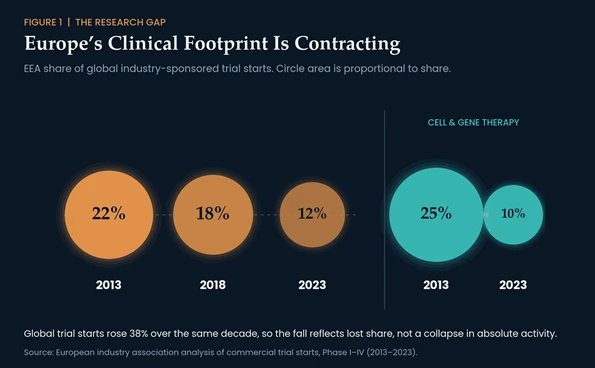
For European majors, the logical response has been to buy the late-stage science that the wider ecosystem is no longer reliably producing at home. M&A therefore works as both a growth lever and a hedge, letting a company participate in innovation wherever it emerges. The risk is that a pipeline assembled largely through acquisition becomes exposed to external valuation cycles and competitive auctions, so the discipline behind each transaction matters more than ever.
The Bolt-On Doctrine: Why European Pharma M&A Now Prizes Precision Over Size
The transformational mega-mergers of earlier decades, built on scale and cost removal, have largely fallen out of favour. Today’s European playbook is built on bolt-on transactions: acquisitions of focused, clinically de-risked companies, typically holding one to three assets aimed at a validated biological target, that can be plugged straight into an existing global development and commercial infrastructure.
The recent deal record illustrates the pattern (Figure 2). In 2025, a Swiss pharmaceutical major agreed to acquire a US developer of RNA therapeutics for neuromuscular diseases for about $12.0 billion. A French major agreed a transaction worth up to $9.5 billion, including a contingent value right, for a US company specialising in precision immunology and rare disease. A Danish antibody company agreed an $8.0 billion acquisition of a bispecific antibody developer focused on solid tumours, and a German science-and-technology group committed $3.9 billion for a US company treating rare tumours. In 2026, a UK major added a $10.6 billion precision lung-cancer acquisition, examined in detail below.
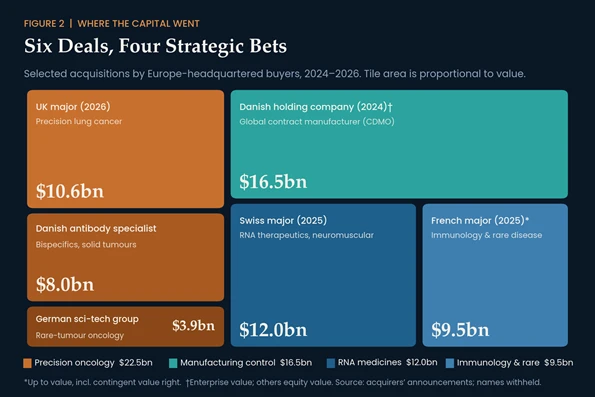
Three features unite these deals. First, each targets a defined gap in the acquirer’s portfolio rather than an abstract bet on scale. Second, most of the acquired assets were at a late clinical or registration stage, compressing the time between capital outlay and revenue. Third, the price tags cluster at a level that buyers can fund largely from cash and debt, preserving balance-sheet flexibility for the next transaction. Industry forecasters estimate that aggregate biopharma M&A value more than doubled in 2025 and put large pharma’s combined deal capacity at roughly $1.3 trillion, which suggests the bolt-on era has considerable room to run.
Following the Money: The Modality Bets Redrawing Europe’s Pharmaceutical Pipeline
Where European acquirers spend tells a clear story about the future shape of their pipelines. Precision oncology remains the dominant destination, with the emphasis now on highly selective molecules that overcome resistance mutations, reach the central nervous system or improve tolerability against the standard of care.
RNA-based medicines represent a second, distinctly European bet. Acquiring platforms that deliver oligonucleotides into muscle and other hard-to-reach tissues gives a buyer not a single product but a repeatable engine for rare and neuromuscular diseases, areas where European health technology assessment bodies often recognise high unmet need. Bispecific and multi-specific antibodies form a third cluster, allowing companies with deep antibody heritage to extend their franchises into solid tumours. Immunology and rare disease complete the picture, attractive because of long product lifecycles and defensible pricing.
The most instructive signal, however, sits outside the drug pipeline itself. A Danish foundation-backed holding company’s $16.5 billion acquisition of a global contract development and manufacturing organisation, completed in 2024, showed that control over production capacity, particularly for injectables and biologics, has become a strategic asset worth paying for. For European boards the lesson is simple: pipeline value is realised only if supply can scale with demand. M&A strategy and manufacturing strategy can no longer be run by separate committees.
Case Study: A $10.6 Billion Pharma M&A Bet That Reached the Market in Weeks
CASE STUDY | PRECISION ONCOLOGY BOLT-ON, 2026
The challenge. A London-headquartered pharmaceutical major faced a well-defined revenue gap, with exclusivity on a key HIV medicine scheduled to erode between 2028 and 2030. Its new chief executive had signalled a preference for acquiring assets with clinically proven targets that address a clear efficacy or tolerability shortfall in current therapy.
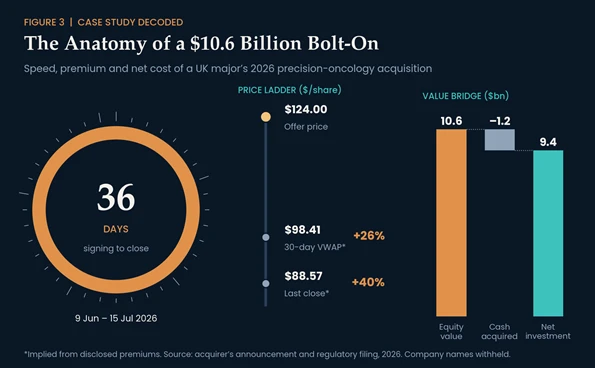
The deal. On 9 June 2026, the company agreed to acquire a Boston-based, clinical-stage precision oncology company for $124 per share in cash. The aggregate equity value was approximately $10.6 billion (£8.0 billion), or about $9.4 billion (£7.1 billion) net of cash acquired. The price represented a 40% premium to the target’s last closing share price and a 26% premium to its 30-day volume-weighted average price. The acquisition was funded primarily from new and existing debt facilities plus cash.
What was bought. Rather than a single molecule, the buyer secured three lung-cancer programmes in one transaction: two late-stage, highly selective kinase inhibitors targeting ROS1 and ALK alterations in non-small cell lung cancer, a disease that can often spread to the central nervous system, plus an earlier-stage medicine and a preclinical portfolio.
Speed of value capture. The tender offer completed and the transaction closed on 15 July 2026, just 36 days after announcement. In the same month, US regulators approved the first lead asset for adults with advanced ROS1-positive disease who had received a prior ROS1 inhibitor, while the second remained under review. The acquirer expects the deal to contribute to revenue growth from 2027 and to strengthen operating profit through its exclusivity-loss window.
The lessons. Three choices stand out. The buyer paid for de-risked biology and near-term launch visibility rather than platform optionality; it acquired a multi-asset franchise that spreads clinical risk across programmes; and it moved from signature to close quickly enough to be positioned for launch as approval arrived. The real test, commercial uptake and retention of the scientists who built the assets, still lies ahead, and that is precisely where most acquisitions succeed or fail.
After the Handshake: Why Integration Decides Whether Pharma M&A Pays
Deal announcements capture headlines; integration determines returns. In pipeline-driven acquisitions, value is concentrated in a small number of assets and an even smaller number of people. The scientists who understand a molecule’s biology and regulatory history are often the most mobile employees in the transaction, and their departure can quietly slow a programme that looked certain at signing.
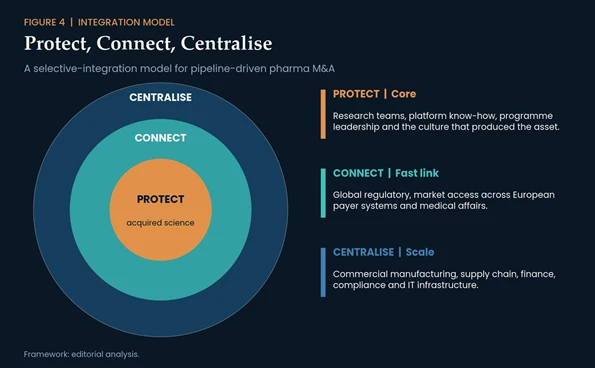
Leading European acquirers are therefore rethinking integration. Instead of absorbing an acquired biotech into group functions on day one, many preserve its research identity for a defined period while connecting it rapidly to the capabilities the target lacked: global regulatory teams, market access expertise across Europe’s fragmented payer systems, medical affairs and commercial-scale manufacturing. The guiding principle is selective integration, centralising what scales and protecting what creates.
Pricing discipline is the other half of the equation. With premiums of 40% paid for de-risked assets, as in the case above, the investment case must rest on realistic launch curves rather than optimistic peak-sales estimates. Boards increasingly use contingent value rights, milestone-based consideration and multi-asset structures to share risk with sellers. Figure 4 sets out a simple model for deciding what to protect, what to connect and what to centralise.
The 2026–2030 Boardroom Equation for European Pharma M&A
Four forces will shape the next phase of European dealmaking. The first is timing: a cluster of major exclusivity losses later this decade creates pressure to secure late-stage assets now, which in turn supports valuations for the best targets. The second is competition for assets. Acquirers from the United States and, increasingly, from Asia are bidding for the same differentiated programmes, and a growing share of early-stage innovation originates in China, where it is often accessed first through licensing rather than outright acquisition.
The third force is regulatory scrutiny. Competition authorities in Europe and the United States continue to examine overlapping portfolios closely, which favours bolt-on structures that raise fewer antitrust concerns. The fourth is policy. European institutions have set an ambition to lift industry-sponsored multinational trials in the region by around 500 over five years. If those efforts succeed, European acquirers will have more home-grown targets to choose from; if they stall, the transatlantic flow of acquired innovation will only intensify.
For chief executives, the practical implication is to treat M&A as a continuous capability rather than an episodic event, supported by dedicated scientific scouting, pre-agreed financing capacity and integration teams that are ready before a deal is ever announced.
Conclusion: From Serial Acquirer to Pipeline Architect
M&A is no longer a supplement to Europe’s pharmaceutical strategy; it is a central pillar of how pipelines are built. The evidence of the past two years points to a clear model: focused bolt-on acquisitions of de-risked precision assets, reinforced by control over manufacturing and executed with speed. Yet buying science is not the same as owning its future. The European companies that lead through 2030 will be those that pair disciplined deal selection with integration that protects scientific talent, and that use their acquisitive strength to reinvest in Europe’s own research base rather than simply substituting for it. The pipeline of the next decade will be bought as much as built, but it will be sustained only by organisations that know how to make acquired innovation truly their own.

Lakshmi is a science writer with a foundation in the laboratory. She earned her master's in biotechnology and trained through research internships at ICGEB (JNU) and DIPAS, DRDO, with her work appearing in the Egyptian Journal of Veterinary Sciences. Now APCRM-certified and part of the editorial team at Pharma Focus America and Pharma Focus Europe, she reports on pharmaceutical technology, research, and innovation — giving complex science a clear and confident voice for industry leaders.