

How GLP-1 Medicines Are Changing Pharmaceutical Manufacturing Priorities
Lakshmi, Editorial Team, Pharma Focus Europe
GLP-1 medicines have moved from a diabetes niche to one of the largest demand shocks the pharmaceutical industry has ever absorbed. Supply shortages that ran from 2022 into 2025, the arrival of oral formats and the strategic value of sterile fill-finish capacity are forcing executives to rethink where capital goes. This article examines how GLP-1 demand is redrawing manufacturing priorities across API synthesis, device assembly and network design, and what European leaders should weigh next.
The GLP-1 Demand Shock No Pharmaceutical Network Was Built For
Pharmaceutical manufacturing networks are usually designed around forecasts that move in single digits. GLP-1 receptor agonists broke that assumption. Within a few years, a therapeutic class once associated mainly with type 2 diabetes became a mass-market treatment for chronic weight management, cardiovascular risk reduction and a widening list of related conditions. Demand did not grow in a straight line; it arrived as a wave that existing plants, supply contracts and device lines were never sized to absorb.
For Europe, the stakes are especially clear. According to the WHO European Regional Obesity Report 2022, 59% of adults in the WHO European Region live with overweight or obesity, and these conditions are linked to more than 1.2 million deaths a year, over 13% of total mortality in the Region. None of the Region's 53 Member States was found to be on track to halt the rise of obesity by 2025. A patient population of that size turns every manufacturing bottleneck into a public-health question and every capacity decision into a board-level one.
The result is a quiet but profound reordering of priorities. Capital that once flowed toward broad portfolios is being concentrated on high-volume peptide synthesis, sterile fill-finish and drug-device assembly. At the same time, the arrival of oral GLP-1 medicines is challenging assumptions that injectables would define the category for a decade. For C-suite leaders, the question is no longer whether GLP-1 medicines matter to manufacturing strategy, but how far they should be allowed to reshape it.
Lessons from the GLP-1 Shortage Years
The clearest signal of how unprepared the system was came from the shortage lists. Injectable semaglutide and tirzepatide were both placed in shortage in the United States in 2022 because demand outran supply. The US Food and Drug Administration declared the tirzepatide injection shortage resolved in October 2024, reaffirming that decision in December 2024, and declared the semaglutide injection shortage resolved on 21 February 2025, citing the ability of supply to meet current and projected demand.
Roughly three years of constrained availability carried consequences well beyond lost sales. Patients faced interrupted therapy, prescribers rationed starter doses and a parallel market of compounded products grew to fill the gap, prompting regulators to set firm deadlines to wind it down once supply recovered. European health systems saw their own pressures, with regulators steering available supply toward patients with diabetes while demand for weight management soared.
The lesson for manufacturing leaders is uncomfortable but useful. The binding constraint was rarely the science; it was physical capacity in a handful of steps that cannot be scaled quickly. Peptide active pharmaceutical ingredient (API), aseptic filling and pen assembly each proved to be a chokepoint, and each requires years, not quarters, to expand.
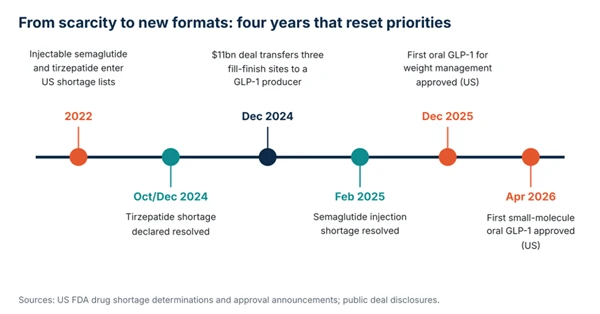
Figure 1: Key GLP-1 supply and approval milestones, 2022 to 2026
GLP-1 Fill-Finish Becomes a Strategic Asset
If one step in the GLP-1 value chain has been re-rated by the market, it is sterile fill-finish. Weekly injectables need filling into cartridges or prefilled syringes under aseptic conditions, followed by assembly into pen injectors, inspection and packaging. Each of these stages runs on specialised equipment, validated processes and trained operators who cannot be hired overnight. Industry investors estimate that building and certifying new fill-finish capacity can take four to five years, which explains why ownership, rather than rental, has become the preferred strategy for the largest GLP-1 producers.
This shift changes the economics of contract manufacturing. For years, outsourcing sterile capacity offered flexibility and lower fixed costs. When a single therapeutic class can absorb entire high-speed lines, flexibility becomes less valuable than certainty. Large producers are now paying premiums for direct control, while contract manufacturers are responding with fresh investment in isolator-based filling, cartridge handling and device assembly to replace capacity that has been taken off the open market.
Case Study: An $11 Billion Bet on GLP-1 Filling Capacity
The most striking illustration of this logic came in December 2024. A foundation-controlled investment holding company completed a $16.5 billion acquisition of a large contract development and manufacturing organisation. As part of the transaction, the leading producer of semaglutide, which that holding company controls, acquired three fill-finish sites for $11 billion: one in Anagni, Italy; one in Brussels, Belgium; and one in Bloomington, Indiana, in the United States.
The strategic rationale was straightforward. Rather than waiting years to design, build and validate greenfield plants, the buyer secured existing, already-qualified aseptic sites with trained workforces, two of them inside the European Union. The acquisition was expected to raise the company's filling capacity gradually from 2026 onward as lines are converted and qualified for its own products.
Three lessons stand out for European executives. First, speed to validated capacity now commands a premium larger than the cost of construction alone. Second, European sites remain highly valuable within global networks, offering regulatory track records, skilled labour and proximity to large patient populations. Third, the deal removed meaningful sterile capacity from the open contract market, a ripple effect that other sponsors, including those outside the GLP-1 field, must now plan around when securing slots for their own injectables.
Devices, Pens and the GLP-1 Assembly Line
GLP-1 medicines have also turned medical-device assembly into a frontline manufacturing concern. A weekly pen is not simply a container; it is a precision combination product whose components, springs, dose mechanisms and labelling must be qualified alongside the drug. Analysts estimate that disclosed industry-wide investments in device capacity supporting GLP-1 medicines amount to around $400 million, spanning primary packaging, pen components and final assembly, including new production halls in Central and Western Europe.
For pharmaceutical leaders, this means device supply chains deserve the same scrutiny as API. Single-sourced components, long tooling lead times and the regulatory burden of switching suppliers can stall an otherwise healthy network. Companies that treat the pen as an afterthought risk discovering that their bottleneck has merely moved downstream.
The Oral GLP-1 Inflection: A New Manufacturing Equation
Just as injectable capacity began to catch up, the category changed shape. On 22 December 2025, the FDA approved a once-daily 25 mg oral semaglutide tablet for chronic weight management, the first oral GLP-1 medicine approved for this use in the United States; the same product was submitted to the European Medicines Agency in the second half of 2025. On 1 April 2026, the FDA approved the first non-peptide, small-molecule oral GLP-1 receptor agonist for obesity, just 50 days after filing, which the agency described as the fastest approval of a new molecular entity since 2002.
These two approvals pull manufacturing strategy in very different directions. Oral semaglutide is the same peptide as the injection, but it is absorbed poorly through the gut, with bioavailability of roughly 1% compared with around 89% for subcutaneous dosing. The practical consequence is a dramatic increase in API demand. At approved maintenance doses, a patient on the weekly 2.4 mg injection uses 9.6 mg of semaglutide every 28 days, while a patient on the daily 25 mg tablet uses 700 mg, roughly 73 times more of the same complex peptide.
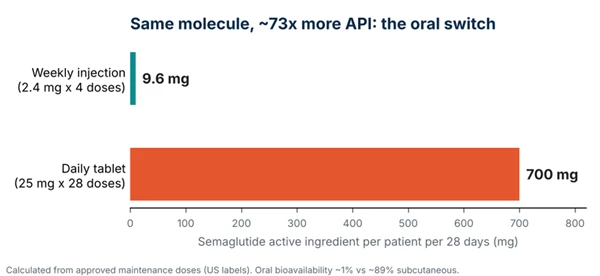
Figure 2: Semaglutide API required per patient per 28 days, injectable versus oral maintenance dose
Small-molecule oral GLP-1 medicines tell a different story. Being non-peptide, they can be produced through conventional chemical synthesis and oral solid-dose processes, which are far more widely available than tonne-scale peptide manufacturing or aseptic filling. They also avoid the cold-chain and device requirements of injectables. For networks with spare tablet capacity, this could unlock faster scale-up; for networks heavily invested in sterile lines, it introduces the risk that some assets may be underused if prescribing migrates toward pills.
Rebalancing the GLP-1 Manufacturing Portfolio
The emerging picture is not one in which pills replace pens, but one in which formats coexist and compete. Injectables are likely to remain important for patients who prefer weekly dosing or need the highest efficacy, while oral options broaden access and appeal to people averse to needles. For manufacturing leaders, the strategic task is to hedge rather than bet.
That hedging plays out on several fronts. Peptide API capacity must now be sized for both injectable and oral peptide formulations, which places a premium on high-yield synthesis routes and greener processes that reduce solvent and reagent consumption at scale. Sterile networks must be designed with modular, multi-format lines that can switch between cartridges, syringes and vials as demand shifts. Oral solid-dose sites, often treated as mature and low-priority assets, suddenly look strategically relevant again.
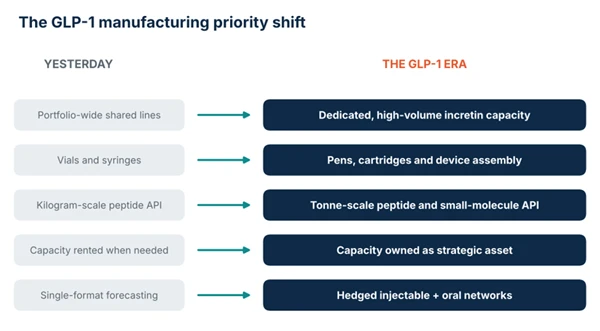
Figure 3: How GLP-1 medicines are reordering manufacturing priorities.
Europe holds structural advantages here. It has a deep base of peptide chemistry expertise, established sterile manufacturing clusters, and strong device and primary-packaging suppliers. It also faces familiar challenges: higher energy costs, lengthy permitting and intense competition for skilled operators. Executives who align GLP-1 investment with broader goals around supply security, sustainability and workforce development are more likely to secure both public support and long-term returns.
Conclusion:
GLP-1 Medicines as a Stress Test for Pharmaceutical Strategy
GLP-1 medicines have become far more than a commercial success story. They are a live stress test of how quickly the pharmaceutical industry can convert scientific breakthroughs into reliable supply at population scale. The shortage years exposed how thin sterile, device and peptide capacity really was. The response has been a decisive shift toward owning critical capacity, investing in dedicated high-volume lines and treating combination devices as core infrastructure.
The next phase will be shaped by format diversity. Oral peptide tablets multiply API requirements, while small-molecule pills open the door to conventional chemistry and oral solid-dose networks. For European C-suite leaders, the winning posture is neither to chase every new format nor to cling to the injectable model, but to build networks flexible enough to serve both. Those who make that call well will not only capture value in obesity and metabolic care; they will set the template for how the industry prepares for its next demand shock.

Lakshmi is a science writer with a foundation in the laboratory. She earned her master's in biotechnology and trained through research internships at ICGEB (JNU) and DIPAS, DRDO, with her work appearing in the Egyptian Journal of Veterinary Sciences. Now APCRM-certified and part of the editorial team at Pharma Focus America and Pharma Focus Europe, she reports on pharmaceutical technology, research, and innovation — giving complex science a clear and confident voice for industry leaders.