
How European CDMOs Are Adapting to the Growing Demand for Complex Drug Manufacturing
Lakshmi, Editorial Team, Pharma Focus Europe
Complex modalities such as antibody-drug conjugates, peptides, highly potent compounds and advanced therapies are rewriting the economics of pharmaceutical outsourcing in Europe. This article examines how European CDMOs are responding: specialising rather than simply scaling, rebuilding sterile operations around revised GMP rules, aligning with new EU industrial policy and strengthening their workforce. A composite case study illustrates the practical choices, and the conclusion sets out what pharmaceutical boards should weigh when selecting partners.
When Complexity Becomes the Core Business of Pharmaceutical Manufacturing
For most of the past two decades, outsourcing in European pharma was largely a question of volume: who could produce a tablet or a vial at the right cost, on time and with a clean inspection record. That question has not disappeared, but it is no longer the one keeping executives awake. The molecules now moving through European pipelines, including antibody-drug conjugates, long-acting peptides, highly potent active ingredients, oligonucleotides, and cell and gene therapies, demand processes that few companies can justify building for themselves. Each combines several manufacturing disciplines into a single product, leaves narrower margins for error and, in many cases, requires containment or aseptic standards far beyond those of conventional plants.
This shift has pushed contract development and manufacturing organisations (CDMOs) from the edge of the supply chain towards its centre. For European CDMOs, the response has been neither uniform nor simple. Some are specialising aggressively, others are reconfiguring legacy assets, and all are operating against a changing regulatory and political backdrop. Understanding how they are adapting matters to every board that depends on them.
The Complexity Premium: Why European CDMO Demand Has Changed Shape
Industry estimates place the European CDMO market at roughly €35–42 billion in 2025–2026, growing at around 7–7.6% a year, with Germany accounting for about 30% of the regional market. Headline growth, however, conceals a more important change: the mix of work is shifting faster than the total.
Complex modalities alter the economics of outsourcing in three ways. First, they are technically integrated. An antibody-drug conjugate requires biologic production, highly potent small-molecule synthesis and a bioconjugation step, each with distinct facility requirements. Few sponsors hold all three competencies in-house, and fewer want to build them. Second, they are capital-intensive relative to likely volumes. A containment suite or aseptic fill line designed for a niche oncology product may run for only a fraction of the year for a single sponsor, which makes shared CDMO infrastructure far more efficient. Third, they are unforgiving of technology transfer. When a process is fragile, moving it between sites late in development introduces material risk to timelines.
The result is that sponsors increasingly value continuity, meaning the ability to keep a molecule with one partner from early development through commercial supply, above marginal savings on unit cost. That preference is reshaping how European CDMOs invest.
From Capacity to Capability: European CDMOs Bet on Specialist Pharmaceutical Platforms
The clearest adaptation is a move away from generic capacity expansion. Rather than adding undifferentiated reactor volume or standard bioreactor trains, many European CDMOs are concentrating capital on capabilities that are hard to replicate: high-potency containment, bioconjugation, solid-phase and hybrid peptide synthesis, sterile injectables for difficult formulations, and viral vector or cell processing.
Specialisation brings pricing power and longer contracts, but it also concentrates risk. A CDMO that commits heavily to a single modality is exposed if clinical attrition thins its client base or a newer technology overtakes it. To manage that exposure, operators are favouring modular and flexible facility designs, such as single-use systems, multi-product suites and platform processes that can be adapted across molecules within the same modality family.
A related shift is towards integration across the value chain. Sponsors developing complex products want fewer handovers between development, analytical, manufacturing and fill-finish providers. European CDMOs are responding by connecting these steps through organic investment, partnerships or consolidation, so that a sponsor works within one quality system and with one accountable team. For C-suite buyers, this changes the procurement conversation from rate cards to governance: who owns the risk when an integrated programme slips?
Containment, Sterility and Annex 1: The New Engineering Baseline for Complex Drug Manufacturing
Complex modalities have also redefined what a compliant facility looks like. Two engineering requirements now dominate capital plans: containment and sterility.
Highly potent compounds, including the cytotoxic payloads used in conjugates, require closed processing, isolator technology and rigorous cross-contamination controls to protect both operators and products. Retrofitting older multipurpose plants to these standards is often costly, which is why many European operators are building dedicated suites rather than upgrading shared ones.
On the sterile side, the revised EU GMP Annex 1, published in August 2022, took effect on 25 August 2023, with its lyophiliser sterilisation requirement applying from 25 August 2024. The revision placed a documented contamination control strategy at the heart of sterile manufacturing and encouraged barrier technologies such as restricted access barrier systems and isolators, expecting a clear rationale where new facilities do not use them. Because many complex biologics and conjugates are delivered as sterile injectables, frequently lyophilised, the Annex has effectively set a new baseline for European fill-finish capacity.
For CDMOs, compliance has become a commercial differentiator. Sponsors now examine contamination control strategies during due diligence, and operators that invested early in isolator-based lines can offer capacity that others cannot.
Brussels Raises the Stakes: EU Policy Turns CDMO Location into Pharmaceutical Strategy
Policy has added a strategic dimension to these technical decisions. Three legislative initiatives stand out.
The reform of the EU general pharmaceutical legislation, the first major overhaul in more than 20 years, reached political agreement on 11 December 2025. The Council formally adopted the package on 28 September 2026; it still requires adoption by the European Parliament before publication, with full applicability expected by 2028. Alongside its rules on regulatory protection, the package strengthens supply and shortage-prevention obligations, which will bring greater scrutiny to the resilience of manufacturing networks.
The Critical Medicines Act, proposed in March 2025, reached provisional agreement between Parliament and Council in May 2026. It focuses on security of supply for essential medicines and introduces a procurement approach that favours EU production. The Council has highlighted that 80% of imported pharmaceutical ingredients come from just five countries, with China alone accounting for 45%.
The proposed European Biotech Act, presented by the Commission on 16 December 2025, targets the gap between European science and manufacturing at scale. Among its measures is a proposed 12-month extension of supplementary protection certificates for qualifying products where at least one manufacturing step, excluding packaging, testing and certification, takes place in the EU.
Taken together, these measures suggest that where a product is made may increasingly influence its commercial value, an argument that favours qualified European CDMO capacity.
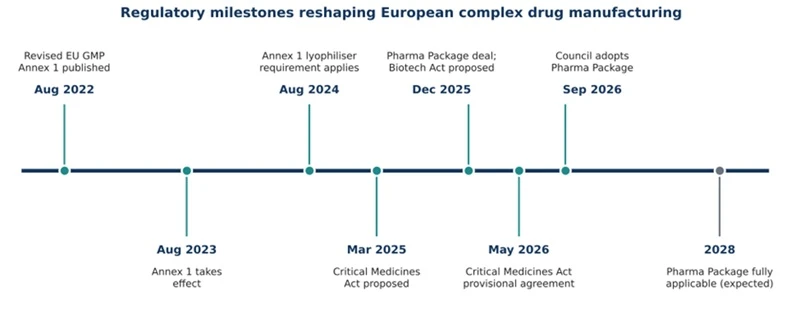
Figure 1: Key EU regulatory and policy milestones affecting complex drug manufacturing, 2022–2028.
The Talent Bottleneck: Why Skilled People Are the Scarcest Input in Complex Pharma Manufacturing
Equipment can be purchased; experienced people cannot be produced on the same timeline. Complex manufacturing needs scientists and operators who understand aseptic technique, potent-compound handling, bioconjugation chemistry and advanced analytics, and who can document their work to inspection standard. The Commission itself acknowledged the shortage of specialised skills in industrial-scale manufacturing when setting out the Biotech Act proposal.
European CDMOs are responding with in-house training academies, structured operator qualification programmes, partnerships with universities and technical colleges, and greater investment in automation and electronic batch records that reduce reliance on manual intervention. For sponsors, workforce depth has become a legitimate diligence question. A partner’s ability to staff an additional shift, retain key process scientists and train replacements quickly can matter as much as its installed capacity.
Case Study: A Mid-Sized European CDMO Reinvents Itself for Complex Conjugate Manufacturing
This case is an illustrative composite based on patterns common across the European sector. It does not describe a single named organisation and deliberately avoids specific financial figures.
A mid-sized European CDMO with a long history in small-molecule active ingredients faced a familiar problem: its multipurpose plant was well utilised but increasingly forced to compete on price. Its leadership team identified antibody-drug conjugates as an adjacent opportunity, given the site’s existing chemistry expertise and its experience handling potent compounds at small scale.
Rather than attempting to build a complete conjugate supply chain at once, the company sequenced its investment. It first upgraded containment for payload and linker synthesis, then added a dedicated bioconjugation suite built around isolator technology and designed from the outset against revised Annex 1 expectations. Antibody production and final sterile fill were secured through long-term partnerships with specialised European providers, supported by a shared quality agreement and a single programme management office presented to sponsors.
Three lessons emerged. First, sequencing limited capital risk while generating early revenue from payload work. Second, designing to current sterile standards from day one avoided the cost of later remediation. Third, sponsors responded most strongly not to the technology itself but to integrated governance: one accountable point of contact across a multi-site process. Over time, the company’s identity shifted from price-competitive chemistry supplier to specialist complex-modality partner.
Conclusion:
Choosing CDMO Partners for a Decade of Complex Pharmaceutical Manufacturing
European CDMOs are adapting to complex drug manufacturing by changing what they sell. Capacity remains necessary but is no longer sufficient; specialist capability, sterile and containment readiness, integrated governance and a skilled workforce now form the basis of competition. At the same time, EU policy is beginning to attach strategic and, potentially, commercial value to European manufacturing location.
For pharmaceutical leaders, the implications are practical. Partner selection for complex products should be treated as a long-term strategic commitment rather than a procurement exercise, judged on technical depth, regulatory readiness, financial resilience and the quality of the relationship as much as on price. Sponsors that secure the right European partners early, while specialised capacity remains finite, will be better placed to move complex therapies from clinic to patient on schedule. Those that wait may find the capacity they need already committed elsewhere.

Lakshmi is a science writer with a foundation in the laboratory. She earned her master's in biotechnology and trained through research internships at ICGEB (JNU) and DIPAS, DRDO, with her work appearing in the Egyptian Journal of Veterinary Sciences. Now APCRM-certified and part of the editorial team at Pharma Focus America and Pharma Focus Europe, she reports on pharmaceutical technology, research, and innovation — giving complex science a clear and confident voice for industry leaders.