

How EU Pharmaceutical Reforms Could Change Drug Development and Market Access
Lakshmi, Editorial Team, Pharma Focus Europe
Europe's first comprehensive rewrite of pharmaceutical law in two decades is nearing final adoption. The new framework trims baseline regulatory protection, ties additional exclusivity to comparative evidence, early EU filing and unmet need, shortens assessment timelines and gives member states new supply powers. For pharma leaders, the reform turns regulatory strategy into a launch-sequencing and portfolio decision. This article examines what changes, what it means for development and market access, and how executives should prepare.
Europe Rewrites Its Pharmaceutical Rulebook
For more than two decades, the rules governing how medicines are developed, authorised and protected in the European Union have rested on a directive from 2001 and a regulation from 2004. That foundation is about to be replaced. The European Commission tabled its proposal for a new directive and regulation in April 2023, the European Parliament set its position in April 2024, the Council followed in June 2025, and negotiators struck a political deal on 11 December 2025. On 28 September 2026, the Council formally adopted the package, leaving a final plenary vote in the Parliament as the last step before publication in the Official Journal. Both acts will enter into force on the twentieth day after publication.
For pharmaceutical executives, the significance lies less in any single clause than in the logic that binds them together. The reform does not simply shorten or lengthen monopoly periods. It reallocates regulatory reward towards behaviours policymakers want to see: comparative evidence, early filing in Europe, broad clinical participation across member states and treatments for unmet needs. That changes the calculus behind trial design, launch sequencing, pricing and lifecycle management. Companies that read the package only as a legal update risk missing what it really is: a strategic reset of the European pharma business model.
From 8+2+1 to 8+1+1+1: The New Arithmetic of EU Pharma Exclusivity
Under the current framework, a new medicine receives eight years of data protection followed by two years of market protection, with a possible further year for a significant new indication, commonly described as 8+2+1. The new package keeps eight years of data protection but cuts baseline market protection to a single year.
The lost year can be recovered, and more, but only conditionally. An additional year of market protection is available for innovative medicines that combine two qualifying conditions: comparative clinical trials with an early EU application; comparative trials with trials conducted in more than one member state; or, where comparative trials are not feasible, multi-country trials with early EU filing. A further year can be granted to products that address an unmet medical need. Combined protection is capped at 11 years, or 12 where a transferable exclusivity voucher is applied.
The headline ceiling therefore matches today's maximum. What changes is the default. Protection that was largely automatic becomes something companies must earn through development and filing choices made years before launch. For portfolio committees, exclusivity can no longer be modelled as a fixed constant in net present value calculations. It becomes a variable that depends on decisions taken at Phase II and Phase III, and it should be treated as such in asset valuations, licensing negotiations and business development diligence.
Evidence as Currency: How EU Pharma Reform Rewires Clinical Development
The criteria attached to extra protection send an unmistakable signal about the kind of evidence Europe wants. Comparative clinical trials, which test a candidate against an active treatment rather than placebo alone, sit at the centre of the reward structure. They are more expensive and carry a higher risk of an unflattering result, but they also produce exactly the data that health technology assessment bodies and payers demand.
This alignment is deliberate. Since January 2025, the EU Health Technology Assessment Regulation has required joint clinical assessments for new cancer medicines and advanced therapy medicinal products, with orphan medicines joining in 2028 and all new medicines by 2030. A development programme built around active comparators now serves both the regulator and the assessors, which helps justify the added investment.
The emphasis on trials across more than one member state also matters. Clinical activity has gravitated towards a limited set of countries, and the reform nudges sponsors to widen their European footprint. Meanwhile, the package aims to speed the regulatory path itself, reducing the standard assessment period at the European Medicines Agency from 210 to 180 days and introducing regulatory sandboxes to test novel approaches. The agency is not starting from a standstill: in 2025 it recommended 104 human medicines for authorisation, 38 of them containing a new active substance and 16 intended for rare diseases.
Rare Diseases and Antibiotics: Where EU Reform Redraws Pharma Incentives
Orphan medicines see one of the most visible adjustments. Standard market exclusivity falls from ten years to nine, while breakthrough orphan medicines can secure two additional years, reaching 11. To qualify, a product must target a rare condition with no authorised treatment in the EU and deliver a clinically relevant reduction in morbidity or mortality. Rare disease developers must now prove not only rarity but transformative value, which places a premium on robust natural history data and meaningful endpoints from the earliest stages.
For antimicrobials, the reform introduces a novel pull incentive: a transferable exclusivity voucher. A developer that brings a qualifying priority antibiotic to market can earn one additional year of protection and apply it to another product of its choice, or sell it. A blockbuster clause bars its use on products whose annual gross sales exceeded €490 million in the preceding four years, limiting the cost to health budgets. The voucher's real worth will depend on how its secondary market develops, but it gives antibiotic programmes a financial logic that has long been absent. A separate four-year data protection regime for repurposed medicines in new, previously unauthorised indications opens another route to value.
The Access Gap EU Pharmaceutical Reform Must Close
Policymakers framed the reform as an answer to a stubborn problem: a single EU authorisation does not translate into equal patient access. The latest Patients W.A.I.T. Indicator, compiled by Europe's pharmaceutical industry federation and published in May 2026, shows the average time from EU marketing authorisation to patient availability reached 597 days, up from 511 days in the 2021 survey. Only 28% of new medicines were fully available on public reimbursement lists in 2025, compared with 42% in 2019, while 49% were not available at all. Oncology products waited longer still, averaging 655 days.
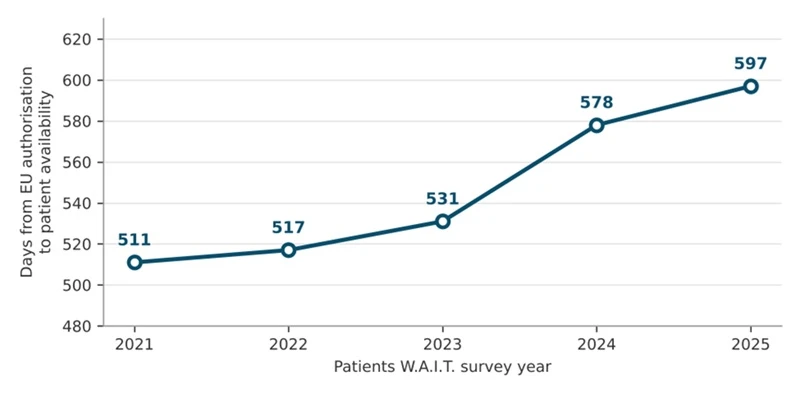
Figure 1: Average time from EU marketing authorisation to patient availability, as reported in each annual Patients W.A.I.T. Indicator survey (days).
The trend line exposes the tension at the heart of the reform. Regulators can accelerate authorisation, but national pricing and reimbursement decisions determine when a medicine actually reaches patients. Trimming baseline protection while access delays lengthen narrows the commercial window in slower markets, with direct consequences for launch strategy.
Case Study: One EU Approval, Two Very Different Pharma Launch Clocks
Consider a new medicine authorised centrally on a single day and valid in every member state. According to the 2025 W.A.I.T. data, patients in Germany gained access after a mean of 158 days. In Romania, the mean was 1,110 days, roughly three years.
Now apply the protection arithmetic, setting patents and supplementary protection certificates aside. Under today's 8+2 baseline, a product reaching German patients after 158 days would enjoy about 9.6 years of protected availability there before generic or biosimilar entry becomes possible; in Romania, about 7.0 years. Under the new 8+1 baseline, those windows shrink to roughly 8.6 and 6.0 years respectively. A product that earns one additional year restores parity with today's baseline, while one that earns both extensions reaches the 11-year cap and gains time in every market.
Two lessons follow. First, the cost of slow access falls hardest on markets that already wait longest, which may tempt companies to deprioritise them, the very outcome the reform hopes to avoid. Second, the conditional extensions are worth most to companies that combine early EU filing with comparative, multinational evidence. Securing an extension is therefore not a regulatory afterthought; it is a market access strategy. These figures are illustrative calculations based on published averages, and individual products will vary.
Supply Duties, Day-One Generics and the New Pharma Lifecycle Playbook
Beyond exclusivity, the package hands member states new leverage. They will be able to require companies to supply medicines that benefit from regulatory protection in sufficient quantities to meet patient needs, with safeguards to stop this power from fuelling parallel trade. Stronger obligations on shortage notification and prevention planning will raise the compliance bar for supply chain and quality teams.
At the other end of the lifecycle, an expanded Bolar exemption allows generic and biosimilar manufacturers to complete the steps needed for launch on day one after intellectual property expires, now including applications to procurement tenders. Originators should expect earlier and sharper erosion at loss of exclusivity and plan lifecycle strategies accordingly, rather than counting on administrative lag.
Boardroom Priorities for the EU Pharmaceutical Reform Era
The first priority for leadership teams is to embed protection criteria into development governance. Decisions about comparator arms, country selection and EU filing timing should be reviewed at portfolio level, with the value of each potential extension quantified alongside development cost.
The second is to revisit launch sequencing. If an early EU application earns additional protection, Europe can no longer be treated as a secondary wave following other major markets. Regulatory, market access and commercial teams will need integrated launch plans that anticipate joint clinical assessment requirements and national reimbursement timelines from the outset.
The third is supply readiness. Companies should map which protected products could become subject to supply obligations and stress-test manufacturing and distribution capacity before regulators ask. Finally, transition planning matters. Member states will generally have two years to transpose the directive, and assets already in late-stage development may fall under different rules depending on timing. Legal, regulatory and finance teams should model each pipeline asset under both regimes now, while there is still room to adjust trial designs and filing plans.
Conclusion: Reform Rewards Pharma Companies That Commit to Europe Early
The EU pharmaceutical package is less a tightening of incentives than a redirection of them. Total protection can still reach today's maximum, but only for companies that generate comparative evidence, run trials across Europe, file early in the EU or address genuine unmet needs. For orphan and antimicrobial developers, the rules create both higher hurdles and new rewards. For every pharma company, the reform links regulatory success more tightly than ever to market access performance.
With final adoption expected shortly, the window for preparation is narrowing. Executives who treat the new rules as a design input for development and launch strategy, rather than a compliance exercise, will be best placed to turn Europe's regulatory reset into competitive advantage.

Lakshmi is a science writer with a foundation in the laboratory. She earned her master's in biotechnology and trained through research internships at ICGEB (JNU) and DIPAS, DRDO, with her work appearing in the Egyptian Journal of Veterinary Sciences. Now APCRM-certified and part of the editorial team at Pharma Focus America and Pharma Focus Europe, she reports on pharmaceutical technology, research, and innovation — giving complex science a clear and confident voice for industry leaders.