
How Biosimilars Are Creating New Opportunities for Pharmaceutical Manufacturers
Lakshmi, Editorial Team, Pharma Focus Europe
Europe's biosimilar market has matured into a strategic arena for pharmaceutical manufacturers. Roughly 100 biologics will lose European exclusivity by 2032, yet most still have no biosimilar in development. Meanwhile, regulators are allowing many biosimilars to reach approval without comparative efficacy trials, reshaping development economics. This article examines where the value is emerging, what a landmark switching study taught the industry, and how leadership teams can position their organisations to capture the next wave.
Pharmaceutical Biosimilars Move from Cost-Saver to Growth Engine
For most of the past two decades, biosimilars were discussed in European boardrooms mainly as a budget lever for health systems. That framing is now too narrow. Since the European Union approved its first biosimilar in 2006, these medicines have become a structural part of the continent's pharmaceutical market and, increasingly, a source of durable revenue for the manufacturers able to develop, produce and supply them reliably.
The scale of the opportunity is tied to the weight of biologics themselves. Biologic medicines, including biosimilars, now account for 44% of the value of the EU pharmaceutical market at list prices. Biosimilars hold about 5% of that market by value and are growing at around 11% a year, a sign that the segment has moved from rapid early uptake into a phase of steady, institutional maturity. For executives, the question is no longer whether biosimilars matter, but where, and how, they can be won.
The Biosimilar Void: Europe's Hidden Pharmaceutical Opportunity
The most striking feature of the coming decade is not competition but its absence. Approximately 100 biological medicines are expected to lose exclusivity in Europe by 2032. Of these, 79% currently have no biosimilar candidate in development anywhere in the world. When candidates whose clinical trials are concentrated outside Europe and North America are set aside, only around 10% of the biologics approaching loss of exclusivity are likely to meet biosimilar competition in Europe.
Measured in value, the gap is large. Biologics nearing European loss of exclusivity represent about US$260 billion in global sales in the year before exclusivity ends. Some US$143 billion of that, or 55%, belongs to molecules with no pipeline activity at all. Many of these products lose protection after 2030, so undisclosed programmes may yet appear. Even so, the numbers describe an unusual situation for a mature industry: a well-mapped, time-bound revenue pool that remains largely uncontested.
Rewriting the Rulebook: Streamlined Biosimilar Regulation Changes the Economics
Historically, the single most expensive element of a biosimilar programme has been the comparative efficacy study, a large confirmatory trial run in patients. European regulators have now concluded that, for most products, this study adds little to what modern analytics already prove. In April 2025 the European Medicines Agency published a draft reflection paper on a tailored clinical approach, and in March 2026 its human medicines committee adopted it. Under the adopted approach, a biosimilar that can be thoroughly characterised with state-of-the-art analytical methods, and that shows comparable pharmacokinetics in humans, is no longer expected to need a comparative efficacy study. The committee expects this to apply to the majority of candidates.
The United Kingdom's regulator moved first, removing the requirement in May 2021 where there is a sound scientific rationale. Regulators in the United States, Canada and India issued draft guidance in the same direction during 2025, while Japan, China and Brazil still required confirmatory efficacy trials as of November 2025.
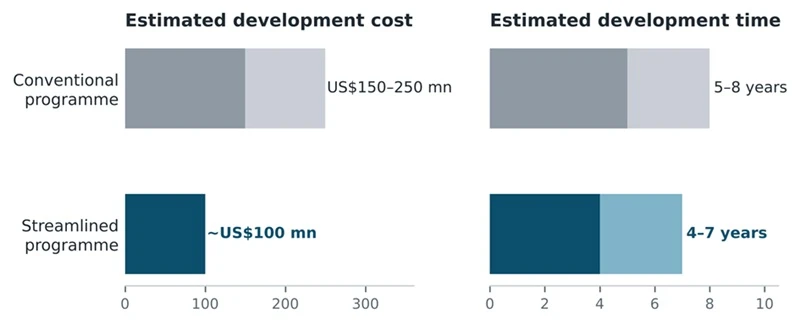
Figure 1: Removing the confirmatory efficacy study could cut biosimilar development costs by up to 50% and shorten timelines. Ranges are global estimates and vary by therapy area and reference-product cost.
The financial implications are substantial. A conventional biosimilar programme is estimated to cost US$150–250 million and take five to eight years. Without a comparative efficacy study, estimates fall to around US$100 million and four to seven years, a reduction in development cost of up to 50%. For portfolio committees, this changes the hurdle rate on dozens of molecules that previously failed internal investment tests.
Beyond the Blockbusters: Where Biosimilar Manufacturers Can Find Uncontested Ground
Lower costs cut both ways. The same reform that unlocks smaller molecules also lowers the barrier for overseas developers, who no longer need to run large European patient trials to enter the market. Competition on the largest molecules will therefore intensify, and margins there will compress faster than before.
The strategic white space lies elsewhere. Twenty-six biologics approaching EU loss of exclusivity by 2032 have projected global sales below US$100 million in the year before expiry. Under the old cost model, few of these justified a programme. Under a streamlined model, with lean development and shared manufacturing platforms, several become viable, particularly for mid-sized manufacturers that cannot win a price war on a blockbuster but can be the first, or only, supplier of a niche biologic.
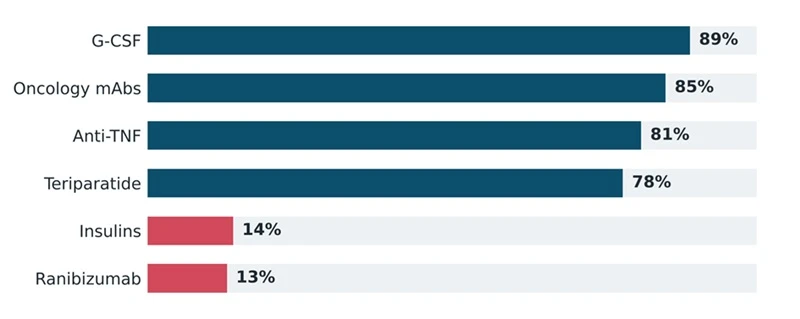
Figure 2: Biosimilar share of volume versus the reference product in the EU, 2024, by product segment. Source: pan-European biosimilar competition analysis, January 2026.
Uptake data reinforce the point that success depends on segment dynamics, not just on approval. In 2024, biosimilars held 89% of EU treatment-day volume against their reference products in G-CSF, 85% in oncology monoclonal antibodies and 81% in anti-TNF therapies. In insulins the figure was only 14%, and in the ophthalmology anti-VEGF agent ranibizumab it was 13%. Where prescribing is concentrated in hospitals and tenders, biosimilars win quickly. Where patients self-inject daily, or where specialist preferences and device familiarity dominate, manufacturers need patient support, device design and physician engagement, not just a lower price.
Europe's Biosimilar Access Gap: A Pharmaceutical Frontier in Central and Eastern Europe
Biosimilar competition has generated an estimated €75 billion in list-price savings across Europe up to mid-2025. The distribution is uneven: €64 billion arose in Western Europe and €11 billion in Central and Eastern Europe. Patient treatment days per capita for the biologics studied remain 35% higher in Western Europe, and that gap has not narrowed over the past five years despite biosimilar entry.
Closing it would require an estimated €18 billion of additional investment in biologic medicine use in Central and Eastern Europe, phased over several years. For manufacturers, this is both a public-health responsibility and a commercial signal. Under-treated populations, combined with health systems seeking affordable options, describe a market where volume growth, rather than share-taking alone, can drive returns. Companies that build local partnerships, flexible pricing and reliable supply in these countries are positioning for the region's next stage of growth.
Case Study: How a National Switching Trial Unlocked Biosimilar Demand at Scale
Clinical evidence that payers and physicians trust has always been the gateway to biosimilar volume, and the clearest European example came from Norway. When biosimilar infliximab arrived in Norway, many prescribers were reluctant to switch patients who were stable on the originator. The Norwegian government responded by funding an independent study to answer the question directly.
The trial enrolled 482 adults across 40 departments in 25 Norwegian hospitals, all on stable infliximab therapy for conditions spanning Crohn's disease, ulcerative colitis, spondyloarthritis, rheumatoid arthritis, psoriatic arthritis and chronic plaque psoriasis. Patients were randomised 1:1, with 241 continuing on the originator and 241 switching to the biosimilar, under double-blind conditions for 52 weeks. Disease worsening occurred in 26% of the originator group and 30% of the switch group, within the prespecified non-inferiority margin of 15%. Adverse event rates were similar between arms. The results were published in a leading peer-reviewed medical journal in 2017, and a 26-week open-label extension found no difference in outcomes after the remaining originator patients also switched.
The commercial lesson for manufacturers is clear. A single, rigorous, publicly funded study did more to normalise switching than years of promotional effort, because it addressed the specific doubt holding back demand. Since then, the European Medicines Agency and the Heads of Medicines Agencies have stated that biosimilars approved in the EU are interchangeable with their reference products from a scientific viewpoint. Manufacturers who invest early in real-world evidence and in partnerships with clinical communities can accelerate uptake in segments where hesitation, rather than price, is the binding constraint.
Competing in a Global Biosimilar Arena: Europe's Edge and the Rising Challengers
Europe remains the reference market for the sector. Its biosimilar market is valued at around US$18 billion at list prices, 55% larger than that of the United States, and of the biosimilars approved in Europe, the United States or both, 71% were authorised in Europe first. Yet the ownership landscape is changing. A growing share of European approvals now goes to companies headquartered in the United States, India and South Korea, often through partnerships with established European players.
For European manufacturers, this raises the strategic value of capabilities that are hard to replicate from afar: large-scale, compliant biologics manufacturing within the region, proven supply reliability, and deep relationships with hospital procurement bodies. As European policymakers place greater emphasis on supply security, local manufacturing footprint is likely to become a competitive asset in tenders, not merely an operational detail.
Strategic Imperatives for Pharmaceutical Leaders in the Biosimilar Decade
Taken together, the evidence points to a different playbook from the one that served the first generation of biosimilars. Portfolio selection should begin with the loss-of-exclusivity calendar and the pipeline void, favouring molecules where competition is thin and where streamlined development makes the economics work. Investment should shift towards analytical science, because characterisation data, rather than large efficacy trials, will now carry the weight of regulatory approval.
Manufacturing capacity deserves board-level attention. Regulatory streamlining will bring more entrants faster, and the winners in tenders will be those able to guarantee volumes from day one. Differentiation will increasingly come from device design, formulation convenience and patient support, especially in self-administered therapies where price alone has not shifted prescribing. Finally, early dialogue with payers on launch timing, pricing and access expansion, particularly in under-served markets, can convert a loss-of-exclusivity event into sustained volume growth.
Conclusion:
Biosimilars as a Strategic Pillar of European Pharmaceutical Growth
Biosimilars have earned their place in Europe's healthcare systems through two decades of safe use and €75 billion in list-price savings. The next chapter will be shaped less by proving the concept and more by who chooses to compete. With roughly 100 biologics losing exclusivity by 2032, most still uncontested, and with development costs set to fall sharply as comparative efficacy trials become the exception, the opportunity for pharmaceutical manufacturers has rarely been more clearly defined.
The organisations that benefit most will treat biosimilars not as a low-margin side business, but as a disciplined growth strategy built on scientific excellence, manufacturing reliability and genuine partnership with health systems. For Europe's C-suite, the decisions taken in the next two to three years will determine who leads the biosimilar decade, and who watches it from the sidelines.

Lakshmi is a science writer with a foundation in the laboratory. She earned her master's in biotechnology and trained through research internships at ICGEB (JNU) and DIPAS, DRDO, with her work appearing in the Egyptian Journal of Veterinary Sciences. Now APCRM-certified and part of the editorial team at Pharma Focus America and Pharma Focus Europe, she reports on pharmaceutical technology, research, and innovation — giving complex science a clear and confident voice for industry leaders.