How AI Could Improve R&D Productivity Across the European Pharma Sector
Lakshmi, Editorial Team, Pharma Focus Europe
Europe’s pharmaceutical industry invested an estimated €55 billion in R&D in 2024, yet the region’s share of global commercial clinical trials has almost halved in a decade. This article examines how artificial intelligence can lift pharma R&D productivity across Europe, from target discovery and molecular design to trial execution and regulatory submission. It separates proven value from hype, draws lessons from a landmark AI-designed molecule, and sets out the leadership choices that convert AI investment into pipeline output.
Record Spending, Stalled Returns – Can AI Break Europe’s Pharma R&D Deadlock?
Few industries invest in the future as heavily as European pharma. According to the region’s pharmaceutical industry federation, the sector invested an estimated €55 billion in research and development in Europe in 2024, making it the most research-intensive industry on the continent. Yet boards increasingly confront an uncomfortable asymmetry. Spending keeps climbing, while the outputs that matter most (approved medicines, first launches in Europe and the volume of clinical research conducted on European soil) are not rising in step.
The underlying economics have barely shifted in a generation. Bringing a molecule from discovery to launch still takes 10 to 12 years, and roughly nine of every ten compounds that enter Phase 1 trials never reach the market. At the same time, the European Economic Area’s share of global commercial clinical trials fell from 22% in 2013 to 12% in 2023, even though the total number of trials worldwide grew by 38% over the same decade. Europe’s science base remains world-class. Its problem is conversion: turning excellent research into products, quickly and at acceptable cost.
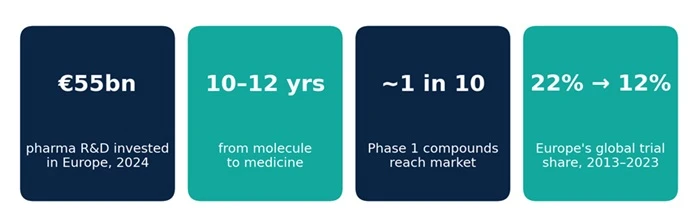
Figure 1: The European pharma R&D productivity gap at a glance
Artificial intelligence is not a cure-all for that problem, but it is the most credible productivity lever available to European R&D leaders today. This article examines where AI is already changing the economics of pharma R&D, where claims are running ahead of evidence, and which decisions European executives must make now if they are to capture real productivity gains rather than fund another cycle of disconnected pilots.
The Leaky Pharma Pipeline: Where AI Can Seal Europe’s R&D Value Gaps
R&D productivity is ultimately governed by three variables: time, cost and probability of success. Most improvement programmes of the past two decades have pushed on one variable at a time. Outsourcing lowered cost, adaptive trial designs saved time, and portfolio reviews tried to kill weak projects earlier. AI is different in kind, because it can act on all three variables at once, and because its benefits compound. A better-chosen target improves the odds at every stage that follows it.
The points of leakage are familiar to every R&D head. Candidate molecules are synthesised and tested in large numbers because medicinal chemistry has long relied on iterative trial and error. Programmes fail late, frequently for efficacy reasons rooted in biology that was poorly understood when the target was chosen. Trial start-up consumes months in site feasibility, protocol amendments and patient recruitment. Regulatory documentation absorbs large specialist teams. At heart, each of these is a data problem, and data problems are where AI performs best.
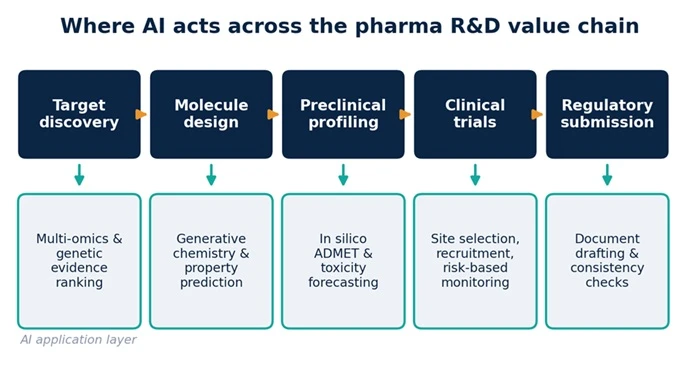
Figure 2: AI applications mapped to each stage of the pharma R&D value chain
For European companies the potential leverage is unusually high. The continent holds some of the richest longitudinal health data in the world, spread across national registries, biobanks and hospital systems. Fragmentation across member states, with different languages, formats and governance regimes, has historically limited its use. AI techniques for data harmonisation, federated learning and clinical language processing can turn that fragmented asset into a usable one without moving sensitive records out of the institutions that hold them.
AI at the Bench: Compressing the Pharma Discovery Clock
Discovery is where AI’s impact is most visible. Machine learning models trained on chemical and biological data can predict binding affinity, selectivity, toxicity and pharmacokinetic behaviour before a compound is ever made. Generative models propose novel structures optimised against several parameters simultaneously. The practical result is that chemists synthesise fewer and better compounds, and design-make-test-analyse cycles that once took months can shrink to weeks.
Target discovery benefits in parallel. By integrating genomic, proteomic, imaging and clinical data, AI systems can rank potential targets by the strength of their genetic and mechanistic link to disease, the kind of evidence associated with higher clinical success. Advances in protein structure prediction have turned structural insight from a bottleneck into a routine input for many programmes.
Executives should nonetheless stay clear-eyed. Faster discovery does not automatically mean better medicines. Discovery accounts for a minority of total development spend; most of the money is consumed in clinical development, where failure is most expensive. An AI programme that accelerates preclinical work but feeds the clinic with molecules that fail at the historical rate improves timelines, not productivity. The prize lies in using AI to raise the quality of what enters the clinic, not merely its speed.
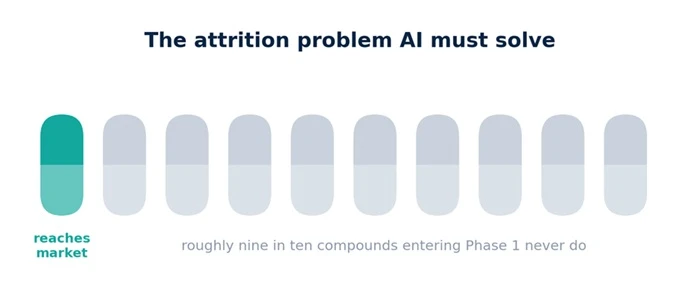
Figure 3: Pictograph of clinical attrition, the core productivity challenge for AI in pharma
AI in the Clinic: Winning Back Europe’s Lost Pharma Trials
The erosion of Europe’s clinical trial base is the region’s most pressing productivity signal. Independent analysis prepared for the industry estimated that the decline represents 60,000 fewer patients accessing trials that involve a European Economic Area country. Over the same decade, China’s share of global commercial trials rose from 8% to 18%. Sponsors place studies where they can be approved, activated and enrolled fastest, and Europe has been losing that race.
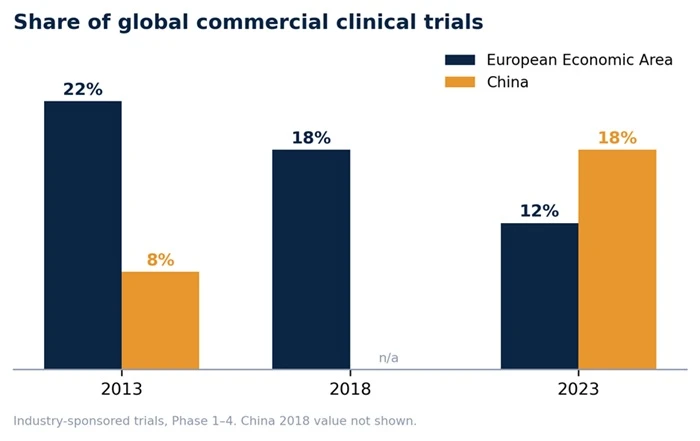
Figure 4: Europe’s share of global commercial clinical trials has fallen as China’s has risen
AI addresses the operational roots of that decline. Language models can read protocols and eligibility criteria against real-world data to locate where eligible patients actually are, rather than where sites have historically recruited. Predictive models can flag sites likely to under-enrol before they are activated. Protocol-simulation tools show how each inclusion and exclusion criterion shrinks the eligible population, exposing criteria that restrict recruitment without meaningfully protecting safety or data quality, a common trigger for costly amendments.
Further downstream, AI supports risk-based monitoring by detecting anomalous data patterns across sites in near real time, and it underpins external control arms built from historical and real-world data in settings such as rare diseases, where randomising patients to placebo is difficult. Europe’s Clinical Trials Regulation, fully applicable to all trials since the end of its transition period in January 2025, created a single submission route across member states. Pairing that harmonised process with AI-driven feasibility and recruitment offers a realistic path to restoring Europe’s appeal as a location for global studies.
Case Study: The AI-Designed Pharma Molecule That Reached the Clinic in Under a Year
In early 2020, a Phase 1 study began in Japan for a candidate treatment for obsessive-compulsive disorder, a long-acting serotonin 5-HT1A receptor agonist. It was widely reported as the first molecule designed with AI to enter human trials. The compound emerged from a collaboration between a UK-based AI drug-design specialist and an established Japanese pharmaceutical company with deep expertise in monoamine GPCR drug discovery.
The partners reported completing the exploratory research phase in less than 12 months, against a typical industry average of 4.5 years. The development candidate was identified after synthesising around 350 compounds, compared with the roughly 2,500 usually required. For a European audience, the model is instructive: a domain-rich incumbent supplied biological insight and development capability, while a European AI specialist supplied design speed.
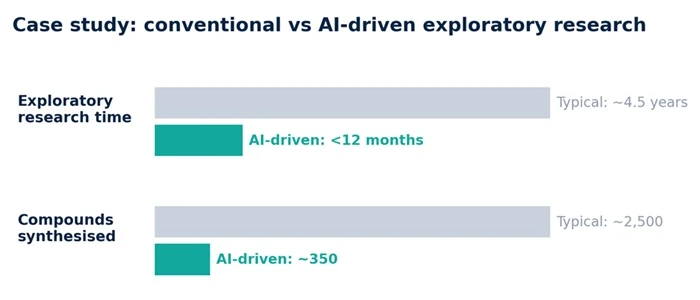
Figure 5: Reported efficiency gains in the AI-driven discovery programme
The more valuable lesson lies in what happened next. Development of the molecule was discontinued in 2022. Its target was already well validated; AI transformed the chemistry but did not change the biological hypothesis on which clinical success ultimately depended. The episode captures both sides of AI in pharma R&D: dramatic efficiency in discovery, and no immunity to clinical reality. Companies that expect AI to bypass clinical risk will be disappointed. Those that bank the time it saves and reinvest it in stronger target validation, better translational models and sharper patient selection are the ones positioned to capture genuine productivity gains.
Regulation as Runway: How Europe’s AI Rulebook Can Become a Pharma Advantage
Many executives regard Europe’s regulatory environment as a brake on AI. That view deserves challenge. The EU AI Act entered into force on 1 August 2024, establishing a risk-based framework for AI systems. In September 2024, the European Medicines Agency adopted a reflection paper on the use of AI across the medicinal product lifecycle, setting out expectations on data quality, transparency, validation and human oversight, calibrated to the influence an AI system has on regulatory decisions and patient safety.
Clarity has commercial value. Companies that embed governance, documentation and model validation into their AI programmes from the outset will find AI-generated evidence far easier to defend in regulatory submissions. Europe’s demanding privacy expectations, often cited as an obstacle, have pushed the region towards privacy-preserving methods such as federated learning, which are fast becoming the norm for multi-party health data collaboration. The European Health Data Space framework, which entered into force in 2025, will progressively open secondary use of health data for research under controlled conditions. A company that masters trustworthy AI under European rules builds a capability that travels well to every other major market.
From Pilots to Pipeline: The Boardroom Agenda for Pharma AI
The gap between AI’s promise and its measured impact on pharma R&D is rarely technological. It is organisational. Many companies run dozens of AI pilots, each owned by an enthusiastic team, few of which scale beyond a single programme. The first executive decision is therefore one of accountability: AI in R&D needs an owner at leadership level with authority over data, budgets and ways of working, not a loose federation of experiments.
Data foundations come next, and they are less glamorous than algorithms. Decades of assay results, failed compounds and trial datasets sit in incompatible systems across legacy sites and acquired businesses. Making that history findable, interoperable and reusable is the single investment that determines whether AI models learn from a company’s full experience or only from its most recent projects. Negative data, meaning the compounds and hypotheses that failed, is particularly valuable and particularly neglected.
Talent strategy must shift from hiring isolated data scientists to building bilingual teams in which chemists, biologists and clinicians understand what models can and cannot do, and in which computational scientists understand the biology. Partnership architecture matters as well. The case above shows how an incumbent and a specialist can combine strengths, but only when data rights, intellectual property and decision rights are defined before the first model is trained.
Finally, measurement must move from activity to outcome. Counting models deployed or hours saved says little about R&D productivity. Boards should track cycle time from target selection to candidate nomination, cost per candidate, and phase-transition success rates over time, and they should compare AI-enabled programmes against conventional ones with the same rigour applied to any clinical claim. What gets measured at portfolio level is what gets scaled.
Conclusion: Europe Has the Science, Data and Rules – Now AI Must Turn Pharma R&D into Medicines
Europe does not lack the ingredients for an AI-driven revival in pharma R&D productivity. It has deep scientific talent, uniquely rich health data, a sizeable and sustained R&D budget, and an emerging regulatory framework that rewards trustworthy innovation. What it has lacked is the organisational will to connect those ingredients at scale.
The evidence to date points to a measured conclusion. AI can compress discovery timelines dramatically and can attack the operational inefficiencies that have driven clinical trials away from Europe. It cannot, on its own, overturn biological uncertainty. The European companies that win will treat AI neither as a magic bullet nor as a side project, but as a disciplined capability, governed from the top, built on clean data and judged by pipeline outcomes. For the region’s pharma leaders, the question is no longer whether AI will reshape R&D productivity. It is whether Europe will lead that change or import it from elsewhere.

Lakshmi is a science writer with a foundation in the laboratory. She earned her master's in biotechnology and trained through research internships at ICGEB (JNU) and DIPAS, DRDO, with her work appearing in the Egyptian Journal of Veterinary Sciences. Now APCRM-certified and part of the editorial team at Pharma Focus America and Pharma Focus Europe, she reports on pharmaceutical technology, research, and innovation — giving complex science a clear and confident voice for industry leaders.