Global CDMO Expansion: Supporting the Growing Advanced Therapy Pipeline
Lakshmi, Editorial Team, Pharma Focus Europe
Europe's advanced therapy pipeline is maturing faster than the manufacturing base built to serve it. This article examines how global CDMO expansion is redrawing capacity, cost and control for cell and gene therapy developers, why European boards face a distinctive build-or-buy calculation under new EU industrial policy, and what pharmaceutical and biotech leaders should be demanding from CDMO partners before the next wave of approvals lands.
Introduction
The European advanced therapy sector has spent the better part of two decades proving a scientific point: that engineered cells, corrected genes and reprogrammed immune systems can deliver durable clinical benefit. That argument is now largely settled. The question facing pharmaceutical and biotech leadership is industrial rather than scientific — whether these therapies can be manufactured consistently, at a cost European health systems will absorb, and at volumes suited to indications far broader than the ultra-rare diseases where the field began.
That question is no longer answered inside a company's own building. It is answered across a global network of contract development and manufacturing organisations that is expanding quickly, unevenly, and not always in the modalities or geographies European sponsors need most. For a chief executive weighing a pivotal readout against a manufacturing slot reserved eighteen months in advance, CDMO strategy has quietly become one of the most consequential items on the board agenda. It sets launch timing, shapes gross margin, and in more cases than the sector likes to admit, determines whether a programme survives the transition from clinic to market at all.
What follows is an examination of where advanced therapy CDMO capacity is genuinely going, why Europe's industrial position is more fragile than its scientific reputation implies, and what commercial leaders should be negotiating for while they still have leverage.
The Advanced Therapy Pipeline Has Outgrown the Factory Floor That Built It
The composition of the advanced therapy pipeline is changing in ways that carry direct manufacturing consequences. Gene therapy programmes continue to advance at every stage of development, with a steady flow of candidates moving into late-phase trials, concentrated in rare haematological, neuromuscular and central nervous system disorders. More significant for capacity planning is the migration of engineered cell therapy out of oncology and into autoimmune disease — lupus, myositis, systemic sclerosis and related conditions where early clinical responses have been striking enough to redraw the addressable population from a few hundred patients to potentially tens of thousands.
This is the point where manufacturing assumptions quietly break. A GMP suite designed around thirty autologous batches a year, staffed by scientists who also run the process development, is an entirely rational asset for a Phase I orphan programme. It is an unmanageable liability for a therapy that may need to serve a rheumatology population across twenty-seven member states. The economics of advanced therapy manufacturing are dominated by fixed cost, skilled labour and batch failure rates, none of which improve simply because demand rises. Scale in this field is not a volume problem to be solved later; it is a design decision taken years earlier, usually before the sponsor knows how large the market will be.
That is precisely why the CDMO question has moved up the corporate agenda. Building dedicated capacity for an indication that may or may not expand is a capital allocation gamble few European biotechs can underwrite. Outsourcing it transfers the capital risk — and, less comfortably, a considerable amount of control.
Why the Advanced Therapy CDMO Market Is Expanding Faster Than It Is Being Absorbed
By any conventional reading, supply is arriving. The global cell and gene therapy CDMO market has grown from roughly USD 6.9 billion in 2025 to an estimated USD 8.9 billion in 2026, and forecasts place it above USD 21 billion by 2030, implying sustained annual growth in the mid-twenties. Capital is flowing into new suites, new fill-finish lines and new vector facilities across North America, Europe and Asia-Pacific, with the latter growing fastest on the strength of lower production costs and government-backed biomanufacturing programmes.
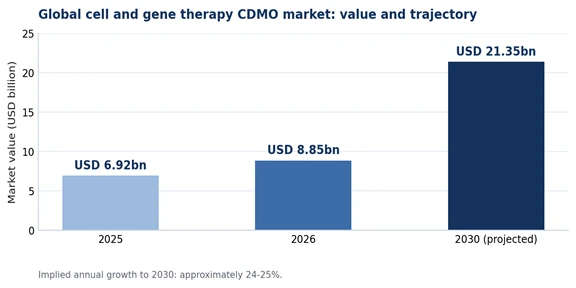
Figure 1. Global cell and gene therapy CDMO market: value and trajectory, 2025-2030.
And yet developers report the opposite experience. Recent industry capacity surveys indicate that more than half of respondents struggled to find available gene therapy manufacturing capacity, with a near-identical proportion reporting the same difficulty for cell therapy. Both figures have remained stubbornly high across successive years.
The contradiction resolves once capacity is understood correctly. In advanced therapy manufacturing, a suite is not a commodity. Each product carries its own vector construct, cell type, potency profile and analytical package, and the deviation from any standard platform is usually substantial. A facility optimised for lentiviral autologous processing does not absorb an AAV programme without months of engineering, requalification and comparability work. Announced square metres, therefore, tell a European board almost nothing. What matters is whether a partner has run a process resembling yours, at your scale, through a regulatory filing that succeeded.
Europe's CDMO Dilemma: World-Class Science, Hesitant Industrialisation
Europe's structural problem is not discovery. It is the persistent gap between research excellence and industrial conversion — the pattern in which promising ATMP science originates in European academic centres and scales, commercially, somewhere else. The European Commission has acknowledged this openly. The proposed European Biotech Act, published in December 2025, sets out to simplify fragmented regulatory processes, improve access to scale-up finance and actively incentivise EU-based biomanufacturing, with a second instalment focused on industrial biotechnology expected to follow. It sits alongside the Critical Medicines Act and the broader pharmaceutical package, on which co-legislators reached provisional agreement in late 2025.
For advanced therapy sponsors, one element of that package deserves particular board-level attention: the proposed integration of the Committee for Advanced Therapies into the Committee for Medicinal Products for Human Use. The intent is procedural coherence and reduced fragmentation. The risk, widely voiced across the sector, is dilution of the concentrated ATMP-specific expertise that developers have relied on for scientific advice. Either way, the assessment environment in which a European CDMO strategy will be judged is shifting while manufacturing commitments are being signed.
The commercial implication is a timing mismatch. Policy support for European biomanufacturing is arriving over a horizon of years; capacity decisions for programmes reading out in 2027 and 2028 are being made now. Leaders who wait for incentives to materialise will book slots into a tighter market than the one they are currently observing.
The Advanced Therapy CDMO Contract Is Now a Clinical Risk Document
There is a regulatory shift beneath all of this that too few commercial teams have internalised. As regulators accept smaller clinical datasets for therapies addressing severe unmet need, they compensate by leaning harder on manufacturing evidence. Process understanding, validated analytical methods, qualified starting materials and a defensible comparability strategy carry evidentiary weight they simply did not carry a decade ago. In practical terms, the quality of a CDMO relationship has become part of the clinical argument, not an operational footnote to it.
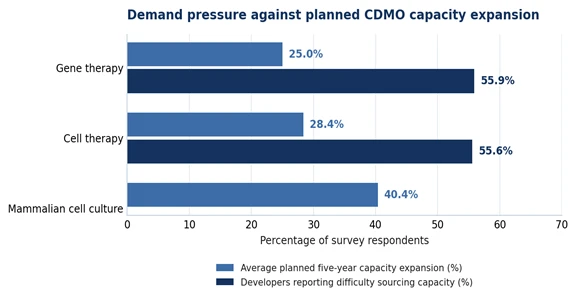
Figure 2. Reported difficulty sourcing advanced therapy manufacturing capacity, set against average planned five-year expansion by modality.
That reframing should change how contracts are written. Ownership of process know-how, access to raw analytical data rather than summary certificates, contractual clarity on who bears the cost and the timeline of a failed batch, secured capacity in a second qualified site, and the right to inspect and to participate directly in regulatory interactions are no longer refinements for the procurement team to negotiate at the margin. They are the terms that determine whether a filing holds together. Sponsors who treat the manufacturing services agreement as a cost document rather than a risk document generally discover the difference at the worst possible moment — during pre-approval inspection.
Case in Point: A European Developer Rewrites Its CDMO Map Mid-Pipeline
Consider a pattern now familiar across European advanced therapy developers, seen repeatedly in sponsors moving an autologous cell therapy from early clinical work into pivotal trials. The company begins with a single regional contract manufacturer, chosen for proximity, responsiveness and a workable price for a modest number of clinical batches. The relationship functions well while volumes are small.
Two things then change simultaneously. Clinical data in an autoimmune indication broadens the target population well beyond the original oncology hypothesis, and the partner's suites fill with programmes signed earlier and at larger scale. The sponsor is not dropped; it is simply deprioritised in the scheduling queue. Slots move by weeks, then by quarters. Because the process was never fully characterised for transfer, moving it elsewhere requires a comparability exercise the company has neither budgeted nor staffed, and each month of delay erodes the exclusivity runway that underpinned the valuation.
Developers who navigate this well tend to have done three things early. They characterised the process for portability from the outset rather than optimising narrowly around one facility's equipment. They secured contractual capacity commitments — including reservation fees for suites they might not use — well before the pivotal readout. And they built dual-region supply, accepting duplicated qualification cost as the price of not having a single site, in a single jurisdiction, hold the entire launch hostage. The lesson is uncomfortable but consistent: in advanced therapy manufacturing, redundancy purchased before it is needed is invariably cheaper than flexibility purchased under pressure.
Small Footprints, Large Consequences: Decentralised CDMO Models for Advanced Therapies
A quieter structural shift is underway alongside the expansion of large centralised plants. Closed, automated and increasingly modular manufacturing platforms are making it feasible to produce certain autologous therapies close to the patient — within hospital networks or in compact regional units rather than a single continental facility. For autologous products with short vein-to-vein requirements and demanding cold-chain logistics, the argument is compelling: shorter turnaround, lower shipping risk, and a cost base less dependent on transcontinental transport.
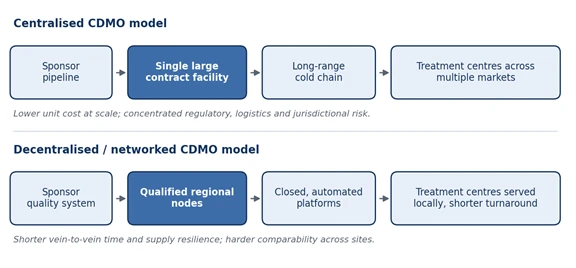
Figure 3. Centralised and decentralised CDMO models for advanced therapies, and the trade-offs each carries.
European clinical and academic bodies have been arguing for exactly this shape — a dense network of connected ATMP hubs supported by standardised, decentralised manufacturing and harmonised requirements across member states. The obstacles are regulatory and operational rather than technical. Revisions to EU GMP guidance covering ATMPs remain under consultation, and comparability across multiple small sites is considerably harder to demonstrate than consistency within one. Yet for boards, the strategic point holds: the future advanced therapy CDMO relationship may look less like a single large outsourced plant and more like a licensed, monitored network operating under the sponsor's quality system.
What the Advanced Therapy CDMO Market Will Reward Next
Three shifts should shape European CDMO selection over the next planning cycle. First, platform depth will matter more than installed footprint; the partners that command pricing power are those with genuine repeat experience in a specific modality and a track record of surviving inspection, not those with the newest ribbon-cutting. Second, the modality mix is moving. Interest in in vivo approaches and off-the-shelf allogeneic products, which shift demand towards vector and delivery-system capacity rather than patient-specific processing suites, will progressively reprice different kinds of capacity. A ten-year commitment to autologous-only infrastructure is a heavier bet in 2026 than it appeared in 2022.
Third, geographic concentration has become a financial exposure rather than a logistics preference. Tariff pressure on imported equipment, single-use systems and vector components has already raised input costs for manufacturers in both North America and Europe. Sponsors dependent on a single manufacturing jurisdiction are carrying a policy risk they do not control and frequently do not quantify. Dual-region qualification is expensive; discovering its absence during a trade dispute or a supply interruption is more expensive still.
Conclusion
The global expansion of CDMO capacity is real, well capitalised and accelerating. It is also poorly matched, in the short term, to what European advanced therapy developers actually need: process-specific expertise, secured and portable capacity, and partners capable of standing behind manufacturing evidence when clinical datasets are thin. Aggregate market growth conceals a market that remains functionally tight for precisely the programmes Europe is best at generating.
European policy is moving in a supportive direction, and the ambition behind the Biotech Act and its accompanying measures is serious. But legislation will not book a suite, characterise a process for transfer or resolve a comparability question raised eight weeks before a pre-approval inspection. Those remain executive decisions, and they are increasingly decisions with a short window.
For chief executives and their manufacturing leadership, the practical conclusion is straightforward. Treat CDMO strategy as a core element of the corporate plan rather than a downstream procurement exercise. Negotiate for portability and redundancy while the pipeline is still early and the leverage still exists. And recognise that in advanced therapies, the distance between an approved product and a stranded asset is measured in manufacturing readiness, not in scientific merit.

Lakshmi is a science writer with a foundation in the laboratory. She earned her master's in biotechnology and trained through research internships at ICGEB (JNU) and DIPAS, DRDO, with her work appearing in the Egyptian Journal of Veterinary Sciences. Now APCRM-certified and part of the editorial team at Pharma Focus America and Pharma Focus Europe, she reports on pharmaceutical technology, research, and innovation — giving complex science a clear and confident voice for industry leaders.