Generative AI in Pharma: Scaling Productivity without Compromising
Lakshmi, Editorial Team, Pharma Focus Europe
Generative AI has reached every desk in the pharmaceutical enterprise faster than any technology before it, and European companies face a governance environment no other market imposes. This article maps where generative capability creates near-term value, identifies the verification bottleneck that limits it, examines the control framework European boards must fund, and sets out the decisions that separate measurable throughput from expensive novelty.
Introduction: The First Technology to Arrive Everywhere at Once
Most enterprise technologies enter a pharmaceutical company through a single door. A manufacturing execution system arrives at a site. A clinical data platform arrives in development. Governance follows the deployment, because there is a deployment to govern. Generative AI did not behave this way. It reached medical writers, regulatory managers, safety officers, market access teams and commercial staff simultaneously, frequently before any European executive committee had approved a policy, a vendor or a budget line.
That distinction explains most of what has followed. Adoption is near-universal; measured productivity is not. Pilot enthusiasm is high; the number of European organisations able to state, in a board paper, how many working days generative tools removed from a regulatory submission last quarter remains small.
The strategic question in Europe has therefore shifted. It is no longer whether the models are good enough — for the drafting and summarisation tasks that dominate pharmaceutical work, they demonstrably are. It is whether the enterprise around them can verify, approve and defend what they produce at the speed they produce it, under a regulatory framework that is stricter and more prescriptive than anywhere else in the world.
Pharma Is a Language Industry — Which Is Why This Lands So Hard
A pharmaceutical company is, in operational terms, a document factory attached to a laboratory and a plant. Protocols, investigator brochures, statistical analysis plans, clinical study reports, dossier modules, safety narratives, labelling texts, responses to regulatory questions, standard medical information replies, training materials, and their equivalents in twenty-four official European languages. The proportion of skilled professional hours spent producing, reviewing and reconciling structured text is extraordinary, and it has been resistant to automation because the text is not templated in any mechanical sense.
Generative models attack precisely this cost base. But the value is not distributed evenly, and the European governance burden attaching to each application varies sharply.
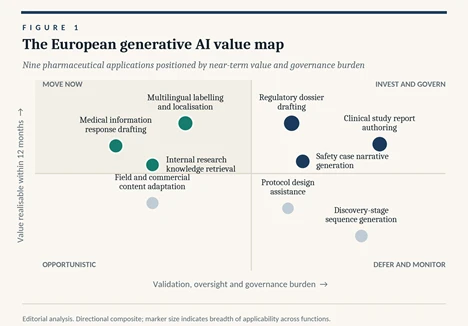
Figure 1. Near-term value and governance burden are only loosely correlated — several high-value applications sit in the quadrant demanding the most control.
Figure 1 carries an uncomfortable message for anyone hoping generative AI would be a quick win. The applications with the largest twelve-month value — regulatory dossier drafting, clinical study report authoring, safety case narratives — sit in the quadrant demanding the heaviest oversight. The genuinely low-burden applications, such as internal knowledge retrieval, are useful but rarely material to the profit and loss account.
The exception worth close attention is multilingual labelling and localisation. It combines high near-term value with moderate governance burden, and it is a structurally European problem that no American market analysis will prioritise for you.
Where the Days Actually Disappear
The productivity claim most often made for generative AI concerns authoring hours. That is the wrong metric. In pharmaceutical document production, elapsed time is dominated not by writing but by waiting: for source data reconciliation, for the third reviewer's availability, for a comment cycle, for rework.
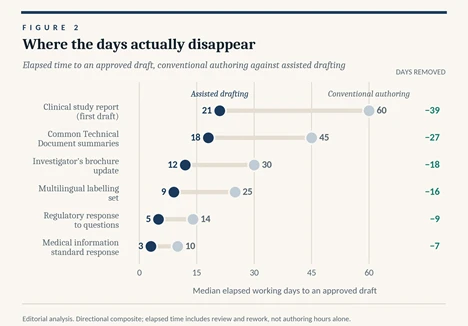
Figure 2. The compression is real but partial — assisted drafting removes waiting and rework, not the approval step itself.
Figure 2 shows where compression is achievable and where it is not. A first-draft clinical study report can move from roughly sixty elapsed working days to around twenty, because the model removes both the blank-page delay and much of the reconciliation between narrative and tabulated results. A standard medical information response compresses proportionally further because its review chain is short.
What does not compress is the approval itself. Every one of these documents still requires a qualified human to take professional and legal responsibility for it. That step is the constraint, and it is the one most business cases quietly assume away.
The Verification Tax: Drafting Scales, Approval Does Not
Deploy generative drafting across a European medical writing, regulatory and safety organisation and something predictable happens. Draft volume rises steeply within two quarters. The pool of people qualified to review, correct and sign those drafts rises hardly at all, because that pool is constrained by qualification, experience and — in the case of safety documentation — named regulatory accountability.
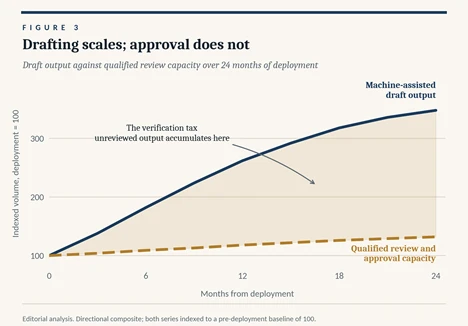
Figure 3. Output rises steeply; the qualified review pool does not. The widening gap is where value silently converts into backlog.
The gap in Figure 3 is not a transitional inconvenience. It is the structural characteristic of the technology in a regulated environment, and it produces three failure modes: growing backlogs of unapproved drafts; reviewer fatigue leading to degraded scrutiny precisely as volume rises; and — most damaging — the quiet normalisation of light-touch review, which is how an error reaches a submission or a patient.
The organisations handling this well have made an unintuitive move. They have invested in review capacity and review tooling at the same time as generation capacity, and in several cases ahead of it. Structured comparison against source data, automated consistency and traceability checks, and reviewer interfaces that surface only what has changed are not glamorous investments. They are the ones that determine whether the drafting saving is ever realised.
Case Study: Rebuilding a European Medical Writing Function
Consider an anonymised European mid-cap with development operations in three countries and a medical writing group of around forty people, facing a submission schedule that had outgrown it by roughly a third.
The initial approach was conventional: a drafting assistant deployed to the whole writing group with training and a prompt guide. Within four months draft output had risen sharply and the review queue had lengthened. Elapsed time to approved documents was essentially unchanged. The programme was, on its own stated measure, failing.
The redesign that followed had three components. First, drafting was restricted to document types with a controlled source of truth — study reports, dossier summaries, brochure updates — and withdrawn from tasks where the model was inventing rather than assembling. Second, the company built a verification layer: automated checks reconciling every figure in a generated draft against the statistical output that produced it, with unmatched values flagged before a human ever opened the document. Third, seven experienced writers were moved permanently out of authoring and into a review and quality function, with the explicit expectation that they would author less.
Twelve months later, elapsed time to approved clinical study report fell by roughly sixty per cent, the submission schedule was met without external contract writers, and the recorded rate of factual corrections found at final quality review had fallen rather than risen. The headcount was identical. What changed was where the capacity sat.
Europe's Distinctive Constraint: Risk Rules Meet GxP
European pharmaceutical companies operate under a control environment that has no direct equivalent elsewhere: horizontal risk-based rules governing AI systems, sitting alongside long-established GxP requirements, data protection obligations, national language requirements and evolving expectations around health data access. These frameworks were not designed together, and reconciling them is now a board-level task rather than a compliance footnote.
The practical translation is a control matrix that must be funded before deployment, not retrofitted after it.
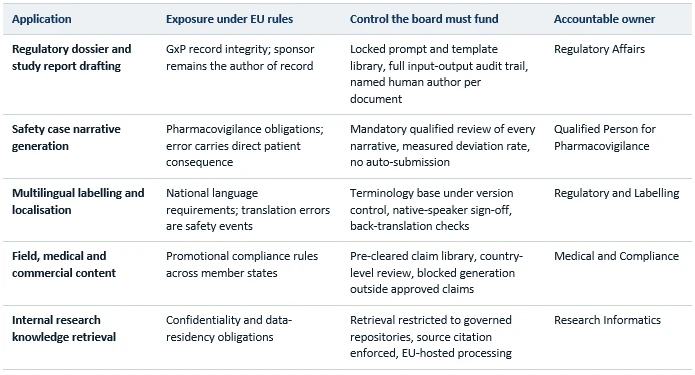
Table 1. Control requirements by application — the framework a European pharmaceutical board must fund before scaling.
Two principles run through the table. Authorship never transfers to the system: a named human remains responsible for every regulated document. And traceability is not optional — an organisation that cannot reconstruct which inputs produced a given output cannot defend that output to an inspector.
Five Decisions for the European Pharmaceutical Board
- Fund verification before generation. Review capacity, reconciliation tooling and reviewer interfaces determine whether drafting savings are ever banked. Approve them in the same budget line, not the following year.
- Restrict deployment to controlled sources. Generative tools perform reliably when assembling from a governed source of truth and unreliably when filling gaps. Draw that boundary explicitly and enforce it in the tooling.
- Treat multilingual capability as a European asset. Labelling, localisation and country-level content are a structural cost in Europe and an unusually good fit for the technology. Do not inherit an investment sequence designed for a single-language market.
- Name the human author on every regulated output. Accountability that is diffuse before an inspection becomes personal during one. Make it explicit in advance.
- Measure elapsed time to approval, never draft volume. Draft volume is the metric that makes a failing programme look successful. Elapsed time to an approved document is the only number worth reporting to a board.
Conclusion: The Constraint Has Moved
Generative AI has changed what is scarce inside a pharmaceutical company. The ability to produce a competent first draft of a complex regulated document — once a genuine bottleneck, guarded by specialist skill and long lead times — is no longer scarce. What is scarce, and becoming more so, is the qualified judgement required to verify that draft, take responsibility for it, and defend it to a regulator.
European leadership teams that grasp this will invest asymmetrically: modestly in generation, which is now largely a procurement decision, and heavily in verification, traceability and the redeployment of experienced professionals into review roles that carry more responsibility than the authoring work they replace. Those that do not will accumulate impressive volumes of unapproved output, an unchanged submission calendar and a persuasive internal narrative of transformation.
The distinction between the two will not be visible in an adoption statistic. It will be visible in elapsed time to approval, in inspection readiness, and eventually in the speed at which a European medicine reaches the patients waiting for it. That is the measure worth governing against, and it belongs on the board agenda now rather than after the first backlog forms.

Lakshmi is a science writer with a foundation in the laboratory. She earned her master's in biotechnology and trained through research internships at ICGEB (JNU) and DIPAS, DRDO, with her work appearing in the Egyptian Journal of Veterinary Sciences. Now APCRM-certified and part of the editorial team at Pharma Focus America and Pharma Focus Europe, she reports on pharmaceutical technology, research, and innovation — giving complex science a clear and confident voice for industry leaders.