From Visibility to Decision Readiness: The Next Phase of Quality Maturity in Pharma
Kavita Vengurlekar, Vice President - Data and Insights, Caliber Technologies
Pharma companies can now see quality issues much earlier, thanks to digital systems. But faster visibility hasn’t always meant faster decisions. This article explains why the next step in quality maturity is decision-readiness – connecting signals, risk, and context so teams can act sooner, with confidence, and without compromising compliance.
Introduction
Over the past decade, pharmaceutical organisations have made strong progress in both digitising and digitalising quality operations. Systems such as laboratory information management systems (LIMS), manufacturing execution systems (MES), and electronic quality management systems (eQMS) have strengthened traceability, embedded workflows, and enabled real time visibility across quality processes.
As a result, quality leaders today can see deviations, out of specification results, audit observations, and performance trends much earlier than before. They often identify deviations as they occur, rather than weeks later in periodic reviews.
Yet, despite this progress, a specific challenge persists.
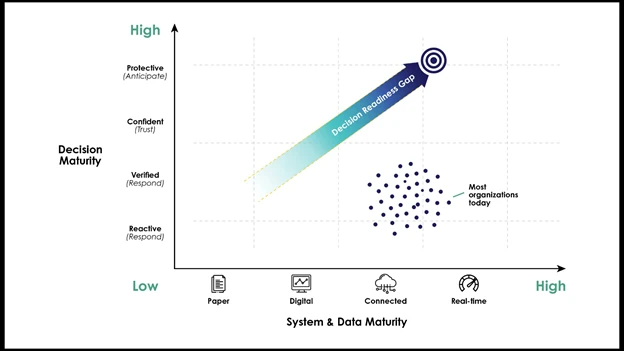
In areas such as batch release, investigations, and quality risk evaluation, signals now arrive earlier, but decisions still take time. This article focuses on that gap. It is not about the absence of systems or data. It is about a more nuanced constraint that becomes visible as quality environments mature: decision readiness. Decision readiness reflects an organisation’s ability to interpret signals in context, assess risk, align stakeholders, and act with confidence without compromising regulatory rigor.
When signals arrive early, but decisions still wait
In processes such as batch release, investigation closure, and risk evaluation, decision timelines often remain unchanged. Reviews remain sequential. Alignment takes time. Actions depend on confirmation rather than early indication.
Industry benchmarking and maturity models reinforce this observation. ISPE’s Pharma 4.0™[1] maturity framework highlights that organisations advance rapidly in system connectivity and data availability, yet decision making maturity lags. Improvements in visibility do not automatically translate into faster decisions unless workflows, escalation paths, and decision ownership evolve alongside the technology.
Regulatory expectations reflect this reality. Inspectors increasingly assess quality maturity through outcomes – right first time performance, cycle times, and effectiveness of response, not simply through the presence of digital infrastructure.
Frameworks such as ICH Q10 (pharmaceutical quality system) reinforce this shift by emphasising continuous monitoring, management responsibility, and timely action as foundations for continual improvement. [2]
The industry has become proficient at capturing and monitoring quality signals. Converting those signals into timely, confident decisions remains the harder part.
Where decision readiness breaks down
Quality decisions rarely slow down because data is missing. They slow down at the point where data must be interpreted, validated, and aligned across functions.
This breakdown appears consistently in three situations.
1. Data is available, but not yet actionable
In many organisations, the required data already exists when a signal appears:
- Process parameters captured through manufacturing execution systems.
- Analytical results generated and approved within laboratory information management systems.
- Event records, investigations, and corrective actions documented in electronic quality management systems.
Even with this visibility, teams pause before acting. They verify consistency across systems, confirm completeness, and review historical context.
Until this work is completed, the signal remains visible, but not actionable because its risk context is not yet fully understood.
This is not a limitation of technology. It reflects the gap between seeing information and trusting it enough to act.
2. Decisions depend on cross functional alignment
Quality decisions rarely sit within a single function. [2]
Batch release decisions, investigations, and risk assessments require input from production, quality assurance, quality control, and, in some cases, engineering or supply chain teams.
Each function brings a valid perspective. Alignment is not only about agreeing on data. It is about agreeing on risk and the appropriate level of response.
Even when the signal is clear, decisions depend on shared confidence. In this model, action waits for agreement rather than signal clarity.
3. Decision assurance is built repeatedly
In regulated environments, decisions must be defensible.
Teams need assurance that data is complete, consistent across systems, interpreted correctly, and aligned with regulatory expectations. This assurance is built through validation, cross checking, and structured review. [2]
These steps are essential. However, when the same data must be reconciled repeatedly across systems and teams, decision timelines extend. Data moves quickly. Decisions do not.
In practice, teams are not just validating data. They are establishing confidence in the risk behind the signal.
| “Decision readiness is not a data problem. It is the ability to act on trusted signals, with shared confidence, at the right moment.” |
Why is this challenge more visible now
This gap between signals and action is more visible today because quality systems have improved.
Digitalization has accelerated signal detection, expanded data availability, and enabled earlier identification of potential issues. What once surfaced during periodic reviews now emerges during routine operations.
At the same time, decision making models have not evolved at the same pace.
Industry perspectives, including practitioner guidance and operating model research from the International Society for Pharmaceutical Engineering (ISPE), continue to highlight the challenge of linking data to knowledge and decisions within quality systems.
Many organisations still operate with sequential review structures, function based decision ownership, and manual alignment points between teams.
These approaches ensured control when data arrived late. In real time environments, they introduce friction.
What does this impact in practice
Limited decision readiness affects both operational performance and compliance outcomes. This delays not only decisions, but also the organisation’s ability to respond proportionately to risk.
Batch release timelines remain extended even when all required data is available. Investigations take longer as teams validate and align repeatedly. Recurring issues persist because early signals do not consistently trigger early intervention.
Quality teams spend significant time consolidating information and verifying consistency instead of analysing risk and guiding action.
Regulators increasingly look beyond documentation quality. They assess how quickly organisations respond, how effectively decisions are made, and whether signals lead to timely and appropriate action.
In this context, decision readiness becomes a visible indicator of quality maturity.
What decision readiness looks like in practice
In mature environments, decision readiness evolves into risk-informed decision-making where signals, context, and risk are connected. In practice, four shifts make a measurable difference.
From fragmented data to contextual insight
Mature organisations connect related quality signals like events, trends, historical data, and cross functional impact into coherent views. Context reduces interpretation effort and shortens the path to decision confidence.
From sequential reviews to earlier risk alignment
Instead of step by step handoffs, teams align earlier through shared visibility. Discussions happen sooner, reducing waiting time without removing control.
From repeated validation to trusted data environments
Strong data integrity and traceability reduce the need for constant rechecking. Teams spend less time verifying information and more time making decisions.
From shared responsibility to defined ownership
Clear ownership improves accountability and speed. Teams understand who makes the decision, when it is made, and what information supports it.
Strengthening the quality ecosystem
Decision readiness reflects how well the quality ecosystem functions as a whole.
When systems, workflows, and teams operate in alignment:
- Signals are interpreted faster.
- Decisions are made with greater confidence.
- Actions follow without unnecessary delay.
This approach aligns closely with regulatory expectations under frameworks such as ICH Q10, which emphasise continuous monitoring, management responsibility, and timely response.
The system begins to function not just as a repository of events, but as a connected environment for interpreting risk and guiding action.
Enabling decision readiness
This is where integrated quality platforms increasingly play a role.
Manufacturing and life sciences operating model studies, including recent quality and operations transformation research by Deloitte, highlight that connecting signals, workflows, and decision context significantly reduces the effort required to build decision assurance across functions.
The advantage is not in generating more data. It is in making existing data usable at the point of decision.
From visibility to action
Pharma has made meaningful progress in improving visibility across quality operations. That phase delivered control, consistency, and transparency.
The next phase is more specific. It is ensuring that visibility leads to action quickly, confidently, and consistently.
Quality maturity will not be defined by how early signals appear, but by how effectively organisations interpret risk and act on it with confidence.
The shift ahead is clear. From visibility to decision readiness, to intelligence-driven, risk-informed quality.
References:
- https://ispe.org/initiatives/pharma-4.0
- https://link.springer.com/article/10.1208/s12248-026-01234-x

Dr. Kavita is a seasoned leader in data and insights with over 20 years of experience. A result-oriented solution designer, she specialises in data warehousing and big data analytics. Having led complex projects at IBM, Capgemini, and others, she drives impactful outcomes. Under her leadership, CaliberAPQR has gained strong industry recognition.