From Digital Transformation to Intelligent Pharma: How AI Is Reshaping Pharmaceutical Strategy
Arnab Kumar Biswas, Senior Business Analyst (Assistant Manager), Mendine Pharmaceuticals Pvt. Ltd
Pharmaceutical companies are moving from digital transformation towards decision intelligence. This article examines how AI, analytics and connected platforms can improve strategic decision-making, market intelligence and organisational learning, and argues that sustainable advantage will depend on combining machine intelligence with human judgement and accountability.
The Digital Paradox
Pharma's digital transformation has solved one problem well: access to information. Market signals arrive continuously. Commercial teams generate customer and channel data, medical and scientific functions accumulate new evidence, and supply and finance teams produce operational signals that enterprise platforms can now connect across what were once separate systems.
Yet more information does not automatically produce better decisions. An organisation can be highly digitised and still rely on slow reporting cycles, fragmented evidence, and decisions made only after a market change has become visible. Digital systems can make a business easier to observe without making it faster to learn.
This is the next challenge for pharmaceutical leaders: not simply where technology can automate work, but whether it can help an organisation recognise change earlier, interpret it more effectively, and act with greater confidence. Artificial intelligence matters here not because it is another powerful software tool, but because its strategic value lies in connecting signals, identifying patterns, testing scenarios and bringing relevant intelligence into decisions before opportunities or risks become obvious. The opportunity is to move from a digital organisation to an intelligent one.
From Digital to Intelligent
Digital transformation has changed how pharmaceutical organisations collect, store, share and analyse information. The next question is more consequential: what changes when that information reaches the decision-maker?
Digitisation puts information into digital form. Digitalisation uses technology to improve existing processes. Digital transformation changes capabilities and operating models. The emerging step, decision intelligence, connects data, analytics, AI, and human judgement to decisions that materially affect the organisation.
Decision intelligence is not a term specific to pharma. Industry analysts, Gartner among them, have described it since around 2022 as a cross-industry discipline for engineering how decisions are made and improved through feedback1, and organisations in banking, retail and logistics have already begun applying it. What follows is an attempt to translate that broader discipline into a form specific to pharmaceutical decision-making, where regulatory accountability, patient safety and scientific uncertainty give human judgement a weight it does not carry in most other industries.
The distinction matters because technology investment can easily become an end in itself. A dashboard can improve visibility, a workflow platform can reduce administrative effort, and an analytical model can improve a forecast, none of these outcomes, by itself, guarantees a better strategic decision. Decision intelligence starts with the decision rather than the technology: which decisions are slow, fragmented, uncertain, or poorly supported by evidence, and how data, analytics, and AI can improve them without removing the accountability of the people responsible.
For pharmaceutical leaders, this represents a shift in emphasis. The objective is not to place AI everywhere. It is to place intelligence where better judgement can materially change an outcome.
The Decision Intelligence Gap
Pharmaceutical organisations rarely suffer from a complete absence of information. The more common problem is that important signals are distributed across functions: commercial teams hold customer and channel data, market access teams monitor reimbursement developments, medical teams hold scientific and stakeholder insights, supply functions see operational constraints, finance sees resource implications, and regulatory teams track changes that can alter the path to market. Each dataset may be valuable in isolation, yet the strategic meaning often emerges only when several signals are considered together.
This creates a decision intelligence gap: the distance between a signal appearing somewhere in the organisation and the organisation recognising what that signal means.
AI can help narrow that distance. It can process large volumes of structured and unstructured information, identify relationships that merit attention, classify emerging signals and generate alternative scenarios. The value, however, does not arise from prediction alone. It arises when the resulting insight enters a decision process with a clear owner and a defined action.
A useful way to view this is the Pharma Decision Intelligence Loop:
Signal → AI-assisted interpretation → Human judgement → Strategic decision → Action → Outcome → Organisational learning.
The loop matters because the outcome of one decision becomes information for the next. An organisation that can close this loop reliably learns faster than one that waits for periodic reports. The objective is not to automate the entire loop; it is to shorten the distance between signal and informed action while preserving human accountability.
Where AI Creates Strategic Value
Market intelligence: the shift is from reporting what already happened, such as market share last quarter, to surfacing early signals — a competitor's field activity pattern that precedes a launch, or a prescribing shift among a small set of high-value accounts that predicts a larger move. The question changes from what happened to what is starting to happen, and whether it is worth acting on before it becomes obvious.
Commercial strategy: retrospective sales analysis has always told teams where they did well. Predictive segmentation and resource-allocation tools can now suggest where the next unit of commercial effort will do the most good, before the quarter closes rather than after.
R&D and medical affairs: analytical models that once sat in isolation, pharmacokinetics, adverse-event signals, literature review, are increasingly integrated into decision support that a cross-functional team can use together, rather than each function working from its own partial picture.
Operations: automation historically meant doing the same task faster. Predictive supply and quality analytics change what is being automated: not the task itself, but the early warning that lets a plant head intervene before a batch fails, rather than investigate after it does.
The common thread across all four is this: AI does not simply make existing activities faster. It changes what information is available at the moment a strategic choice has to be made, a more consequential kind of change than automation on its own.
The Human Advantage
The rise of AI does not remove the need for pharmaceutical judgement. In many important decisions, it increases its importance.
Pharmaceutical organisations operate within scientific uncertainty, regulatory requirements, patient-safety considerations and ethical constraints2. A model can identify a statistical relationship or recommend an apparently attractive option without understanding every consequence of acting on it. This is why the objective should not be autonomous decision-making everywhere, but a deliberate division of labour.
AI is well suited to scale, pattern recognition, classification and rapid processing. Human professionals remain essential for context, challenge, interpretation, accountability and decisions involving ambiguity. As routine analytical work becomes easier to automate, the value of experienced professionals shifts towards asking better questions, challenging model outputs, recognising unusual circumstances and deciding when evidence is insufficient, a judgement premium.
That premium also creates a management responsibility. Employees need enough AI literacy to understand how a model reached a recommendation, what data may be missing, where uncertainty lies and when an output should be challenged. Without that capability, organisations risk automation bias: a tendency to accept a machine-generated recommendation simply because it appears objective.
Human oversight should therefore be designed into the decision process from the beginning, with clear ownership, escalation rules and records of consequential decisions, rather than added as a final approval step after deployment.
Building the Intelligence Loop
Moving towards decision intelligence requires organisational discipline as much as technology. Five priorities offer a practical starting point.
Start with the decision. Identify decisions that are slow, fragmented or repeatedly dependent on manual analysis. Technology should solve a defined decision problem rather than create another technology project.
Connect the signals. Important information often remains divided between systems and functions. Data ownership, quality and context must be treated as strategic capabilities, not IT housekeeping.
Keep accountability human. Every important AI-supported decision should have a clearly identified owner, in line with the risk-based, accountable-use approach set out in the European Union's AI Act3.
Build the feedback loop. A decision should produce an outcome, and that outcome should become information for future decisions, turning isolated AI use cases into a learning system.
Measure decision performance. AI programmes are often evaluated through automation rates or hours saved. Leaders should also ask whether decisions are becoming faster, better informed and more accountable.
Regulators and health bodies are moving in a similar direction: the European Medicines Agency's reflection paper addresses AI use across the medicinal product lifecycle4, and OECD guidance treats responsible-AI principles as applicable well beyond any single sector5. The objective is a closed organisational loop in which signals become insight, insight informs judgement, decisions create outcomes, and outcomes improve future decisions.
Five Questions Leaders Should Ask
1. Which strategic decisions remain slower than the information available to support them?
2. Where are important signals still trapped inside functional or technological silos?
3. Which decisions could benefit from AI-assisted scenario analysis rather than retrospective reporting?
4. Where should human judgement remain mandatory, and who is accountable when an AI-supported recommendation is challenged?
5. Are AI investments improving decision quality, or simply increasing the amount of information available?
These questions shift the discussion from technology adoption to organisational capability and offer a practical test for whether a digital transformation programme is becoming an intelligent operating model or simply adding another layer of software.
The Next Digital Advantage
The first phase of digital transformation made information accessible. The next phase must make intelligence actionable. AI will not create that transition by itself; it requires connected data, capable people, appropriate governance and decision processes designed to act on useful intelligence.
The organisations that gain an advantage will not necessarily be those with the most AI tools or the largest datasets. They will be those that build a shorter, safer and more intelligent path from signal to judgement, decision, action and learning.
The future of pharmaceutical strategy is therefore unlikely to be defined by human judgement versus machine intelligence, but by how effectively the two are designed to work together. The next competitive advantage in pharma may not be having more intelligence. It may be learning faster from the intelligence already available.
|
SIGNAL → INTERPRETATION → JUDGEMENT → DECISION → ACTION The greater the delay between these stages, the greater the opportunity cost. |
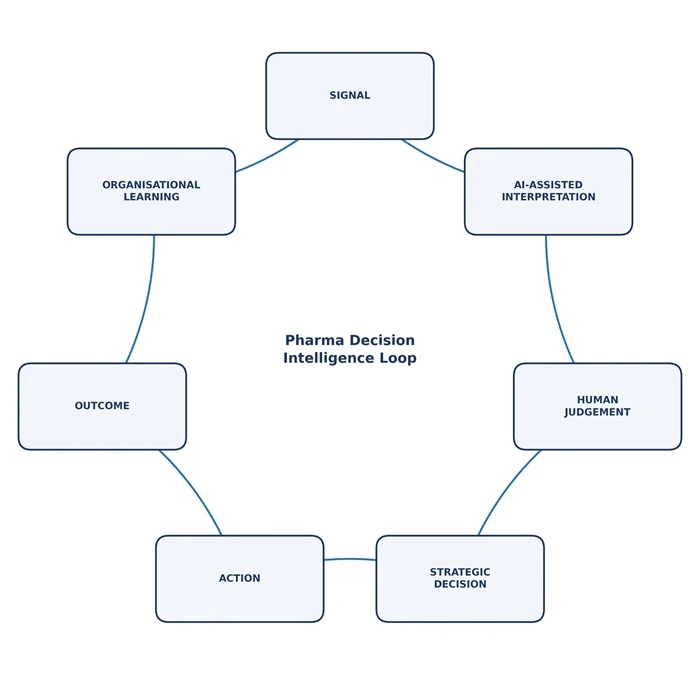
Figure 1. The Pharma Decision Intelligence Loop — a pharma-specific application of the decision intelligence discipline, developed for this article.(AI Generated)
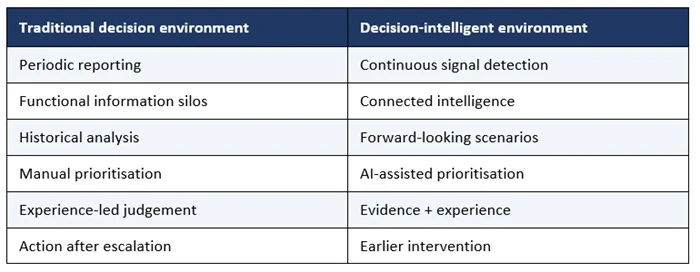
Table 1. From Traditional to Decision-Intelligent Decision-Making
| As routine analytical work becomes easier to automate, the value of experienced professionals shifts towards context, challenge, interpretation and accountability. |
References
1. Gartner. Decision Intelligence — technology trend definition and Magic Quadrant for Decision Intelligence Platforms.
2. World Health Organization. Ethics and governance of artificial intelligence for health.
3. European Union. Regulation (EU) 2024/1689 — Artificial Intelligence Act.
4. European Medicines Agency and Heads of Medicines Agencies. Reflection paper on the use of artificial intelligence in the medicinal product lifecycle.
5. Organisation for Economic Co-operation and Development. Artificial intelligence and responsible AI resources.

Arnab Kumar Biswas is a Senior Business Analyst (Assistant Manager) at Mendine Pharmaceuticals Pvt. Ltd., with seven years of experience in pharmaceutical strategy and commercial excellence, spanning field sales, business analysis, and strategic marketing. He writes on AI-enabled decision-making, commercial transformation, and the future of pharmaceutical growth, with a focus on translating emerging technologies into practical, executive-level strategies.