

Europe’s CGT Manufacturing Readiness: Challenges and Opportunities
Lakshmi, Editorial Team, Pharma Focus Europe
Europe has the science to lead in cell and gene therapy (CGT), yet manufacturing capacity, not discovery, increasingly decides which therapies reach patients. This article examines Europe’s CGT manufacturing readiness through regulatory, operational and commercial lenses, drawing on European Medicines Agency data, the 2025 pharmaceutical reform and the proposed European Biotech Act. A hospital-based CAR-T case study illustrates an alternative production model, and the article maps where C-suite leaders can capture value next.
Few areas of pharmaceutical innovation carry as much promise, or as much operational fragility, as cell and gene therapy. A single dose can replace years of chronic treatment, yet each batch may begin with a patient’s own blood, travel across borders under cryogenic conditions and depend on viral vectors produced in litres rather than tonnes. For European executives, the question is no longer whether these therapies work. It is whether Europe can make them reliably, affordably and at the pace that patients and payers now expect.
The regulatory record is sobering. Since the first product was authorised under the EU’s dedicated advanced therapy medicinal product (ATMP) framework in 2009, the European Medicines Agency’s expert committees have issued positive opinions covering 33 ATMPs as of mid-2026. Nine of those have since been withdrawn or not renewed, a reminder that approval marks the midpoint of the journey and that manufacturing economics often decide what happens next.
Meanwhile, the policy environment is shifting faster than at any point in two decades. A political agreement on EU pharmaceutical reform in December 2025, a proposed European Biotech Act published days later and a new regime for substances of human origin due in 2027 will all reshape how CGT products are made. This article assesses where Europe stands, where the pressure points lie and where opportunities await leaders who act early.
Approval Is Not the Finish Line: Europe’s CGT Manufacturing Reality Check
Europe’s attrition in advanced therapies is rarely a story of failed science alone. EMA data show that 51 marketing authorisation applications for ATMPs were submitted between 2009 and May 2026; 13 were withdrawn and seven received negative draft opinions. Behind many such outcomes sit recurring manufacturing questions. Can the process be validated at commercial scale? Can comparability be demonstrated after a process change? Can the product be supplied at a cost that national health systems will reimburse?
Unlike small molecules or even monoclonal antibodies, cell and gene therapies resist classic economies of scale. Autologous products are effectively batches of one. Every patient sample introduces biological variability, every manufacturing slot is booked against a clinical calendar, and every failed batch means a patient who must wait or, at worst, cannot be treated. Release testing that runs for days eats into tight vein-to-vein timelines, which is why potency and sterility assays have become strategic rather than purely technical concerns.
Europe adds a fragmentation problem of its own. A therapy may be manufactured in one Member State, administered in another and reimbursed under the rules of a third, each with its own expectations for hospital qualification, chain-of-identity documentation and certification. Manufacturing readiness therefore cannot be delegated to operations alone; it is a board-level question of market access, capital allocation and reputation.
Rewriting the Rulebook: Four Regulatory Shifts Redefining CGT Manufacturing
Sterile manufacturing raised the bar. The revised EU GMP Annex 1, in force since 25 August 2023, made a documented contamination control strategy a central expectation. Because most cell-based products cannot be terminally sterilised, the practical effect for CGT manufacturers has been a decisive push towards closed, automated and single-use processing and away from open manipulation in conventional cleanrooms.
The pharmaceutical reform resets timelines. On 11 December 2025, EU institutions reached political agreement on the broadest overhaul of pharmaceutical legislation in more than twenty years. The package amends the ATMP Regulation, cuts the standard assessment period from 210 to 180 days, makes marketing authorisations valid for an unlimited period by default and opens the door to regulatory sandboxes for medicines that cannot be developed under current rules. Most provisions are expected to apply from around mid-2028, leaving a narrow window to align quality systems and supply-continuity plans with tougher shortage-prevention obligations.
The Biotech Act puts a price on location. Published by the European Commission on 16 December 2025, the proposed European Biotech Act targets Europe’s scale-up gap. It would amend both the Clinical Trials Regulation and the ATMP Regulation, recognise centres of excellence for advanced therapies as strategic projects and offer a possible 12-month extension of supplementary protection for qualifying products where at least one manufacturing step, excluding packaging, quality testing and certification, takes place in the EU. If adopted in that form, where a CGT product is made would carry a direct intellectual-property reward for the first time. A parallel public–private initiative aims to mobilise €10 billion for biotech and life sciences across 2026 and 2027.
Starting materials come under new rules. Regulation (EU) 2024/1938 on substances of human origin will apply from 7 August 2027. Because donor and patient cells are the starting material for most cell therapies, apheresis units and tissue establishments that feed manufacturing networks will operate under updated quality and safety standards. Manufacturers reliant on hospital collection should treat 2027 as a supply-chain milestone, not merely a compliance date.
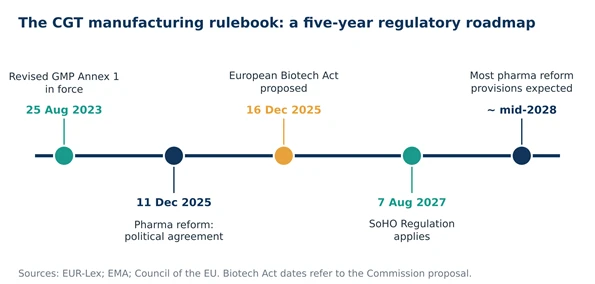
Figure 1. Key EU regulatory milestones shaping CGT manufacturing, 2023–2028.
Vein-to-Vein Under Strain: The Operational Fault Lines in CGT Production
Four fault lines dominate executive conversations. The first is viral vector supply. Lentiviral and adeno-associated vectors remain expensive and slow to produce, and a single quality deviation upstream can idle an entire downstream cell therapy schedule. The second is cost of goods. Labour-intensive processes, extensive quality control and cryogenic logistics keep per-patient costs high, squeezing margins in markets where health technology assessment bodies scrutinise every euro.
The third is talent. Aseptic operators, qualified persons with ATMP experience and analytical scientists versed in potency assays are scarce, and competition for them intensifies whenever a new facility opens. The fourth is capital risk. Purpose-built CGT facilities are costly, and a single late-stage clinical failure can leave capacity stranded. Together, these pressures explain why flexible, modular and partnership-based manufacturing strategies are gaining ground over large single-product plants.
Pipeline Pressure: The Demand Signals CGT Manufacturing Leaders Should Read
Regulatory activity is a useful proxy for future manufacturing demand. EMA scientific advice procedures for ATMPs rose from 53 in 2022 to 76 in 2025, an increase of roughly 43% in three years, with a further 29 recorded between January and May 2026. Access to the agency’s PRIME scheme points the same way: of 184 ATMP requests discussed since 2016, 78 have been granted eligibility. Type II variations for authorised ATMPs, which can cover changes to manufacturing processes, sites and controls as well as new clinical data, climbed from 33 in 2024 to 59 in 2025. Each signal foreshadows clinical and commercial batches that someone in Europe will have to make.
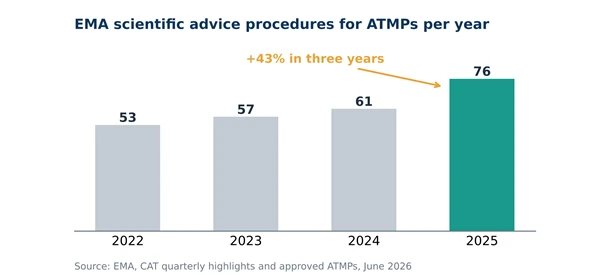
Figure 2. EMA scientific advice procedures for ATMPs, 2022–2025.
Case Study: How a Barcelona University Hospital Built a Point-of-Care CAR-T Blueprint
In February 2021, an autologous anti-CD19 CAR-T therapy developed entirely within a university hospital in Barcelona became the first CAR-T developed in Europe to be authorised by a national regulator outside the centralised marketing authorisation pathway. Spain’s medicines agency granted approval under the EU hospital exemption for adults older than 25 with relapsed or refractory acute lymphoblastic leukaemia.
The route was deliberate. The hospital obtained GMP approval for its in-house manufacturing in 2017, built its own vector and cell production capability and filed its hospital-exemption dossier in February 2020. After authorisation, a price of €89,270 per treatment was agreed with the Spanish Ministry of Health in June 2021, and a dedicated pharmacovigilance programme followed. In December 2021, the therapy became the first academic product to receive PRIME eligibility from the EMA, and it was later selected as the first participant in the agency’s pilot offering enhanced regulatory support to academic and non-profit ATMP developers.
Three lessons stand out for industry leaders. First, manufacturing close to the patient can simplify logistics and give clinicians more control over scheduling. Second, early and sustained engagement with regulators turned a national exemption into a bridge towards EU-wide authorisation rather than an end point. Third, decentralised production succeeds only when its quality systems are as rigorous as industrial ones; replicating that rigour across multiple sites is the next frontier.
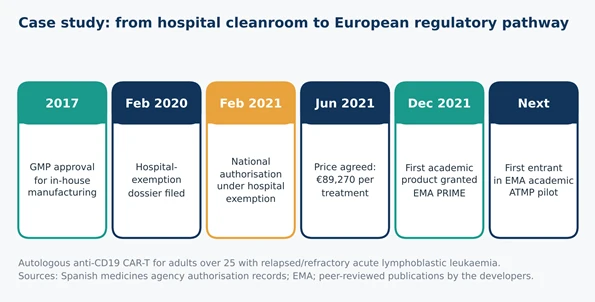
Figure 3. Key milestones in the hospital-developed CAR-T pathway.
Where the Value Lies: Five Opportunity Zones in European CGT Manufacturing
Closed and automated processing is the most immediate lever. Integrated, closed platforms reduce cleanroom grade requirements, cut manual interventions and support the contamination control logic Annex 1 now expects, while easing the talent bottleneck.
Distributed point-of-care networks offer a second route. Linking hospital-based production units under a single quality umbrella could shorten turnaround and broaden access, provided comparability and oversight are engineered in from the start.
Digital and AI-enabled quality is the third. Electronic batch records, in-line analytics and data-driven release decisions can compress review times. The proposed Biotech Act asks the EMA to issue guidance on using advanced technologies, including AI, in manufacturing, which should give early adopters greater regulatory certainty.
Vector and starting-material sovereignty is the fourth. Securing European vector capacity and resilient cell-collection networks reduces exposure to single points of failure and aligns with the policy emphasis on supply security. Finally, academic–industry alliances can turn Europe’s strong translational centres into commercial engines, especially if centres of excellence for advanced therapies gain the strategic status the Biotech Act proposes.
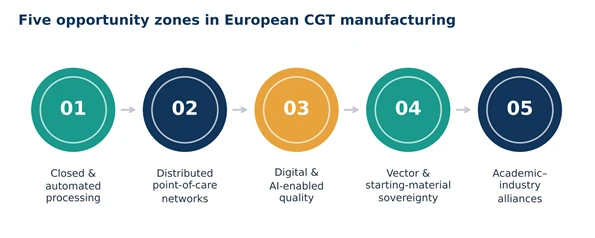
Figure 4. Five opportunity zones for European CGT manufacturing leaders.
Conclusion
Europe’s CGT challenge has shifted from discovery to delivery. Strong science, an experienced regulator and a growing pipeline give the region a genuine opportunity, but manufacturing readiness will determine whether that pipeline becomes accessible treatment or another set of withdrawn authorisations. The coming 24 months are pivotal: the pharmaceutical reform will move towards application, the Biotech Act will be negotiated, and the rules for substances of human origin take effect in August 2027.
For C-suite leaders, the agenda is clear. Treat manufacturing as a strategic asset rather than a cost centre, invest in closed and digital processes before capacity is needed, build partnerships that spread capital risk, and engage regulators early. Companies that align their production strategy with Europe’s evolving framework now will be best placed to turn scientific leadership into reliable, affordable therapies for patients across the continent.

Lakshmi is a science writer with a foundation in the laboratory. She earned her master's in biotechnology and trained through research internships at ICGEB (JNU) and DIPAS, DRDO, with her work appearing in the Egyptian Journal of Veterinary Sciences. Now APCRM-certified and part of the editorial team at Pharma Focus America and Pharma Focus Europe, she reports on pharmaceutical technology, research, and innovation — giving complex science a clear and confident voice for industry leaders.