Digital Twins in Pharmaceutical R&D: Simulating Biology for Faster Innovation
Lakshmi, Editorial Team, Pharma Focus Europe
Digital twins are continuously updated computational replicas of molecules, patients, processes and plants. Moving out of heavy engineering and into pharmaceutical research, they allow biology to be simulated before capital is committed to it, compressing development cycles and retiring risk earlier. This article maps where pharmaceutical digital twins already earn their keep, what still limits them, and how R&D leaders can make simulated evidence credible to regulators.
Introduction:
When the Pharmaceutical Laboratory Learns to Predict Itself
For most of its modern history, pharmaceutical research has been an experimental science with a statistical conscience. Build the molecule, dose the animal, run the trial, count the failures, and let the survivors pay for everything that did not make it. That arrangement has become progressively harder to defend. Attrition remains concentrated in the phases where money has already been spent, biology has grown more complex as the industry moves into cell therapy, gene therapy and multi-specific biologics, and payers across Europe are less willing than ever to absorb the cost of that inefficiency in the launch price.
Digital twins propose something different. Instead of running an experiment and then learning from it, a digital twin lets an organisation run the experiment in silico first, watch where it breaks, and commit physical resources only to the versions worth testing. The concept arrived from aerospace and industrial engineering, where virtual replicas of turbines and airframes have been paired with their physical counterparts for two decades. Its migration into pharmaceutical R&D is more difficult, because a cell line is less predictable than a jet engine and a patient far less predictable still. It is also more valuable, for exactly the same reason.
What a Pharmaceutical Digital Twin Really Is — and What It Is Not
A digital twin is not a model, a dashboard, or a simulation run once at the start of a programme. Those are static artefacts. A digital twin is a virtual representation of a specific physical entity that is fed by live or near-live data from that entity, updates itself as the entity changes, and returns predictions that alter what happens to the entity next. The defining feature is the closed loop: measurement flows into the model, the model returns a decision, the decision changes the physical system, and the resulting data recalibrates the model again.
In a pharmaceutical setting, the physical entity might be a perfusion bioreactor, a tablet press, an entire fill-finish suite, a tumour, a patient's cardiac conduction system, or the population enrolled in a study. The virtual side is rarely a single algorithm. Most working pharmaceutical twins are hybrids, pairing mechanistic models that encode known biology and physics with machine learning layers that absorb the residual variation nobody can yet write an equation for. The mechanistic component gives the twin explanatory power and the ability to extrapolate beyond observed conditions. The statistical component gives it accuracy where the science is incomplete.
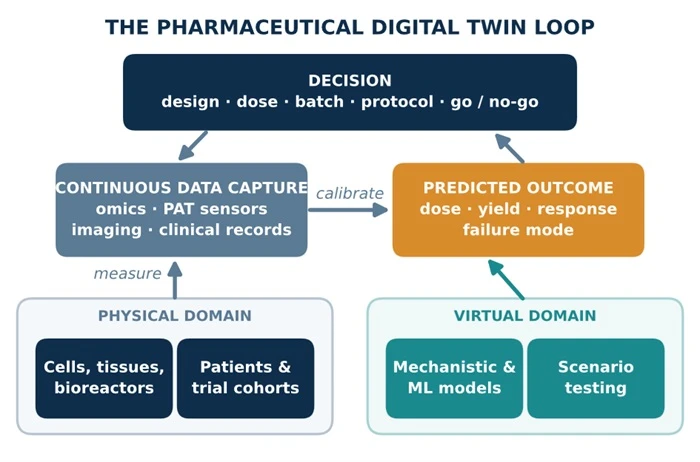
Figure 1: The closed loop that separates a true pharmaceutical digital twin from a one-off simulation.
From Molecule to Patient: Mapping the Digital Twin Across the Pharmaceutical Pipeline
Digital twins are not equally mature across the pipeline, and R&D leaders who assume otherwise tend to fund the wrong pilot. At the discovery end, virtual representations of target proteins and their binding environments now routinely inform candidate ranking, but they remain closer to advanced predictive modelling than to a continuously updated twin, because there is no persistent physical counterpart streaming data back.
The picture changes sharply once a programme has an asset. In preclinical development, quantitative systems pharmacology models allow teams to represent an entire disease pathway and test how the candidate perturbs it under conditions no animal study would practically cover. Physiologically based pharmacokinetic modelling, arguably the most established form of biological twin in the industry, reconstructs absorption, distribution, metabolism and elimination in a virtual physiology detailed enough that European and American regulators already accept it in place of certain interaction and paediatric studies. Downstream, in chemistry, manufacturing and controls, twins of unit operations and whole production trains are the most industrially mature application of all.
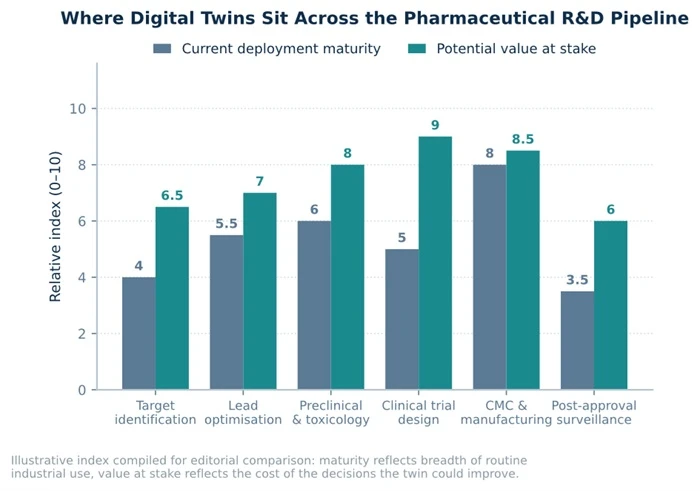
Figure 2: Deployment maturity and value at stake vary widely by pipeline stage; the widest gaps mark the strongest investment cases.
The Virtual Patient: How Digital Twins Are Redrawing the Pharmaceutical Clinical Trial
The most consequential application, and the least settled, is the virtual patient. Here the twin is a computational representation of an individual or of a synthetic population, built from baseline characteristics, disease history, imaging, molecular profiling and longitudinal outcome data drawn from earlier studies and real-world sources. Once such a population exists, a protocol can be rehearsed before a single participant is screened. Teams can test how the trial behaves under different inclusion criteria, dosing intervals, endpoint definitions and dropout assumptions, and identify the design choices that quietly destroy statistical power.
The more radical use is the simulated control arm. In rare disease, paediatric indications and oncology settings where randomising to placebo is ethically fraught or practically impossible, virtual controls generated from patient twins can supplement or partially replace a conventional comparator group. That reduces the number of participants exposed to a treatment that will not help them and shortens recruitment in populations where recruitment is the binding constraint. It also shifts the burden of proof onto the model, which is where the difficulty begins: a regulator evaluating such a submission is no longer only assessing a drug, but assessing whether the simulated patients were entitled to exist.
A digital twin does not remove uncertainty from pharmaceutical development. It relocates uncertainty from the clinic, where it is expensive and slow to resolve, to the model, where it can be interrogated cheaply and repeatedly.
Twinning the Process: Simulating the Batch Before the Bioreactor Is Filled
If the virtual patient is the frontier, the process twin is the workhorse. Biologics manufacturing generates dense, structured, well-instrumented data of exactly the kind digital twins require. Temperature, pH, dissolved oxygen, feed rates, metabolite concentrations and spectroscopic readings arrive continuously from process analytical instrumentation, and the underlying kinetics are reasonably well understood. That combination makes a bioreactor a far more tractable subject than a human being.
A mature process twin predicts titre, glycosylation profile and impurity formation hours ahead of the physical batch, allowing operators to adjust feeding strategy before a deviation becomes a deviation report. It also transforms scale-up. Rather than discovering at 2,000 litres that a process optimised at bench scale behaves differently under altered mixing and shear conditions, teams can simulate the transfer, identify the parameters that will drift, and design the campaign around them. For organisations moving assets between development sites and contract partners across Europe and Asia, that predictive tech-transfer capability is often where the business case closes first.
Case in Point: The Biologics Programme That Ran Its Scale-Up Twice
The following account is a composite, assembled from patterns that have become common among mid-sized European biologics developers and presented without identifying details.
A developer with a monoclonal antibody entering late preclinical development faced a familiar squeeze: an aggressive first-in-human target date, a single in-house pilot facility, and a process that had never been run above 200 litres. Traditionally the team would have booked sequential engineering runs and absorbed whatever the scale-up revealed. Instead, the group invested eight months in building a hybrid twin of the upstream process, combining a mechanistic cell growth and metabolism model with a machine learning layer trained on four years of archived batch records from adjacent programmes.
The twin was calibrated against three bench-scale runs, then used to simulate several hundred scale-up scenarios spanning agitation rates, feed timing and seed density. It predicted that two of the four candidate feeding strategies would depress a critical quality attribute at production scale in ways invisible at bench scale. Those strategies were dropped before any physical run was scheduled. The team executed two engineering runs instead of the five originally budgeted, and the second confirmed the twin's predicted titre within a narrow margin. Process development compressed by roughly eight months, and the same twin was subsequently reused to support the comparability package when a second manufacturing site was brought online.
The instructive detail is not the time saved but the reason it was saved. The organisation did not build a better bioreactor. It built a credible way to be wrong cheaply, and then spent its physical capacity only on the experiments that remained genuinely uncertain.
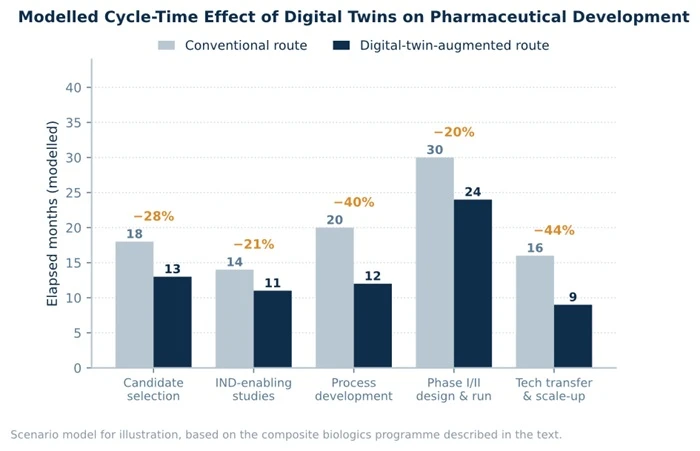
Figure 3: Modelled cycle-time effect across development phases, based on the composite programme described above.
The Hard Part: Why Pharmaceutical Digital Twin Programmes Stall
Most digital twin initiatives in pharmaceutical R&D fail long before anyone questions the science. They fail because the data cannot be assembled. Decades of research generate records in instrument-specific formats, in unstructured batch documentation, in laboratory notebooks and in validated systems that were never designed to export anything. A twin needs contextualised, machine-readable, time-aligned data, and the effort to produce it is typically underestimated by a wide margin.
The second constraint is validation. A model that predicts well on historical data may fail entirely on a new construct, a new indication or a new site, and organisations rarely define in advance what accuracy would be sufficient for the decision the twin is meant to inform. The third is ownership. A digital twin is a living asset requiring continuous recalibration, and when the pilot budget expires and no function has been given responsibility for maintaining it, the model silently drifts out of correspondence with the thing it was meant to represent.
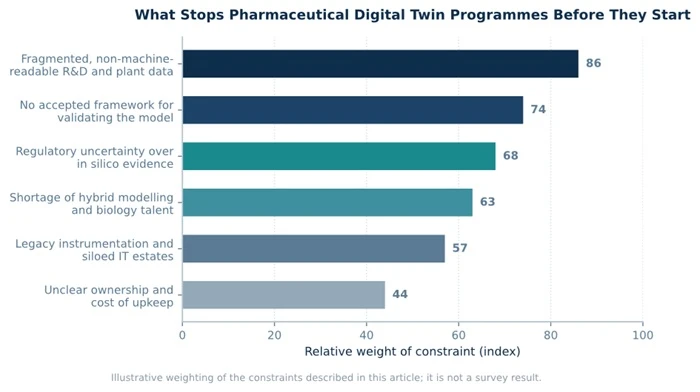
Figure 4: The constraints that most often halt pharmaceutical digital twin programmes are organisational rather than scientific.
Making Simulated Pharmaceutical Evidence Regulator-Ready
Regulators in Europe and the United States are considerably more receptive to model-informed evidence than the industry's caution suggests, provided the modelling is presented with the same rigour expected of an experiment. Model-informed drug development pathways exist precisely to accommodate submissions where simulation carries part of the evidentiary weight, and physiologically based pharmacokinetic analyses have already replaced specific clinical studies in approved applications.
What determines acceptance is credibility assessment. Sponsors must state what question the model is answering, how consequential that answer is to patient safety, and what verification and validation evidence supports its use at that level of consequence. A twin used to prioritise internal experiments needs far less justification than one used to waive a study. Engaging agencies early, before the modelling architecture is locked, remains the single most reliable predictor of whether simulated evidence survives review. Sponsors who present a finished model and ask for endorsement generally receive questions instead.
Conclusion:
The Pharmaceutical Enterprise That Rehearses Its Own Future
Digital twins will not compress pharmaceutical development by replacing biology with computation. Biology remains stubbornly resistant to full representation, and any organisation promising otherwise is selling something. What twins change is the sequence of commitment. They move the point at which an organisation learns that an approach will fail from after the money has been spent to before, and in a portfolio where the cost of late failure dominates everything else, that shift compounds quickly.
For executives, the practical implication is that this is not primarily a modelling investment. It is a data, validation and accountability investment that happens to produce models. The organisations pulling ahead are not those with the most sophisticated algorithms; they are those that made their process and clinical data machine-readable, defined in advance what a trustworthy prediction looks like, and assigned someone to keep the twin honest after the pilot ended. The pharmaceutical company that can rehearse its own development programmes before running them will not merely be faster. It will be taking a fundamentally different class of risk than its competitors, and doing so with its eyes open.

Lakshmi is a science writer with a foundation in the laboratory. She earned her master's in biotechnology and trained through research internships at ICGEB (JNU) and DIPAS, DRDO, with her work appearing in the Egyptian Journal of Veterinary Sciences. Now APCRM-certified and part of the editorial team at Pharma Focus America and Pharma Focus Europe, she reports on pharmaceutical technology, research, and innovation — giving complex science a clear and confident voice for industry leaders.