Digital Bioprocessing: AI and Automation in Biologics Manufacturing
Lakshmi, Editorial Team, Pharma Focus Europe
Biologics manufacturing is being rewritten by in-line sensing, machine learning and closed-loop automation. Digital bioprocessing links real-time process data to predictive models that adjust bioreactors while a batch is still running, reducing variability, cost per gram and release timelines. This article examines the technology stack, the economics, the regulatory expectations and the organisational barriers European biopharmaceutical leaders must address to move from isolated pilots to plant-wide capability.
Introduction: Why Digital Bioprocessing Became a Boardroom Question
For most of the modern biologics era, a mammalian cell culture batch was managed the way a ship is navigated in fog: a fixed course, periodic position checks and very little ability to correct mid-voyage. Operators set a feed strategy, pulled offline samples once or twice a day, and waited for the analytics to say whether the batch had drifted. By the time a titre shortfall or a glycosylation shift appeared in the data, the biology that caused it had already happened.
Digital bioprocessing dismantles that delay. By combining in-line sensing, contextualised manufacturing data and machine learning models capable of acting on it, a biologics suite can now detect the early signature of a failing batch and correct it while the cells are still growing. The commercial consequence is significant: in a modality where a single failed 2,000-litre run can cost more than a million euros in materials, capacity and schedule, the ability to intervene in real time changes the economics of an entire facility.
The Cost-per-Gram Problem Digital Bioprocessing Was Built to Solve
European biologics manufacturers face a squeeze that conventional lean improvement does not resolve. Payer pressure is compressing biologic prices, biosimilar competition is arriving sooner, and the pipeline is shifting toward modalities — bispecifics, antibody-drug conjugates, cell and gene therapies — that are harder to make and produced in smaller volumes. Fixed-cost-heavy plants built for blockbuster monoclonals are being asked to run diverse, lower-volume, higher-complexity products without a proportional rise in cost.
The traditional levers are largely exhausted. Cell line engineering and media optimisation have already delivered titres that would have seemed implausible fifteen years ago. What remains stubbornly expensive is variability: the batches that deviate, the investigations they trigger, the quality oversight they absorb and the capacity held in reserve to absorb their consequences. Deviation management and quality assurance routinely account for a fifth to a third of biologics conversion cost.
This is precisely the territory where AI and automation operate. Digital bioprocessing does not primarily promise a better cell line. It promises that every batch behaves like the best batch — that process variation is detected early, corrected automatically and documented without human transcription. For a European C-suite weighing capital allocation, that is a more durable proposition than incremental yield.
Inside the Digital Bioprocessing Stack: From Raman Probes to Self-Correcting Bioreactors
Digital bioprocessing is often discussed as a single technology purchase. It is not. It is a stack of five interdependent layers, and weakness in any one of them caps everything above it.
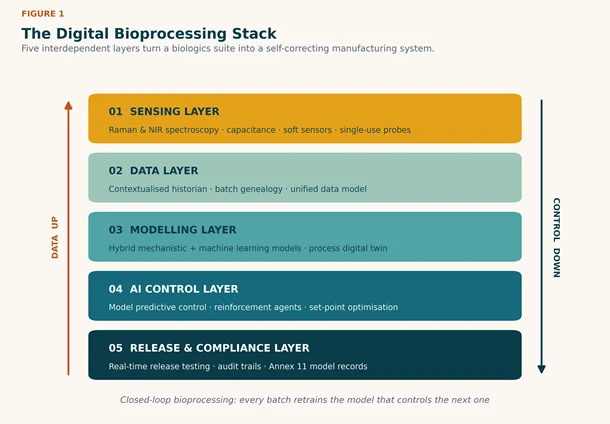
Figure 1 — The five layers of a digital bioprocessing architecture, from in-line sensing to real-time release.
At the base sits the sensing layer. In-line Raman and near-infrared spectroscopy, dielectric capacitance probes and single-use sensors now allow continuous measurement of glucose, lactate, viable cell density and, increasingly, quality attributes that once required offline assays. Where hardware sensors are impractical, soft sensors infer the unmeasurable from the measurable.
Above it sits the data layer, and this is where most programmes quietly fail. Raw process signals are useless until they are contextualised — tied to a batch, a piece of equipment, a recipe step and a raw-material lot. Without that genealogy, a model cannot separate a true process signal from an instrument artefact.
The modelling layer converts contextualised data into prediction. The most effective architectures in bioprocessing are hybrid: mechanistic kinetic models that encode known biology, wrapped in machine learning layers that capture what the mechanism does not explain. Purely statistical models generalise poorly across scales and cell lines; hybrid models extrapolate far more reliably.
The control layer closes the loop, translating prediction into a feed rate, a temperature shift or a chromatography step change. The release and compliance layer then captures the evidence — every model version, input and control action — in a form an inspector can follow.
AI in Biologics Manufacturing: Moving Beyond the Golden Batch
Multivariate batch monitoring has existed in biopharmaceutical plants for two decades. The golden-batch approach compares a running process against an envelope derived from historically successful runs and raises an alarm when it strays. It is useful, and it is fundamentally retrospective: it tells an operator that something has changed, not what to do about it.
AI shifts bioprocess control from alarm to action. Model predictive control uses a forward-looking process model to compute the feed or environmental adjustment that will land the batch on target, then applies it continuously. Reinforcement learning approaches, still largely at pilot stage, go further by discovering feeding strategies no human would have designed.
The more immediate value lies away from the bioreactor. Machine learning applied to deviation records compresses investigation cycles by clustering events and surfacing probable root causes across historical batches. Vision systems inspect vials and closures at a consistency human inspectors cannot sustain. Predictive maintenance models flag failing pumps and valves before they take a suite offline. Language models draft and cross-check batch record narratives.
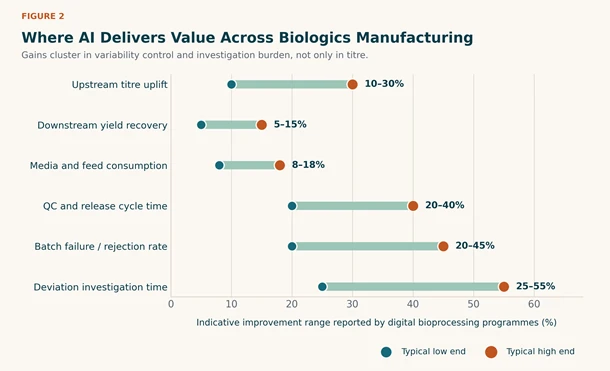
Figure 2 — Reported improvement ranges from AI applications across upstream, downstream and quality operations.
Executives evaluating AI in biologics manufacturing should note the pattern in Figure 2. The largest reported gains are not in titre. They are in the elimination of rework, investigation burden and release delay — costs that never appear on a process flow diagram yet dominate the conversion cost line.
Automation and Continuous Biomanufacturing: Where the Economics Actually Shift
AI and automation are frequently conflated, but they reward different investments. AI improves decisions; automation removes the human hand from execution. The compounding effect appears when both are applied to intensified and continuous bioprocessing.
Perfusion-based upstream processing, connected to continuous capture chromatography, changes the physics of a biologics facility. Smaller bioreactors run for longer at far higher cell densities, product is harvested continuously rather than in discrete lots, and the downstream train is sized for steady flow rather than peak surge. The facility produces substantially more drug substance per square metre of cleanroom.
Continuous processing, though, is viable only with real-time control. There is no opportunity to sample, wait and decide when material moves through the train hour by hour — which is why continuous biomanufacturing and digital bioprocessing have become, in practice, the same programme. Process analytical technology provides the measurement, automated control provides the response, and real-time release testing converts accumulated evidence into a shortened quality decision.
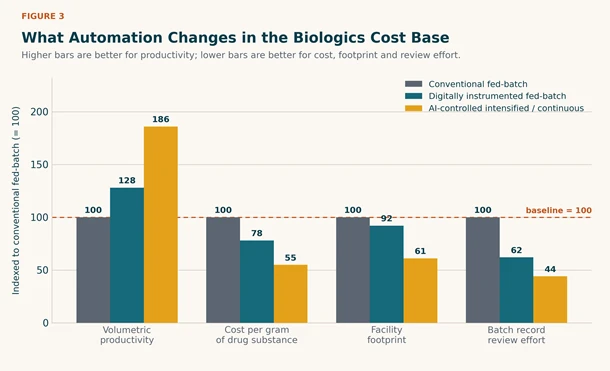
Figure 3 — Indexed comparison of conventional, digitally instrumented and AI-controlled continuous biologics manufacturing.
Figure 3 shows the indexed effect across four dimensions European operations leaders track closely. The productivity gain is visible, but the more consequential numbers are footprint and batch record review effort — the two costs that most constrain European sites in expensive, space-limited facilities.
Case Study: Rebuilding Upstream Control Around AI at a European Biologics Site
A mid-sized biologics site in Western Europe producing a commercial monoclonal antibody across four 2,000-litre single-use bioreactors illustrates how these programmes unfold in practice.
The site's problem was consistency, not capacity. Titre varied by more than 20 per cent between campaigns, two to three batches a year were rejected for aggregate levels outside specification, and each rejection triggered an investigation that occupied quality and manufacturing science teams for weeks.
The programme began with data rather than algorithms. Eighteen months of historical batch data — process parameters, raw material certificates, environmental monitoring and quality results — were consolidated into a single batch-genealogy model. That exercise alone, before any AI was deployed, revealed that aggregate excursions correlated strongly with a specific combination of feed timing and dissolved oxygen profile during late exponential phase.
In-line Raman probes were then qualified for glucose and lactate, and a hybrid mechanistic-machine learning model was trained to predict end-of-batch titre and aggregate level from day-four process signatures. The model initially ran in advisory mode: operators saw the prediction and decided. After two campaigns of demonstrated accuracy, feed control was placed under model predictive control within a validated design space.
Across the following year, campaign-to-campaign titre variability fell by roughly half, no batches were rejected for aggregation, and deviation investigation time dropped sharply as the contextualised data set turned root-cause analysis into a query rather than an archaeology project.
The Regulatory Reality: Validating AI Models Under European GMP Expectations
The most common executive objection to digital bioprocessing is regulatory. It is also the most overstated, with one important caveat.
European regulators have been explicit that quality by design, process analytical technology and enhanced process understanding are welcome. The GMP framework for computerised systems expects risk-based validation proportional to impact, and international quality guidelines already accommodate adaptive control within a defined design space. A model adjusting a feed rate inside an approved range is not, in regulatory terms, a radical proposition.
The genuine difficulty is lifecycle management of models that learn. A validated system is expected to behave predictably; a continuously retraining model, by definition, changes. The workable answer separates the two concerns: lock the model version used in GMP control, validate it as a configured system, retrain offline, and treat each new version as a change requiring assessment and, where material, regulatory notification.
Three practices consistently reassure inspectors: complete data lineage from raw signal to control action; documented model performance monitoring with defined limits that trigger human intervention; and a clearly specified fallback to conventional control if the model degrades. Sites that build these in from the design phase meet far less friction than those retrofitting them after a pilot succeeds.
Why Digital Bioprocessing Programmes Stall — and What Separates the Sites That Scale
The gap between digital bioprocessing ambition and deployment remains wide, and the reasons are organisational far more often than technical.
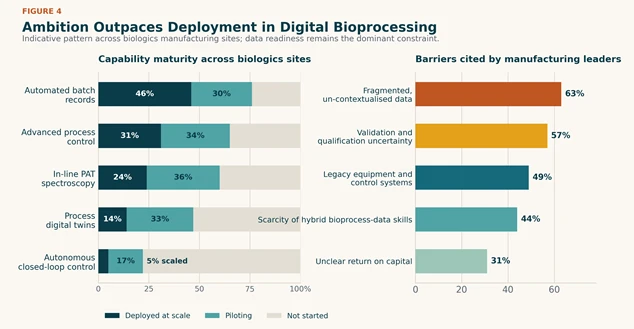
Figure 4 — Capability maturity across biologics sites, set against the barriers manufacturing leaders most often cite.
Data fragmentation is the dominant constraint. A typical biologics site runs distributed control systems, a manufacturing execution system, a laboratory information management system, environmental monitoring and enterprise planning software that were never designed to describe the same batch. Until those sources are unified around a common batch model, every analytics project pays the same integration cost again.
Legacy equipment compounds the problem. Control systems installed a decade or more ago frequently cannot expose data at the frequency advanced control requires, or cannot accept external set-points at all. Retrofit is possible but rarely cheap.
Scarcity of hybrid skills is the quietest barrier. Digital bioprocessing needs people who understand both cell culture physiology and machine learning validation, a combination neither engineering nor data science curricula reliably produce.
What distinguishes sites that scale is sequencing. They fix data contextualisation first, choose a single high-value process problem rather than a platform, keep the first model in advisory mode long enough to earn operator trust, and resource change management as seriously as technology. Programmes that begin with a platform purchase and search for a use case afterwards rarely reach production.
Conclusion: Automation Is the Manufacturing Strategy, Not the Support Function
Digital bioprocessing is not an IT modernisation exercise attached to a manufacturing plant. It is a change in how biologics are made — from processes that are monitored and documented to processes that are predicted and controlled.
For European biopharmaceutical leaders the strategic case rests on three points. It converts variability, the most expensive and least visible cost in biologics manufacturing, into a controllable parameter. It is the enabling condition for intensified and continuous processing, where the step change in cost per gram and facility footprint actually lies. And it builds the data foundation every subsequent capability — real-time release, autonomous operations, plant-wide digital twins — will depend on.
The sites holding a cost advantage at the end of this decade will not necessarily be those buying the most sophisticated algorithms. They will be those investing now in contextualised data, in-line measurement and the validation discipline that makes automated decisions defensible. That work is unglamorous, cumulative and difficult to accelerate later. It is also the point at which digital bioprocessing stops being a pilot and becomes a manufacturing strategy.

Lakshmi is a science writer with a foundation in the laboratory. She earned her master's in biotechnology and trained through research internships at ICGEB (JNU) and DIPAS, DRDO, with her work appearing in the Egyptian Journal of Veterinary Sciences. Now APCRM-certified and part of the editorial team at Pharma Focus America and Pharma Focus Europe, she reports on pharmaceutical technology, research, and innovation — giving complex science a clear and confident voice for industry leaders.