Data-Driven Pharma: Enterprise AI Strategies for R&D, Quality, and Operations
Lakshmi, Editorial Team, Pharma Focus Europe
Pharmaceutical enterprises have outgrown the pilot phase of artificial intelligence, yet value remains trapped inside individual functions. This article examines how European pharmaceutical leaders can build enterprise AI strategies that connect research, quality and operations through a shared data foundation, a governed model portfolio and a workforce equipped to act on machine output. Architecture and accountability, not algorithms, now separate genuine data-driven performance from expensive experimentation.
Introduction: Why Pharmaceutical AI Has Outgrown the Proof of Concept
Few boardrooms in European pharma still need convincing that artificial intelligence matters. The argument has moved on. The uncomfortable question now facing chief executives, chief scientific officers and heads of operations is why an organisation running eighty or ninety AI initiatives can rarely point to eighty or ninety changes in how it discovers, releases or ships a medicine.
The answer is rarely technical. Model performance is seldom the binding constraint; most pharmaceutical use cases are solved problems in machine learning terms. What fails is everything around the model. Data sits in systems that were never designed to speak to one another. Ownership is ambiguous. Validation pathways are improvised for each new tool. Business users are handed a prediction with no authority to act on it. The result is a portfolio of demonstrations that impress visitors and change nothing.
Enterprise AI is therefore less a technology programme than an act of organisational design. It asks a pharmaceutical company to decide, deliberately, how information moves across the boundary between research, quality and supply — boundaries that decades of functional specialisation have made deliberately firm. The companies pulling ahead in Europe are not those with the most sophisticated algorithms. They are those that have made the fewest excuses about their data.
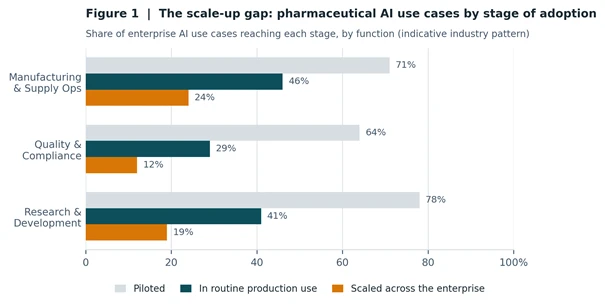
Figure 1: Most pharmaceutical AI use cases stall between pilot and enterprise scale — the gap is widest in quality and compliance.
The Data Foundation: Pharma's AI Ambition Is an Architecture Decision First
Every serious enterprise AI strategy in pharmaceuticals eventually collapses back into a question about data architecture. A model that predicts dissolution failure is only as good as the contextualised process data feeding it. A model that ranks trial sites needs recruitment history, protocol complexity and monitoring findings expressed in a common vocabulary. When each function maintains its own definitions of a batch, a site or a product, cross-functional AI becomes a translation exercise rather than an analytical one.
The practical response is a shared semantic layer: harmonised master data, an agreed ontology for products, materials, equipment and studies, and lineage that records where every value came from and what happened to it. This is unglamorous work, and it competes badly for capital against visible applications. Yet organisations that skip it pay for it repeatedly, once per use case, in data preparation effort that never compounds.
A second architectural choice matters just as much. Pharmaceutical data is not merely structured records; it is instrument output, batch records, deviation narratives, regulatory correspondence and scientific literature. An enterprise strategy that indexes only the structured tenth of that estate leaves most of the company's accumulated knowledge outside the reach of its models.
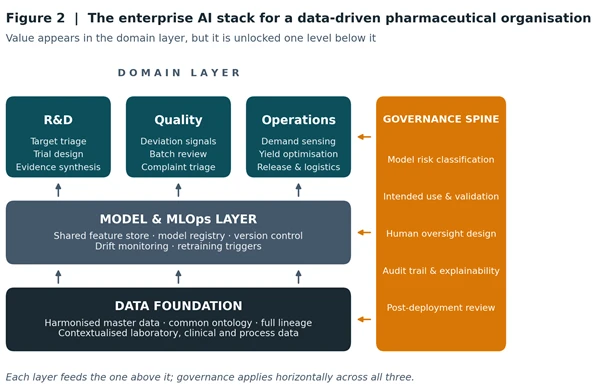
Figure 2: An enterprise AI stack in which a shared data foundation and a governance spine support every domain application.
AI in Pharmaceutical R&D: From Discovery Headlines to Portfolio Decisions
Research attracts the loudest AI claims and delivers the slowest measurable return, for reasons that are structural rather than disappointing. Discovery cycles are long, attrition is stochastic, and a target prioritised today may not read out for a decade. Enterprises that judge research AI by near-term revenue will misprice it every time.
The sharper opportunity lies one level up, in how research decisions are made rather than how molecules are found. Machine learning applied across historical programme data can quantify what an organisation has learned about its own failure modes — which target classes it has repeatedly abandoned at the same stage, which assay packages actually predicted downstream success, which indications it has entered on enthusiasm rather than evidence. Few pharmaceutical companies can currently answer these questions systematically, because programme knowledge lives in slide decks rather than structured records.
Language models have changed the economics of that reconstruction. Regulatory documents, study reports and internal reviews can now be parsed into structured evidence at a cost that makes retrospective portfolio analysis viable. Applied to trial design, the same capability supports faster protocol feasibility assessment, sharper eligibility criteria and more realistic enrolment forecasting — decisions that shorten development timelines without touching the underlying science.
AI in Pharmaceutical Quality: Reading the Signals Before They Become Deviations
Quality is where enterprise AI meets its most demanding audience, and where the discipline it imposes is most valuable. The prize is a shift from retrospective investigation to anticipatory control: models that detect drift in a granulation step before specification limits are breached, that cluster deviations to expose a shared root cause across sites, that triage complaints by likely product impact rather than arrival order.
Two constraints shape what is achievable. The first is that quality data is heavily narrative. Deviation records, CAPA files and audit observations carry their meaning in free text, which is precisely why language models have found earlier traction here than in structured analytics. The second is that every model touching product quality must be defensible. European regulators have signalled clearly that AI used in GxP contexts will be assessed on intended use, data provenance, human oversight and lifecycle control rather than on accuracy alone.
That expectation is not an obstacle to overcome but a design specification. Quality organisations that treat model validation as an extension of existing computerised systems and risk management practice, rather than as a novel discipline, move considerably faster than those waiting for definitive guidance. Risk-based thinking already embedded in pharmaceutical quality translates directly to model risk classification.
AI in Pharmaceutical Operations: A Data-Driven Nervous System for the Supply Network
Operations delivers the fastest and most legible returns, which is why it deserves early attention in any enterprise strategy. Demand sensing that draws on prescription signals, channel inventory and tender cycles outperforms consensus forecasting on the products that matter most. Yield and cycle-time models convert historical batch data into process understanding that engineers can act on within a quarter. Predictive maintenance reduces unplanned downtime on constrained lines where an hour of capacity has a defined commercial value.
The strategic point is not the individual application but the connective tissue between them. A supply network that reads demand signals, plant performance, quality events and logistics constraints in a single data model can rebalance production in days rather than planning cycles. Cold-chain visibility for advanced therapies makes that requirement acute rather than optional, since an excursion is not a costed inefficiency but a lost patient dose.
Operations also serves a political function inside an enterprise programme. Its returns arrive early, are easy to audit and buy credibility for the slower work in research and quality. Sequencing matters: leaders who start where value is measurable earn the mandate to invest where value is delayed.
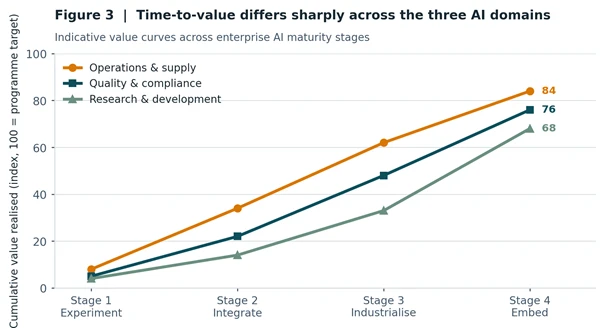
Figure 3: Operations returns arrive first and fund the slower, compounding value created in quality and research.
Inside a European Enterprise AI Programme: What Changed When the Data Did
A mid-sized European specialty pharmaceutical manufacturer operating four sites offers an instructive pattern. Its first two years of AI activity produced twenty-three pilots across research, quality and manufacturing; three reached routine use. An internal review found the failure was not model quality but the absence of anything shared — no common product hierarchy, no model inventory, no agreed route to validation, and no functional owner accountable for adoption after handover.
The reset was structural. The company invested eighteen months in a harmonised data layer covering products, equipment and studies before commissioning new use cases. It established a single model register with risk classification tied to existing quality risk management practice, so that a scheduling optimiser and a batch release support tool were not held to identical evidentiary standards. Business ownership moved to the functions, with a central team retaining architecture, validation and monitoring.
Outcomes followed the sequencing described above. Supply and manufacturing use cases delivered first: forecast error on the top thirty products fell by roughly a fifth, and unplanned downtime on two constrained lines declined materially within four quarters. Quality applications followed, with deviation investigation cycle times shortening as narrative clustering surfaced repeat root causes across sites. Research value proved slowest and least quantifiable, though portfolio reviews became evidential rather than anecdotal. The instructive figure is not any single improvement but the conversion rate: use cases reaching production rose from thirteen per cent to over sixty.
Governing Pharmaceutical AI: Building Models That Are Auditable by Design
Governance is where most enterprise AI strategies in pharma either mature or quietly stall. The failure mode is familiar — a policy document, an ethics committee and no operational mechanism connecting either to the models actually running in production.
Workable governance rests on three practical elements. A complete inventory of deployed models, with an owner and a stated intended use for each, makes the estate visible; nothing can be governed that is not known. Risk classification proportionate to consequence ensures scrutiny lands where it belongs, distinguishing a tool that informs a quality decision from one that schedules maintenance. And lifecycle monitoring — drift detection, periodic revalidation, defined retraining triggers — recognises that a validated model is a snapshot, not a permanent state.
For European enterprises, the regulatory environment adds specificity rather than novelty. Horizontal AI legislation, evolving expectations for AI in medicinal product lifecycles, and established computerised systems requirements point in a consistent direction: document the intended purpose, evidence the data, design meaningful human oversight and retain the audit trail. Organisations that build these into deployment tooling rather than committee review scale far more comfortably.
The Operating Model: Funding an AI Portfolio, Not a Pipeline of Pharma Pilots
The final determinant of success is how enterprise AI is organised and financed. Fully centralised teams build technically sound tools that functions decline to adopt; fully devolved models produce duplicated infrastructure and ungovernable variety. The configuration that holds is a small central capability owning architecture, platform, validation approach and governance, with embedded domain teams owning problems, adoption and benefit realisation.
Funding should follow the same logic. Annual project cycles are poorly suited to capability building, since a data foundation delivers no attributable benefit in the year it is constructed. Treating enterprise AI as a portfolio with distinct horizons — near-term operational returns, medium-term quality capability, long-term research advantage — allows leaders to fund the foundation without pretending it will pay back like an application.
Workforce readiness completes the picture and is consistently underfunded. A prediction changes nothing unless someone is empowered, trained and expected to act on it. Enterprise AI in pharmaceuticals ultimately asks scientists, quality professionals and planners to change how they decide, which is a leadership task rather than a technical one.
Conclusion: The Data-Driven Pharmaceutical Enterprise Is Built, Not Bought
The competitive question in European pharma is no longer whether artificial intelligence will reshape research, quality and operations. It is which organisations will have built the conditions for it to do so. Those conditions are unglamorous and largely internal: harmonised data with credible lineage, a governed and visible model estate, functional ownership of outcomes, and funding structures that tolerate delayed returns on foundations.
The distinction that matters is between companies treating AI as a set of applications to acquire and those treating it as a capability to construct. The first approach produces a widening collection of tools and a narrowing sense of progress. The second is slower to demonstrate and considerably harder to reverse — and it is the one that turns data-driven ambition into a measurable operating advantage across the pharmaceutical enterprise.

Lakshmi is a science writer with a foundation in the laboratory. She earned her master's in biotechnology and trained through research internships at ICGEB (JNU) and DIPAS, DRDO, with her work appearing in the Egyptian Journal of Veterinary Sciences. Now APCRM-certified and part of the editorial team at Pharma Focus America and Pharma Focus Europe, she reports on pharmaceutical technology, research, and innovation — giving complex science a clear and confident voice for industry leaders.