Cybersecurity in Pharma: The Threat No One Budgeted For
Lakshmi, Editorial Team, Pharma Focus Europe
Pharma spent a generation hardening itself against contamination and recall—while cyber risk stayed a forgotten IT line item. That framing has collapsed. Today's attackers don't just steal data; they halt sterile production, freeze global distribution, and enter through unaudited suppliers. Under Europe's rules, the liability now lands personally on the CEO. This is the operational and legal exposure most balance sheets never priced.
Introduction:
There is a particular kind of risk that organisations are bad at pricing: the one that has never happened to them. Pharmaceutical companies have spent a generation building sophisticated defences against the risks they know intimately—contamination, adulteration, deviation, recall. Quality systems are mature, inspection-ready, and deeply funded. Cyber risk has never enjoyed that status. It sat in the IT budget, framed as a data-protection problem, insured against, and largely forgotten.
That framing has collapsed. The threat now reaching pharmaceutical companies does not merely steal data. It stops the manufacture of sterile injectables. It freezes distribution across continents. It arrives through a supplier no one thought to audit, and under Europe’s current rules, it lands the consequences squarely on the desk of the chief executive. This is not a story about firewalls. It is a story about an operational and legal exposure that most balance sheets have never accounted for.
‘’For decades, the industry treated cyber risk as an IT line item. In 2026, it has become a board-level liability that can halt production, expose executives personally, and cost more than any product recall.’’
Why Pharma Became a Prime Target
The industry did not become attractive to attackers by accident. It sits at the intersection of nearly every quality that a sophisticated criminal or state-linked group values. It holds highly valuable data—intellectual property, drug patents, clinical trial results, research data, patient information and commercially sensitive records—that attackers can use for ransom, fraud, espionage or resale on criminal marketplaces. A single stolen research dataset can represent a decade of investment.
But the more consequential shift is operational. Modern manufacturing depends on a dense web of connected equipment—much of it designed, in an earlier era, for reliability rather than security. Regulators have warned that commercially available manufacturing equipment often does not meet cybersecurity standards by default, and that manufacturing has become the most-targeted category among critical infrastructure sectors. When an attacker encrypts the systems that run a fill-finish line, the damage is not measured in leaked records. It is measured in batches not made and patients not supplied.
The threat actors are not amateurs. Analysts describe ransomware as having completed its transition from disparate criminal hackers into a full industry—one with specialists, supply chains, and business models. Advanced persistent threat groups linked to nation-states have targeted pharmaceutical and clinical research firms through spear phishing, brute-force attacks and password spraying.
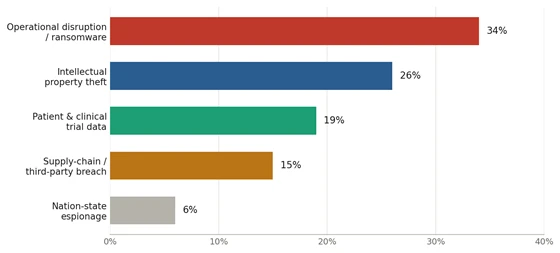
Figure 1. What attackers are after. Illustrative distribution of pharma-targeted incidents. The two largest categories—operational disruption and IP theft—are precisely the ones traditional data-privacy defences were never designed to stop.
The Attack Surface No One Owns
To understand why pharma is so exposed, it helps to map where an attack actually travels. The danger rarely enters through the front door of a well-defended corporate network. It enters through the seams—the connections between an organisation and the ecosystem it depends on.
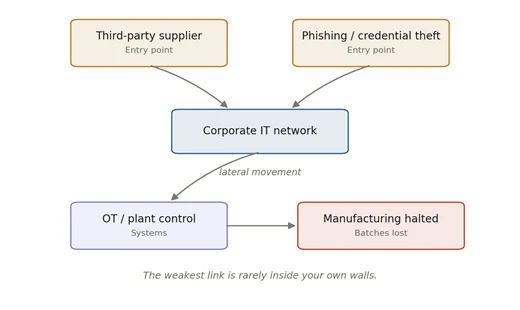
Figure 2. How an intrusion propagates. The most damaging attacks cross the boundary between corporate IT and operational technology—turning a data breach into a manufacturing crisis.
The critical insight is that the most damaging intrusions cross a boundary the industry has historically treated as sacrosanct: the wall between information technology—the email, the databases, the corporate systems—and operational technology, the machines that actually make product. Once an attacker moves laterally from the first to the second, a data breach becomes a manufacturing crisis. And the initial entry point is frequently not the company itself but a smaller, less-defended partner. A ransomware attack on a contract research organisation serving the pharma and biotech sector encrypted key systems and forced shutdowns, illustrating how supply-chain dependencies convert one company’s breach into everyone’s problem.
The Regulation That Changed the Stakes
For European pharmaceutical leaders, the calculus shifted decisively with the arrival of enforceable EU cybersecurity law. What was once a matter of prudent IT hygiene is now a legal obligation with personal consequences, and 2026 is the year the enforcement machinery came fully online.
The directive now in force treats cybersecurity as an enterprise risk with accountability at the executive level. It represents the most significant overhaul of EU cybersecurity regulation since 2016, expanding scope from roughly 10,000 entities to an estimated 160,000 or more, with enforcement teeth comparable to the bloc’s data-protection regime. Pharmaceutical manufacturing sits explicitly within its scope.
Three features make this regime different in kind from what came before. First, the financial exposure is severe: fines can reach €10 million or 2% of global turnover for essential entities. Second, and more striking, the accountability is personal. The directive holds management bodies personally accountable and requires them to undergo regular cybersecurity training; one national transposition explicitly elevates cyber risk to a board-level issue with director liability. Third, the reporting clock is unforgiving. A strict incident-reporting timeline requires initial notification within tight, fixed windows, and the first compliance-audit deadline was set for mid-2026.
There is a further complication specific to pharma. A regulatory finding of cybersecurity non-compliance can raise concerns during GMP or GDP inspections, particularly where the gap affects data or supply-chain integrity. In other words, a cyber weakness is no longer contained within IT—it can now contaminate a company’s quality and regulatory standing, the very foundation of its licence to operate.
Case Study: The Supplier That Stopped a Continent
Consider a composite scenario, drawn from the pattern of real incidents across the sector, that illustrates how the modern threat unfolds.
A mid-sized European manufacturer of sterile injectables ran a mature quality operation and a competent IT function. Its defences were, by conventional standards, reasonable. What it had never rigorously assessed was a specialist supplier that provided components and calibration services for its fill-finish lines—a firm a fraction of its size, connected to its systems for routine data exchange.
The intrusion began there. Attackers compromised the supplier through a phishing campaign, harvested credentials, and used the trusted connection to reach the manufacturer’s corporate network. For several days they moved quietly, mapping the environment. Then they crossed the boundary that mattered: from corporate IT into the operational systems governing the plant floor. Data was exfiltrated first—research files, batch records, personnel information—and then systems were encrypted.
The operational consequence was immediate and severe. To contain the spread, the company took systems offline globally, mirroring the containment playbook seen in actual incidents where a manufacturer, upon detecting an intrusion, proactively took systems offline worldwide, notified law enforcement, and engaged external cyber-forensic experts. Sterile production halted. Shipping and receiving froze. Because the company was a link in a broader supply chain, the disruption rippled outward to the hospitals and distributors that depended on its output.
The financial damage from the ransom demand was, in the end, the smallest line in the ledger. The larger costs were the lost production, the forensic and recovery effort, the regulatory reporting obligations triggered within hours, and the scrutiny of quality inspectors newly attentive to whether the breach had compromised data integrity. The lesson was not that the company had been careless with its own systems. It was that it had never priced the risk carried by the smallest partner with a key to its network.
What Adequate Actually Looks Like Now
The encouraging news for pharmaceutical organisations is that they are not starting from nothing. The disciplines that cybersecurity now demands rhyme closely with those the industry already practises in quality management. Many of the building blocks—risk management, change control, supplier qualification, validation and training—already exist within a well-run quality system; the task is to extend and formalise them to meet cybersecurity’s specific demands.
That reframing is the single most useful shift a leadership team can make. Supplier qualification, a concept every quality professional understands, must expand to include the cyber posture of every partner with system access. Change control must encompass the security implications of connected equipment. The incident-response muscle that the industry exercises for product deviations must be trained on cyber events, with the reporting clock built in. The most effective first step for most organisations is a structured gap assessment that maps current controls against the new requirements and cross-references existing quality obligations.
None of this is exotic. It is the application of existing organisational discipline to a risk that discipline was never pointed at. The obstacle is rarely technical capability. It is the budgetary and psychological legacy of treating cyber as someone else’s problem.
Budget for the Threat You Haven’t Seen
The defining feature of this risk is that the companies most exposed to it are often the ones that feel safest, because nothing has happened to them yet. That absence of experience is not evidence of security. It is the reason the threat went unbudgeted for so long.
The shift that 2026 demands of pharmaceutical leadership is not primarily a technical one. It is a shift in accounting—recognising cyber risk as an operational and legal exposure on the same footing as contamination or recall, funded accordingly, owned at board level, and extended across every supplier that holds a key to the network. The organisations that make that shift will treat their next security investment the way they treat their quality systems: as the cost of the licence to operate. The ones that do not will keep carrying a liability that no line item acknowledges—until the day it acknowledges itself.

Lakshmi is a science writer with a foundation in the laboratory. She earned her master's in biotechnology and trained through research internships at ICGEB (JNU) and DIPAS, DRDO, with her work appearing in the Egyptian Journal of Veterinary Sciences. Now APCRM-certified and part of the editorial team at Pharma Focus America and Pharma Focus Europe, she reports on pharmaceutical technology, research, and innovation — giving complex science a clear and confident voice for industry leaders.