Combination Immunotherapy Trials: Designing the Next Generation of Cancer Drugs
Lakshmi, Editorial Team, Pharma Focus Europe
Combination immunotherapy is now a portfolio necessity, yet late-stage combination trials in oncology continue to fail at an uncomfortable rate. This article examines why attaching a second immune target to a checkpoint backbone no longer guarantees value, what the anti-TIGIT collapse revealed about trial design, how single-molecule bispecifics are resetting the economics of dual-pathway blockade, and what Europe's Joint Clinical Assessment now demands of combination regimens seeking access.
Introduction:
Combination Immunotherapy Has Outgrown Its Add-and-Hope Decade
For most of the past ten years, the prevailing strategy in immuno-oncology was addition. Checkpoint blockade delivered durable remissions in a minority of patients; the intuitive fix was to attach a second agent to a PD-1 or PD-L1 backbone and watch whether response rates moved. That intuition built the pipeline the pharmaceutical industry now owns. As of mid-2025, 384 immuno-oncology trials were running in Phase III with a further 63 in Phase II/III, checkpoint inhibitors held roughly 72 per cent of the immuno-oncology market, and the category was projected to approach US$220 billion by 2030. The overwhelming majority of those late-stage studies test a combination rather than a single agent.
The strategy is now colliding with three hard limits at once. Biology has repeatedly declined to behave additively. The control arm has risen, because the comparator in a 2026 protocol is usually itself a combination, so the incremental benefit a new regimen must demonstrate has narrowed while the sample size required to detect it has grown. And in Europe, a new assessment architecture has arrived that asks combination developers a question their programmes have rarely been designed to answer: better than what, in which country, for which patients.
For European pharmaceutical and biotechnology leadership, this is no longer a clinical development detail. It is a capital allocation problem with a compressed decision window.
The Combinatorial Arithmetic That Quietly Breaks Oncology Portfolios
Every combination carries an attribution problem. Regulators and payers want to know what each component contributes, which pushes sponsors towards three-arm or factorial designs that inflate sample size, extend recruitment and multiply monitoring cost. A typical Phase III study in the first-line metastatic setting enrols 800 to 1,000 patients, runs for roughly three years and costs in the region of US$100 million, several times the oncology Phase III average. A combination programme running two such studies in parallel commits a mid-cap biotech's entire cash runway to a single mechanistic hypothesis.
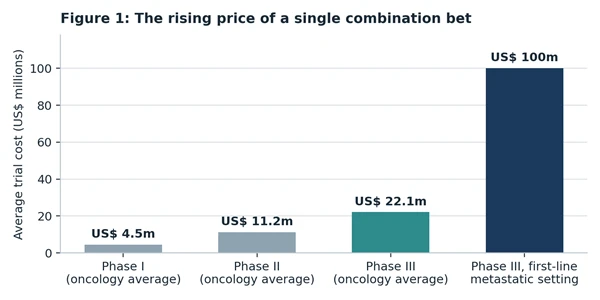
Figure 1: Average oncology trial cost by phase, with a typical first-line metastatic Phase III study shown for comparison. Figures are indicative, drawn from aggregate trial cost analyses, and are not inflation-adjusted.
The odds have not improved as quickly as the spend. Historically, only about one in twenty oncology compounds entering first-in-human study reached approval; more recent analyses put clinical success closer to one in five, but the failures remain concentrated exactly where they hurt most, in Phase II and Phase III. More revealing still, a review of 111 published Phase III oncology randomised trials found that 57.3 per cent reported hazard ratios weaker than the effect their own power calculations had assumed. Combination programmes are not simply unlucky. As a class, they are systematically over-powered by optimism at the design stage.
The board-level consequence is that the most expensive decision in a combination programme is taken long before the pivotal readout. It is taken when a randomised Phase II signal is interpreted generously, when a futility analysis is omitted, and when a partner agent advances without a biomarker of its own.
Case Study: What the TIGIT Reckoning Taught Combination Immunotherapy
No mechanism illustrates the cost of that generosity better than TIGIT. The rationale was among the strongest in the field: the receptor is expressed on activated T cells, natural killer cells and regulatory T cells, and blocking it alongside PD-(L)1 promised to restore two arms of anti-tumour immunity at once. Randomised Phase II data in non-small cell lung cancer appeared to confirm the hypothesis, and the class attracted multiple parallel Phase III commitments across the industry.
Confirmation never came. In previously untreated PD-L1-high advanced non-small cell lung cancer, adding the anti-TIGIT antibody tiragolumab to a PD-L1 inhibitor missed both co-primary endpoints in the SKYSCRAPER-01 study, producing numerical rather than statistical separation in progression-free and overall survival. A consolidation study after chemoradiotherapy in unresectable stage III disease, SKYSCRAPER-03, followed it. In first-line hepatocellular carcinoma, adding the same antibody to an established checkpoint-plus-anti-angiogenic doublet produced a median progression-free survival of 8.3 months against 8.2 months for the doublet alone, with response rates of 29.9 per cent versus 26.0 per cent. Roughly 5,000 patients were studied across the programme before the asset was discontinued. Elsewhere in the industry, a Phase III melanoma combination using a different anti-TIGIT antibody was halted over adverse events and that sponsor exited the target altogether; another terminated a first-line lung study.
The post-mortems are unusually instructive. Investigators on the stage III study explicitly identified the absence of an early futility analysis as a design limitation. The liver cancer programme had been built on a randomised Phase II in which the control arm underperformed, a discrepancy addressed retrospectively rather than prospectively. Trials were open-label because differing dosing and administration schedules made blinding impractical. And crucially, patient selection was anchored on PD-L1 expression, a biomarker for the backbone that says almost nothing about the agent being added to it.
The lesson for combination immunotherapy is not that TIGIT was a poor target. It is that a combination programme without a predictive biomarker for the added component, without a contemporaneous control on the same backbone, and without an enforceable stopping rule is not a hypothesis test. It is an expensive bet placed with shareholders' capital.
One Molecule, Two Targets: How Bispecifics Rewrite Combination Immunotherapy Economics
While co-administration strategies faltered, a structurally different answer matured: build the combination into a single molecule. Bispecific antibodies that engage PD-1 and VEGF simultaneously exploit the spatial proximity of the two pathways within the tumour microenvironment, achieving cooperative binding that separately administered agents cannot replicate. Commercially, they collapse two supply chains, two safety databases and two pricing negotiations into one asset.
The clinical evidence arrived in 2026. In first-line advanced squamous non-small cell lung cancer, a PD-1 by VEGF bispecific combined with chemotherapy extended median overall survival to 27.9 months against 23.7 months for a PD-1 inhibitor plus chemotherapy, a 34 per cent reduction in the risk of death, with median progression-free survival of 11.1 months versus 6.9 months. The benefit extended to patients with low or absent PD-L1 expression, the population checkpoint therapy has always served least well. The modality is now under evaluation in more than 30 settings, including some 15 Phase III studies.
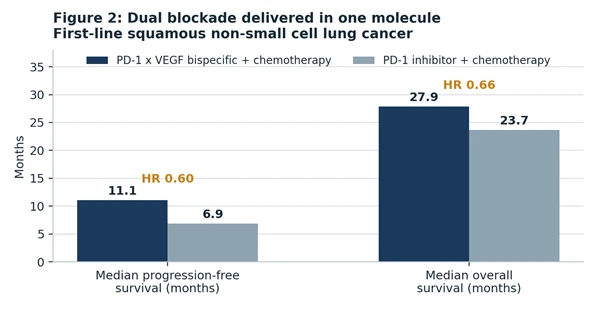
Figure 2: Interim analysis in 532 patients, median follow-up 21.4 months, February 2026 data cut-off. Grade 3 or higher treatment-related adverse events were more frequent in the bispecific arm (69.2 per cent versus 58.9 per cent).
Two cautions belong in the boardroom alongside the headline. The first is tolerability: grade 3 or higher treatment-related adverse events were meaningfully more frequent with the bispecific, and the safety profile of dual-pathway engagement in a single molecule is not automatically the sum of its parts. The second is geography. A parallel global study of the same molecule in EGFR-mutated disease missed statistical significance at its primary overall survival analysis, largely because Western follow-up was far less mature than Asian follow-up; successive data cuts moved the hazard ratio from 0.79 to 0.78 and then 0.76 as Western maturity caught up. For a European organisation, that sequence is the whole lesson. An Asia-weighted dataset with immature European follow-up will not carry a European assessment, however persuasive the pooled hazard ratio appears.
Europe's Comparator Trap: Combination Immunotherapy Under Joint Clinical Assessment
Since 12 January 2025, new oncology medicines and advanced therapy medicinal products entering the European Union have been subject to Joint Clinical Assessment under the EU Health Technology Assessment Regulation. Member states define the assessment scope collectively through PICO questions, covering population, intervention, comparator and outcome, and those questions are additive across 27 healthcare systems with materially different standards of care.
For combination immunotherapy this is the sharpest structural risk in the European market. Because the comparator in each member state is frequently itself a combination regimen, and because national treatment sequences diverge, a single indication fragments into many comparative questions. A published review of 35 simulated PICO exercises across 21 indications, 74 per cent of them in oncology, found an average of eight consolidated PICOs per exercise with an average of seven countries participating. The first published Joint Clinical Assessment report offered a blunt demonstration of the gap: of eight consolidated PICOs, seven could not be assessed because the comparative data simply did not exist.
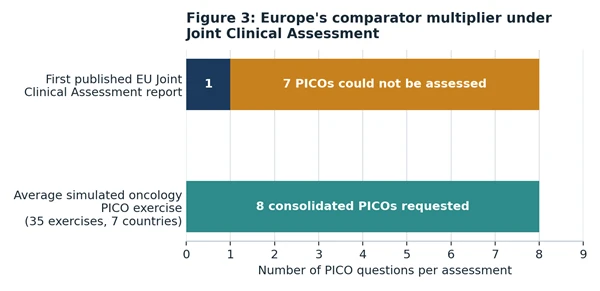
Figure 3: PICO burden under the EU Joint Clinical Assessment framework, based on published simulated scoping exercises and on the first completed assessment report.
That gap reflects a mismatch between what a registrational programme is designed to prove and what 27 payers collectively want to know, rather than poor planning by any one sponsor. Closing it requires decisions taken in Phase I and Phase II rather than at filing: a prospective European PICO map, head-to-head comparative data where ethically feasible, pre-planned indirect treatment comparisons and network meta-analyses where it is not, and real-world evidence generated to a methodological standard assessors will accept rather than assembled defensively after the fact. The voluntary Joint Scientific Consultation, which can be run in parallel with regulatory scientific advice, remains the most under-used instrument available to combination developers.
Designing Combination Immunotherapy Trials That Are Permitted to Fail Early
The design principles that follow are not exotic. They are simply unpopular, because each one creates an opportunity to kill a programme. A combination should not advance on a single-arm signal. The randomised Phase II must carry a contemporaneous control receiving the backbone alone, on the same protocol and at the same sites, so that the added agent's contribution is observed rather than inferred. Futility analyses should be pre-specified with genuine stopping authority vested in an independent data monitoring committee, and the threshold agreed while enthusiasm is high rather than renegotiated once recruitment is under way.
Every added component needs a candidate predictive biomarker of its own, prospectively collected even when it cannot yet be used for enrolment. Master protocols and platform designs with shared control arms materially reduce the cost of testing several combinations against a common standard, and they shorten the interval between a negative signal and a portfolio decision. Endpoints and estimands should be specified with European assessment in view from the outset, with overall survival where achievable and with quality of life, symptom burden and treatment burden collected systematically from Phase II rather than retrofitted at submission. Recruitment should be balanced across regions, supported by a follow-up maturity plan that anticipates how a European subgroup will read at each interim analysis.
Conclusion:
The Combination Immunotherapy Portfolio the Next Decade Will Reward
Combination immunotherapy is not in retreat. It remains the most credible route to extending durable benefit beyond the minority of patients that single-agent checkpoint blockade reaches. What has ended is the era in which combination breadth was itself a strategy, in which owning many partnered assets against a checkpoint backbone counted as a pipeline.
The organisations that compound value over the next decade will be those that treat each combination as a falsifiable hypothesis with a defined cost of being wrong, that engineer dual-pathway biology into single molecules where the science permits, and that design European comparative evidence into Phase II rather than discovering its absence at Joint Clinical Assessment. That is a governance discipline before it is a scientific one. It asks executives to fund fewer combinations, interrogate them harder and stop them earlier, and to accept that in combination immunotherapy the cheapest trial a company can run is the pivotal study it never had to start.

Lakshmi is a science writer with a foundation in the laboratory. She earned her master's in biotechnology and trained through research internships at ICGEB (JNU) and DIPAS, DRDO, with her work appearing in the Egyptian Journal of Veterinary Sciences. Now APCRM-certified and part of the editorial team at Pharma Focus America and Pharma Focus Europe, she reports on pharmaceutical technology, research, and innovation — giving complex science a clear and confident voice for industry leaders.