Bridging the Biotech–Pharma Innovation Gap Through Strategic Partnerships
Lakshmi, Editorial Team, Pharma Focus Europe
Europe produces world-class biotechnology science, yet too many promising molecules stall between discovery and the patient. This article examines why the biotech–pharma innovation gap persists, how strategic partnerships can convert it into shared value, and what European C-suite leaders should demand from alliance design. Drawing on clinical attrition data, the region’s evolving policy landscape and a landmark vaccine collaboration, it argues that partnership governance, not deal size, determines success.
Europe’s Biotech–Pharma Divide Is a Boardroom Problem
Europe has never lacked ideas. Its universities, translational institutes and spin-out companies consistently generate novel biology, from gene-editing tools to antibody engineering and mRNA platforms. What the continent has struggled with is the journey that follows: turning a validated mechanism into an approved, reimbursed and reliably manufactured medicine. That journey demands capital, regulatory fluency, global trial infrastructure and commercial muscle that few young biotech companies possess on their own.
Large pharmaceutical organisations face the mirror-image challenge. They command scale and experience, but they must continually replenish their pipelines with external innovation, often in modalities where internal expertise is still maturing. The result is a structural gap, with the science sitting on one bank of the river and the means to deliver it sitting on the other.
For European executives, this is not an abstract R&D debate. It shapes where value is captured, where high-skilled jobs are created and whether breakthroughs developed in European laboratories reach European patients first. Policymakers have recognised the stakes. On 16 December 2025, the European Commission proposed a Biotech Act as a central pillar of a life sciences strategy that aims to make the EU the world’s most attractive destination for life sciences by 2030.
Legislation alone, however, cannot build the bridge. That work falls to leadership teams who decide how biotech and pharmaceutical organisations collaborate, share risk and govern joint assets. This article sets out why the gap persists, what high-performing biotech–pharma partnerships do differently and how C-suite leaders can design alliances that endure long after the signing ceremony.
The Valley of Death: Where Biotech–Pharma Value Quietly Leaks Away
Drug development remains an exercise in managing attrition. An analysis of 9,704 development programmes that entered clinical trials between 2011 and 2020 found that a Phase I candidate had only a 7.9% likelihood of ultimately securing approval, and that the average journey from Phase I to approval took 10.5 years. Put simply, for every hundred programmes entering the clinic, roughly eight reach patients.
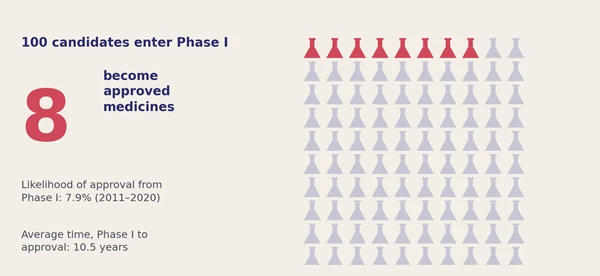
Figure 1: Pictograph – only about 8 in every 100 Phase I candidates become approved medicines.
Source: analysis of 9,704 clinical development programmes, 2011–2020
The losses are not evenly distributed. The same dataset shows that 52.0% of programmes advanced from Phase I to Phase II, while only 28.9% cleared Phase II. Of those reaching Phase III, 57.8% progressed to a regulatory filing, and 90.6% of filed applications were approved. Phase II is where proof-of-concept is tested in patients, where dose and population choices are locked in and where the cost of evidence climbs steeply. It is also, not coincidentally, the stage at which many emerging biotech companies run short of runway.
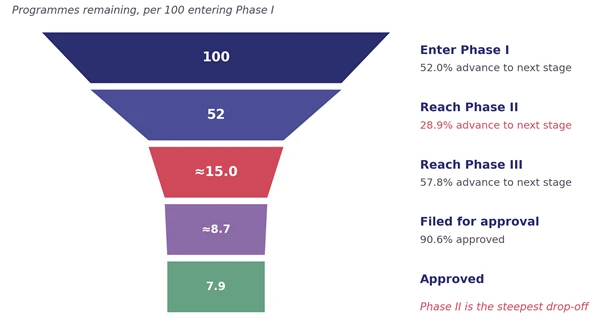
Figure 2: The attrition funnel – programmes remaining at each stage, per 100 entering Phase I.
Source: analysis of 9,704 clinical development programmes, 2011–2020.
Beyond the Licensing Cheque: Biotech–Pharma Partnerships as Shared Operating Systems
For decades, the dominant partnership model was transactional. A biotech company licensed rights to an asset in exchange for an upfront payment, milestones and royalties, and then largely stepped aside. That model still has its place, but it often discards the very capabilities that made the asset promising: the founders’ intimate knowledge of the biology, the agility of a small team and the platform from which follow-on candidates can emerge.
Forward-looking European alliances are increasingly structured as shared operating systems instead. Rather than simply transferring ownership, the partners integrate complementary strengths around a defined scientific objective.
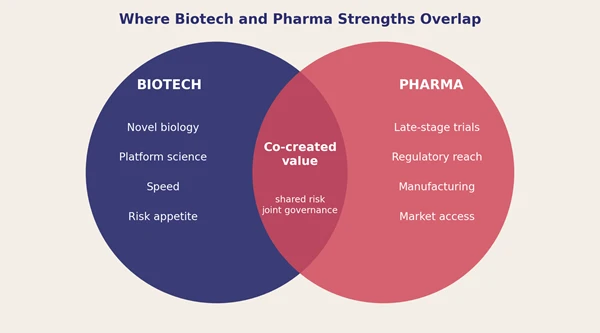
Figure 3: Where biotech and pharma strengths overlap to create shared value.
The biotech partner typically contributes first-in-class biology, platform technology and a tolerance for scientific risk that large organisations find difficult to replicate internally. The pharmaceutical partner contributes late-stage development experience, regulatory relationships across multiple jurisdictions, manufacturing scale-up and market access expertise. That last capability is especially critical in Europe, where pricing and reimbursement are decided nationally and each health system applies its own evidence expectations.
Several structural choices distinguish shared operating systems from simple licences. Co-development arrangements keep the originating team engaged through proof-of-concept, preserving institutional knowledge. Option-based deals allow a pharmaceutical partner to fund research in exchange for the right, but not the obligation, to acquire an asset at a defined inflection point, aligning capital with evidence. Platform collaborations extend beyond a single molecule, giving both parties a stake in a stream of candidates. Equity participation, where appropriate, aligns long-term incentives and signals commitment to other investors.
The common thread is that value is created jointly rather than simply handed over. For boards, this changes the central question from “What is this asset worth today?” to “What can we build together that neither of us could build alone?”
Europe’s Policy Tailwind: Public Capital Behind Biotech–Pharma Collaboration
European institutions have long understood that pre-competitive collaboration can accelerate an entire ecosystem. The Innovative Health Initiative (IHI), a public–private partnership running from 2021 to 2027, has a total budget of €2.4 billion. Of this, €1.2 billion comes from Horizon Europe, the EU’s research and innovation framework programme, €1 billion from industry partners and €200 million from contributing partners.
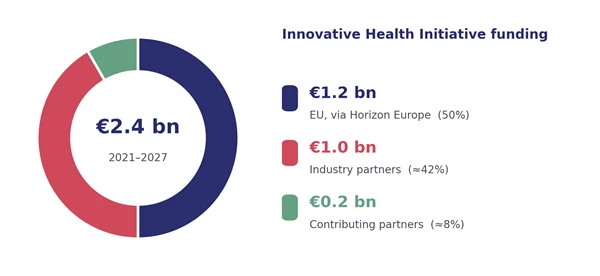
Figure 4: How the Innovative Health Initiative’s €2.4 billion budget is funded.
Source: Innovative Health Initiative funding model, 2021–2027.
Programmes of this kind create neutral ground where biotech companies, pharmaceutical organisations, academic groups, regulators and patient representatives can tackle shared bottlenecks such as biomarker validation, data standards and clinical trial methodology. Relationships formed within these consortia frequently become the foundation for later bilateral partnerships, because the parties have already tested how they work together under real conditions.
The regulatory environment is shifting too. Alongside the proposed Biotech Act, which seeks to address access to capital, regulatory complexity and clinical trial efficiency, the EU has reached agreement on a wider revision of its pharmaceutical legislation. For C-suite leaders, the implication is clear: partnership strategy should be read alongside policy. Alliances designed with an eye on evolving clinical trial rules, data provisions and incentives will be better positioned than those structured purely around today’s framework.
Case Study: Nine Months from Handshake to Authorisation in a European mRNA Partnership
The clearest modern demonstration of what a well-constructed biotech–pharma alliance can achieve came during the COVID-19 pandemic. In March 2020, a German biotechnology company with more than a decade of mRNA platform research formed a development partnership with a large multinational pharmaceutical organisation to advance a vaccine candidate.
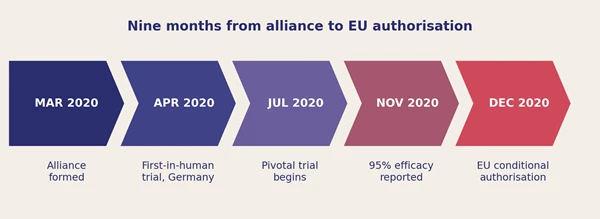
Figure 5: Case study timeline – nine months from alliance to EU conditional authorisation
The division of labour was deliberate. The biotech partner brought the mRNA platform, candidate design and deep scientific understanding of the technology. The pharmaceutical partner contributed global clinical operations, regulatory engagement across multiple agencies, and manufacturing and distribution capacity on a scale no emerging company could have assembled within months.
The first-in-human trial started in Germany in April 2020. By late July, a pivotal efficacy study was under way that would eventually enrol more than 43,000 participants. In November 2020, the partners reported vaccine efficacy of 95% against symptomatic COVID-19, and on 21 December 2020 the vaccine received conditional marketing authorisation in the European Union.
Three lessons stand out. First, the partners committed early, before definitive clinical data existed, allowing activities that normally run in sequence to run in parallel at shared risk. Second, roles were defined around genuine comparative advantage, avoiding duplication and territorial disputes. Third, the biotech partner remained a scientific co-owner rather than a passive licensor, preserving the platform expertise that later drove variant-adapted development.
Extraordinary public-health urgency, accelerated regulatory reviews and public funding all shaped this timeline, and few alliances will operate under comparable conditions. Yet the underlying design principles of early commitment, complementary roles and shared scientific ownership are fully transferable to routine biotech–pharma partnerships.
Built to Survive Phase II: Governance That Makes Biotech–Pharma Alliances Last
Most partnerships do not fail on science alone. They falter when strategic priorities diverge, when decision rights are ambiguous or when a portfolio review inside the larger organisation deprioritises an asset that remains central to the smaller partner’s
existence. Governance is therefore not an administrative afterthought; it is the load-bearing structure of the bridge.
Effective alliances begin with explicit decision rights. Joint steering committees work best when they have a clear mandate, a defined escalation path and a small number of senior members empowered to decide. Uncertainty about who can pause a programme or change its target indication is one of the most common sources of friction and delay.
Equally important is planning for divergence. Priorities will shift over a multi-year programme, and well-designed agreements anticipate this through reversion rights, opt-out provisions and fair transition terms, so that a promising asset returns to its originator rather than sitting dormant on a larger company’s shelf. For European biotech companies, whose valuations often rest on a handful of programmes, such protections are existential.
Cultural integration deserves the same attention as legal structure. Biotech teams move quickly and tolerate ambiguity, while large organisations operate through process and consensus. Dedicated alliance managers fluent in both cultures, shared metrics that reward joint milestones and transparent data-sharing arrangements all reduce friction. Leaders should also measure partnership health, not only asset progress; candid reviews of trust, responsiveness and decision speed often expose problems months before they surface in development timelines.
Conclusion: The Biotech–Pharma Bridge Is Built by Leaders, Not Contracts
The gap between biotech innovation and pharmaceutical delivery is one of the most consequential challenges facing European life sciences. Clinical attrition data show how unforgiving drug development remains, with fewer than one in ten Phase I programmes reaching approval. Yet that same harsh reality is exactly why partnership matters: no single organisation, however large or inventive, can efficiently carry every promising molecule across the valley alone.
Europe enters this period with genuine advantages, including exceptional science, established public–private funding mechanisms and a policy agenda explicitly aimed at strengthening biotechnology. Whether these advantages translate into medicines will depend on the quality of the alliances built on top of them.
For C-suite leaders, the task is to treat partnerships as strategic assets in their own right: engaging earlier, aligning roles with genuine strengths, protecting the scientific engine of the smaller partner and governing with clarity and candour. Organisations that master this discipline will do more than close the innovation gap. They will define how European innovation reaches patients in the decade ahead.

Lakshmi is a science writer with a foundation in the laboratory. She earned her master's in biotechnology and trained through research internships at ICGEB (JNU) and DIPAS, DRDO, with her work appearing in the Egyptian Journal of Veterinary Sciences. Now APCRM-certified and part of the editorial team at Pharma Focus America and Pharma Focus Europe, she reports on pharmaceutical technology, research, and innovation — giving complex science a clear and confident voice for industry leaders.