Blockchain in Pharma: Strengthening Drug Traceability, Compliance, and Supply Chain Security
Lakshmi, Editorial Team, Pharma Focus Europe
Europe’s pharmaceutical supply chain has never been more regulated, more fragmented or more exposed. The Falsified Medicines Directive delivered pack-level verification, but it largely stops at the pharmacy counter and says little about cold-chain integrity, custody transfers or cross-border data sharing. This article examines how permissioned blockchain can extend pharma traceability, turn compliance into a continuous data asset and harden supply chain security, and what C-suite leaders must decide before scaling it.
Pharma’s Trust Problem Has Moved Upstream
For most of the last decade, the European pharmaceutical industry framed supply chain integrity as a packaging problem. Put a unique identifier on every pack, seal it with an anti-tampering device, check it at the point of dispensing, and the falsified medicine threat would be contained. Since February 2019, that model has been law across the European Union, and it has worked better than many sceptics predicted.
Yet today’s threats rarely announce themselves at the pharmacy counter. They surface in a temperature excursion on a cross-border lorry, an unexplained gap between batch release and wholesaler receipt, a repackaging step where one identifier replaces another, or a shortage nobody saw coming because stock data sat in disconnected systems. Trust has moved upstream, into the custody chain itself, where today’s verification architecture is thinnest.
Blockchain, long dismissed in boardrooms as a solution in search of a problem, is quietly finding its problem in pharma: not as a cryptocurrency spin-off, but as a permissioned, shared ledger that lets competitors, distributors, regulators and auditors agree on a single version of events without handing control to any one party. The question for European executives is no longer whether blockchain works in pharma, but where it pays, how it fits existing regulation and what governance it demands.
Beyond the FMD: Where Pharma Traceability Still Breaks Down
The Falsified Medicines Directive created one of the world’s largest pharma verification networks: a European hub connected to national repositories, against which prescription medicine packs are verified and decommissioned. But it was designed as an end-to-end verification system, not full track-and-trace. A pack is checked at the start and at the end of its journey; what happens in between is visible only through risk-based checks and each company’s own records.
That design leaves four structural blind spots. First, custody transfers between wholesalers, especially across borders and through parallel trade, are not recorded in a shared, tamper-evident way. Second, environmental conditions, which matter enormously for biologics, vaccines and cell and gene therapies, are logged in proprietary systems that rarely talk to each other. Third, investigations into exception alerts or suspected diversion still rely on stitching together emails, spreadsheets and partner exports. Fourth, recall execution depends on how quickly downstream partners can confirm where affected batches actually went.
The scale of what is at stake is significant. The World Health Organization has estimated that around one in ten medical products in low- and middle-income countries is substandard or falsified, and an OECD and EU Intellectual Property Office study put global trade in counterfeit pharmaceuticals at up to USD 4.4 billion in a single year. Europe’s legal supply chain is comparatively well defended, but European manufacturers export globally, and reputational damage does not respect regulatory borders.
What Blockchain Actually Changes for the Pharmaceutical Supply Chain
Strip away the hype and a pharma blockchain does three things that conventional databases struggle to do together. It creates a shared record that multiple organisations can write to without trusting a central administrator. It makes that record tamper-evident, because every entry is cryptographically linked to the one before it. And it allows business rules, known as smart contracts, to execute automatically when defined conditions are met.
In practice, this means a manufacturer commissions a serialised batch, a distributor records receipt and onward shipment, a repackager links the old identifier to the new one, and a hospital pharmacy confirms dispensing, all on the same ledger. Each party retains its own systems and its own commercial data. What it shares is a minimal set of event records: which product, which batch, which identifier, which custodian, and when. Crucially, the ledger is permissioned. Only vetted participants join, and access rights determine who sees what.
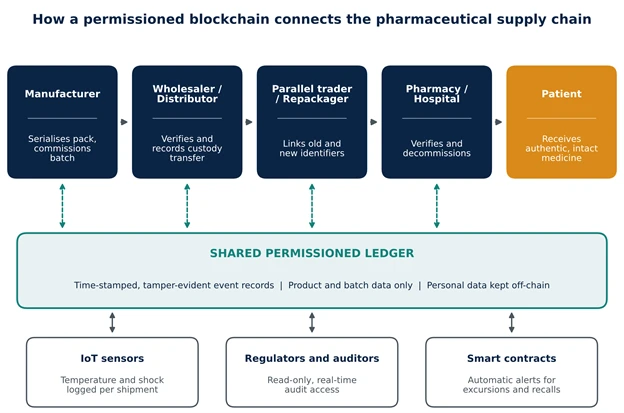
Figure 1: A permissioned blockchain records custody events across the pharmaceutical supply chain, with IoT sensor data, regulator access and smart-contract alerts layered on a single shared ledger.
Blockchain as a Compliance Engine, Not a Compliance Burden
Most pharma compliance functions are built around periodic proof: audits, batch record reviews, annual product quality reviews and inspection readiness exercises. The underlying data exists, but it is fragmented, and assembling it is expensive. Blockchain inverts that model. When every custody event and every temperature reading is written to a tamper-evident ledger at the moment it happens, compliance becomes a continuous property of the supply chain rather than a retrospective reconstruction.
The implications for European Good Distribution Practice are direct. GDP requires distributors to demonstrate traceability and that storage and transport conditions were maintained. A ledger that no single participant can quietly amend aligns naturally with ALCOA+ data integrity expectations. Instead of requesting documents from five partners, a qualified person or inspector can, with the right permissions, view a single verified history.
There is also a strategic regulatory dividend. The EU’s proposed pharmaceutical legislation reform and the proposed Critical Medicines Act both emphasise shortage prevention, supply transparency and early notification. Companies with verifiable, near-real-time visibility of stock across their networks will meet these obligations with far less friction. Pharma blockchain is less about satisfying today’s rules than being structurally ready for tomorrows.
Hardening Pharma Supply Chain Security with Blockchain
Security in the pharmaceutical supply chain is no longer only about counterfeits. It now spans diversion into unauthorised markets, theft of high-value therapies, cyber intrusion into partner systems and the silent degradation of temperature-sensitive products. Blockchain does not eliminate any of these risks, but it changes the economics of exploiting them.
Consider diversion. When every legitimate custody transfer is recorded on a shared ledger, a pack that appears in an unexpected market without a matching history stands out immediately. Consider cold chain. Linking IoT sensor readings to batch identifiers on-chain turns a temperature excursion from a carrier-shipper dispute into a time-stamped fact that can automatically trigger quarantine through a smart contract. For advanced therapies, where chain-of-identity is literally a matter of life and death, that certainty is transformational.
Recalls benefit just as much. With ledger-based traceability, the recall perimeter can be drawn from verified data within hours rather than broadened by uncertainty, reducing both patient risk and the cost of withdrawing unaffected stock. And because a distributed ledger has no single point of failure, it also adds resilience against the ransomware attacks that have disrupted European logistics.
Case Study: What Blockchain Pilots Taught the Pharma Sector About Interoperability
The most instructive real-world evidence comes from across the Atlantic. Under the US Drug Supply Chain Security Act, the Food and Drug Administration ran a Pilot Project Program in 2019 and 2020, inviting manufacturers, wholesalers, dispensers and technology providers to test approaches to interoperable product tracing and verification. Several of these pilots used blockchain or distributed ledger technology, with consortia of competing manufacturers and distributors sharing a common network.
The findings, summarised in the FDA’s published program report, were sobering and useful in equal measure. The pilots showed that distributed ledgers could support product verification and tracing across organisational boundaries, including the verification of saleable returns, a known weak point for diversion. But they also exposed the hard problems: inconsistent data standards between trading partners, the challenge of onboarding smaller dispensers, unresolved questions about who governs and pays for a shared network, and the need for common identifiers that every system interprets the same way. The technology, in short, was rarely the bottleneck. Governance and data quality were.
For European pharma leaders, the lesson is clear. Europe already has a harmonised unique identifier and a functioning verification network. Rather than building a parallel system, the smartest blockchain strategies layer distributed ledger capabilities on top of FMD data, starting with high-value, high-risk segments where shared custody visibility pays back fastest.
The Hard Questions: Blockchain, GDPR and Governance in European Pharma
No serious discussion of blockchain in European pharma can sidestep data protection. The General Data Protection Regulation grants individuals a right to erasure, while a blockchain is designed to be immutable. The European Data Protection Board addressed this tension directly in its 2025 guidance on blockchain, and the practical answer is architectural: keep personal data off-chain entirely, record only product and transaction identifiers or cryptographic hashes on the ledger, and store anything sensitive in conventional systems where it can be corrected or deleted.
Governance is the harder challenge. Who decides which organisations may join, who funds and validates the network, and how are commercial sensitivities protected when competitors share infrastructure? Competition law adds another layer, since information exchange between rivals must stay strictly within what traceability requires. Successful networks resolve these questions before a single transaction is written, typically through neutral, industry-owned governance bodies.
Building a Blockchain Strategy in the Pharma Boardroom
The executives getting most value from blockchain are not those running the most pilots. They are those who have anchored the technology to a specific, measurable business problem. For a vaccine or biologics manufacturer, that may be cold chain integrity and the cost of discarded product. For a company with significant parallel trade exposure, it may be identifier linkage and diversion detection. For an advanced therapy developer, it is almost certainly chain-of-identity from apheresis to infusion.
Equally important is the decision to collaborate rather than compete on infrastructure. A pharma blockchain with one participant is simply an expensive database. Value scales with the number of trading partners on the network, so boards must be willing to co-invest with peers and distributors and accept shared governance in exchange for shared visibility, a cultural shift that requires sponsorship from the very top.
Conclusion:
Blockchain Will Not Fix Pharma’s Supply Chain, Pharma Leaders Using Blockchain Will
Blockchain is not a silver bullet for drug traceability, compliance or supply chain security. But as a permissioned, tamper-evident ledger built on Europe’s existing serialisation backbone, it addresses exactly the gaps the current verification model leaves open: custody transfers, environmental integrity, investigation speed and recall precision.
For European pharmaceutical leaders, the strategic opportunity is to turn traceability from a regulatory cost into a source of operational intelligence and patient trust. That requires choosing the right use cases, keeping personal data off the chain, investing in neutral governance and collaborating across the value chain. The technology is ready. The real test now is whether pharma leadership is ready to share the ledger.

Lakshmi is a science writer with a foundation in the laboratory. She earned her master's in biotechnology and trained through research internships at ICGEB (JNU) and DIPAS, DRDO, with her work appearing in the Egyptian Journal of Veterinary Sciences. Now APCRM-certified and part of the editorial team at Pharma Focus America and Pharma Focus Europe, she reports on pharmaceutical technology, research, and innovation — giving complex science a clear and confident voice for industry leaders.