Biopharma M&A and Licensing: Strategic Partnerships Fueling Innovation
Lakshmi, Editorial Team, Pharma Focus Europe
Biopharma deal making has entered a record-setting phase, with first-half 2026 acquisition value almost matching the whole of 2025 and licensing emerging as the dominant route to external innovation. This article examines why M&A and licensing now work as complementary instruments, how Asian-origin assets and milestone-heavy structures are reshaping deal economics, and what Europe's regulatory reforms mean for boards seeking to turn partnerships into lasting pipeline value.
Introduction: Pharma Deal making Moves from Opportunism to Architecture
For much of the last decade, acquisitions and licensing agreements were debated in European boardrooms as rival answers to the same question: how to refill a pipeline faster than internal research alone allows. That framing no longer holds. In 2026, the most effective pharmaceutical companies run both instruments in parallel, choosing between them asset by asset according to scientific maturity, geographic origin, capital intensity and the degree of control they need.
The urgency is structural. Revenue from a large group of established medicines faces loss of exclusivity before the decade ends, internal discovery productivity remains uneven, and the centre of gravity of early-stage innovation has moved across borders. At the same time, biotech valuations have recovered, financing windows have reopened and large balance sheets carry considerable unused capacity. The outcome is the most intense period of biopharma dealmaking in years.
For European executives, this moment brings a distinctive set of pressures. The region's reformed pharmaceutical legislation changes how long exclusivity lasts and how it is earned, while a proposed Biotech Act aims to make Europe a more competitive place to develop and scale new therapies. Both will influence what assets are worth, where they are developed and how partnership agreements should be written. This article examines the data behind the current surge, the deal structures now defining value, and the disciplines that separate partnerships which generate innovation from those that simply consume capital.
Biopharma M&A Rewrites Its Own Record Book
The headline numbers are striking. Aggregate biopharma acquisition value reached roughly US$133 billion in 2025, more than double the previous year, and the first six months of 2026 alone delivered about US$130 billion across 42 transactions. Average deal size in the first half rose to around US$3.1 billion from US$2.7 billion a year earlier, a sign that acquirers are writing larger cheques rather than simply more of them. Full-year forecasts sit between US$140 billion and US$160 billion, with further upside if momentum holds.
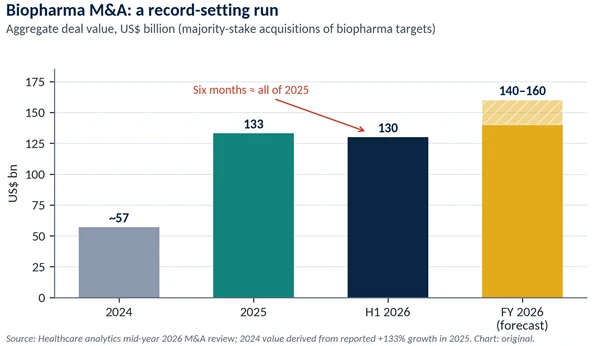
Figure 1: First-half 2026 pharma M&A value nearly equalled the full-year 2025 total, with forecasts pointing to another record year.
Yet this wave differs sharply from the mega-mergers of earlier cycles. Instead of combining two large companies to extract cost savings, buyers are targeting a focused lead programme or a tightly defined platform, usually at a clinical or commercial stage where efficacy signals are already visible. Cardiometabolic disease, immunology, oncology, neuroscience and radiopharmaceuticals dominate target lists. Precision, not scale, is the organising principle.
This shift matters for European acquirers in two ways. Competition for de-risked clinical assets has intensified, lifting premiums and shortening the window in which a target can be secured on sensible terms. And precision acquisitions place more weight on scientific diligence than on financial engineering. Boards that once judged a transaction mainly on earnings accretion now need a firm view on mechanism of action, differentiation against emerging rivals and the realistic probability of regulatory success.
Licensing Becomes the Pharma Industry's Preferred Currency of Risk
If M&A supplies the headlines, licensing is the engine room. Announced licensing value reached about US$166.7 billion in the first half of 2026, ahead of acquisition value over the same period. The more revealing statistic is its composition: only around 6% was paid as upfront cash. The remaining 94% depends on development, regulatory and commercial milestones that may or may not be reached.
This structure is not an accident; it is the design. Milestone-weighted agreements let a licensee pay in proportion to evidence, handing a large share of scientific risk back to the originator while keeping the right to scale investment once data mature. For the originator, a moderate upfront payment and the prospect of substantial downstream income can fund a pipeline without giving up the company.
For C-suite leaders, the implication is that headline licensing values should be read as ceilings rather than commitments. The economically meaningful questions sit in the detail: which milestones are near-term and realistically achievable, how royalty tiers rise with sales, what opt-out rights exist, and who controls development decisions at each stage. Two agreements with identical headline figures can carry very different risk profiles and very different strategic consequences.
Cross-Border Licensing and the Eastern Tilt of the Pharma Pipeline
No change in the licensing landscape has been more consequential than the rise of Greater China as a source of innovative assets. Cross-border out-licensing value from the region climbed from roughly US$13.9 billion in 2021 to around US$137.7 billion in 2025, a near-tenfold jump, and approximately US$60 billion more was signed in the first quarter of 2026 alone. The region now represents an estimated third of global licensing value, and Chinese companies were the sellers in eight of the ten largest licensing transactions worldwide during the first half of 2026.
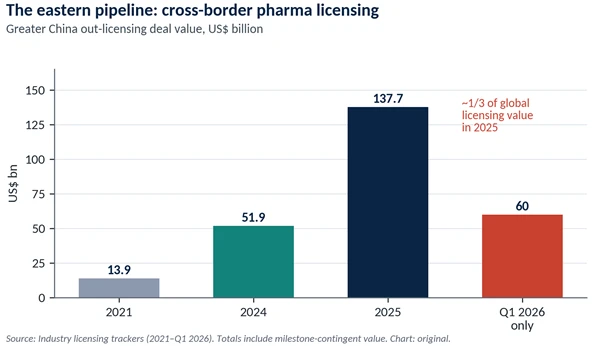
Figure 2: Asset sourcing has shifted east, with Greater China's out-licensing value rising almost tenfold in four years.
The drivers are well understood: rapid and cost-efficient early clinical development, large patient populations for trial enrolment, and a deep pool of biotech companies iterating quickly on validated targets in fields such as antibody–drug conjugates, bispecific antibodies and metabolic peptides. Typical agreements give the Western partner rights outside Greater China while the originator keeps its home market.
For European companies, this channel offers access to differentiated molecules at earlier stages and lower cost than buying equivalent Western biotechs. It also raises new considerations. Prices for high-quality Chinese assets are expected to climb as competition sharpens. Proposed outbound investment screening in the United States could bring certain licensing arrangements under government review, adding uncertainty to timelines. Data generated largely in one population must be bridged to satisfy European regulators. Leaders who treat Asian sourcing as a permanent capability, backed by dedicated scientific scouting, regulatory planning and geopolitical scenario analysis, will capture more value than those who approach it one deal at a time.
From Alliance to Acquisition: Reading the Pharma Partnership Continuum
The most sophisticated business development teams no longer ask whether to license or to acquire. They ask where on a spectrum of control a given opportunity belongs today, and how the relationship could evolve tomorrow.
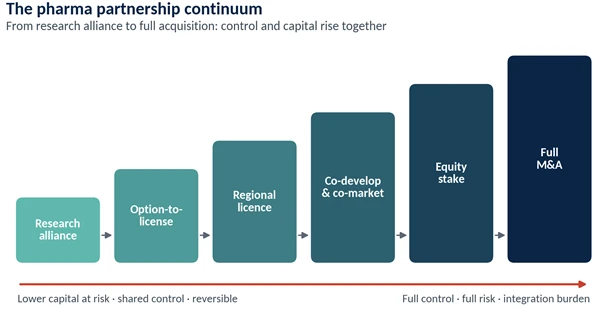
Figure 3: Pharma partnership structures form a continuum in which control, capital at risk and integration burden rise together.
At one end sit research alliances and option-to-license agreements, where capital at risk is limited and exit is simple. Regional licences and co-development deals occupy the middle ground, sharing cost and upside while leaving the originator independent. Minority equity stakes add alignment and often an information advantage ahead of any future bid. Full acquisition sits at the far end, bringing complete control but also full exposure to scientific failure and the heavy work of integration.
Table 1: Matching the pharma deal instrument to the opportunity
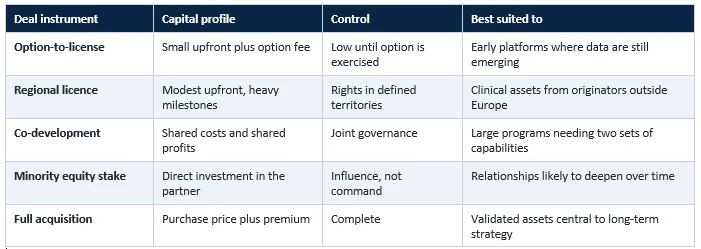
The strategic power of this continuum lies in sequencing. A company can begin with a narrow collaboration, observe its partner's execution and data quality, and then deepen the relationship in stages. Several of the largest acquisitions of recent years followed exactly this route, with the eventual buyer having worked alongside its target for years before making an offer.
Europe's New Rulebook Reprices Every Pharma Deal
European executives must now layer a changing regulatory framework onto every valuation model. Under the reformed general pharmaceutical legislation agreed in late 2025, the standard eight years of regulatory data protection remain, but baseline market protection falls from two years to one. Additional protection must be earned through conditions such as broad supply across member states or addressing unmet medical need, with the combined maximum still reaching eleven years.
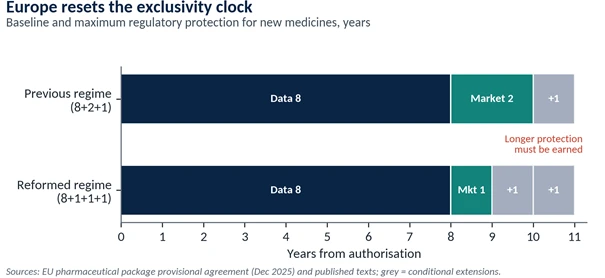
Figure 4: Under the reformed EU framework, pharma exclusivity beyond nine years becomes conditional rather than automatic.
In practice, exclusivity becomes less automatic and more dependent on commercial behaviour. For acquirers and licensees, forecasting peak revenue and exclusivity loss for a European launch now requires explicit assumptions about which extensions a product can realistically secure. Milestone triggers and royalty durations should be drafted with these variables in mind rather than copied from templates built for the old regime.
In parallel, the European Commission published its proposed Biotech Act in December 2025, aiming to streamline clinical trial procedures, harmonize data rules and strengthen biomanufacturing capacity, and a multi-country fast-track pilot for trial authorizations began operating in January 2026. If these measures deliver faster and more predictable development timelines, European biotech assets could grow more attractive to international buyers and more valuable to domestic partners. Companies with European research footprints may find that partnering close to home becomes a credible alternative to sourcing abroad.
Case Study: A Once-Monthly Obesity Licensing Pact Built One Deal at a Time
Few recent transactions illustrate modern partnership design as clearly as the collaboration a UK-headquartered pharmaceutical major signed in January 2026 with a Hong Kong-listed Chinese drug maker. The agreement spans eight long-acting weight-management programs, access to the partner's AI-enabled molecular design capabilities and a proprietary technology intended to allow once-monthly injections.
The financial architecture is revealing. The licensee committed US$1.2 billion upfront, with up to US$3.5 billion in development and regulatory milestones and up to US$13.8 billion in sales-based payments, plus tiered royalties, for a potential total of US$18.5 billion. Upfront cash therefore represents roughly 6.5% of headline value, closely mirroring the wider market pattern.
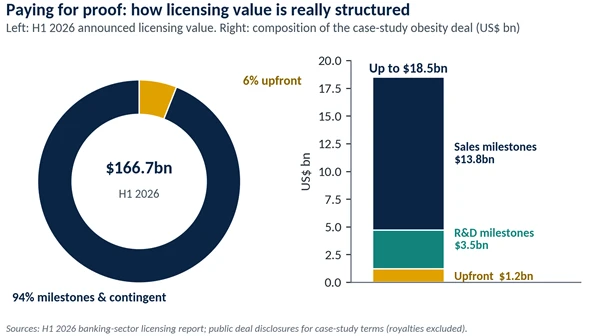
Figure 5: Milestone-weighted economics dominate both the wider pharma licensing market and the case-study obesity agreement.
The division of labour is equally deliberate. The originator continues development through the end of Phase I, after which the licensee takes responsibility for global development and commercialization outside Greater China. The originator keeps its home territories, and the licensee holds an option to co-commercialize there. The agreement also opens the way to applying the dosing technology to the licensee's own metabolic pipeline, extending value beyond the licensed molecules.
What makes the case compelling is its history. The two companies first partnered in 2024 on a single preclinical cardiovascular candidate with a US$100 million upfront payment, broadened into AI-driven discovery of oral chronic-disease medicines in 2025, and added a kidney-disease discovery collaboration in mid-2026. Each deal built trust, validated execution and widened scope, turning a transactional relationship into a strategic one. Commentators noted that the structure delivered an entire obesity portfolio for less than acquiring a comparable biotech outright, where recent takeovers in the field have reached around US$10 billion.
The lesson for European leaders is that partnership scale can be assembled step by step, and that the right structure can deliver acquisition-like breadth without acquisition-like capital exposure.
Where Pharma M&A and Licensing Partnerships Win or Lose Their Value
Signing a transaction marks the start of value creation, not its end. Three disciplines consistently separate successful pharma partnerships from disappointing ones.
The first is integration and governance design. In acquisitions, the greatest danger is often cultural: absorbing an agile biotech into a large organization can slow decisions and prompt the departure of the scientists who created the asset. Many acquirers now keep target teams as semi-autonomous units with protected budgets. In licensing, joint steering committees need clear escalation routes, because disputes over trial design or indication priority can stall programs for months.
The second is portfolio-level thinking. Each transaction should be judged against the combined risk of the whole pipeline, avoiding heavy concentration in a single mechanism or therapeutic area where competitive dynamics can change quickly, as the crowded obesity field shows.
The third is scenario planning for policy and geopolitics. Drug pricing reforms, outbound investment rules and trade measures can reshape an asset's value after signing. Contractual flexibility, including territory carve-outs, change-of-control provisions and restructuring rights, is becoming as important as the headline price.
Conclusion: Turning M&A and Licensing into a Pharma Innovation Engine
Biopharma M&A and licensing are no longer occasional tools for plugging pipeline gaps; they have become the main architecture through which innovation reaches patients. The evidence from 2025 and 2026 points to a market where capital is plentiful, competition for quality assets is fierce, and value depends increasingly on structure rather than size.
For European C-suite leaders, the opportunity is substantial but calls for deliberate choices. Companies that pair rigorous scientific diligence with global sourcing capabilities, that sequence partnerships to build conviction before committing full capital, and that write agreements fit for Europe's new regulatory reality will be best placed to convert today's deal making surge into lasting therapeutic and commercial advantage. The partnerships signed this year will shape the medicines, and the market leaders, of the next decade.

Lakshmi is a science writer with a foundation in the laboratory. She earned her master's in biotechnology and trained through research internships at ICGEB (JNU) and DIPAS, DRDO, with her work appearing in the Egyptian Journal of Veterinary Sciences. Now APCRM-certified and part of the editorial team at Pharma Focus America and Pharma Focus Europe, she reports on pharmaceutical technology, research, and innovation — giving complex science a clear and confident voice for industry leaders.