

Beyond Trial Completion: Post-Trial Responsibilities and Effective Dissemination of Clinical Research
Mirza R. Baig, Professor, Dubai Medical University
The completion of a clinical trial marks the end of data collection but not the end of research responsibility. The scientific and ethical value of a trial is realized only when its findings are disseminated, interpreted, and translated into improved health outcomes. This brief communication highlights key post-trial responsibilities, including results reporting, participant communication, scientific publication, data sharing, post-trial access, ongoing safety surveillance, and knowledge translation. It argues that post-trial activities should be integrated into trial planning and regarded as essential components of the clinical research lifecycle. Ultimately, a clinical trial should be considered complete only when the knowledge generated through participant contributions has been responsibly returned to science, healthcare, and society.
Clinical trials are the cornerstone of evidence-based medicine and pharmaceutical innovation. Through the systematic evaluation of interventions, they provide the evidence required to assess efficacy, safety, and value for patients and healthcare systems. However, the completion of participant follow-up does not signify the completion of a trial's ethical and scientific obligations. Rather, it marks the beginning of a critical phase during which trial findings must be transformed into accessible knowledge capable of informing healthcare decisions.
Participants who enroll in clinical trials frequently accept inconvenience, uncertainty, and potential risks with the understanding that their contribution will advance medical knowledge and benefit future patients. This social and ethical contract creates obligations not only to conduct the research according to accepted scientific standards but also to ensure that the resulting knowledge is disseminated and utilized effectively. Failure to report or communicate findings undermines the contribution of participants and diminishes the societal value of clinical research.
Modern approaches to clinical research increasingly recognize that generating evidence is only one component of a broader evidence ecosystem. Findings must subsequently be interpreted, communicated, incorporated into syntheses, translated into policy and clinical guidance, and ultimately implemented within healthcare systems. Consequently, post-trial activities represent an essential extension of the research process rather than an administrative endpoint.
The Post-Trial Evidence Pathway
The transformation of research data into patient benefit is a complex and sequential process. Following completion of a clinical trial, data must undergo verification, statistical analysis, and scientific interpretation. Results are then disseminated through publications, registries, conferences, and other communication channels before being incorporated into systematic reviews, guidelines, regulatory assessments, and clinical decision-making.
This process may be conceptualized as an evidence pathway:
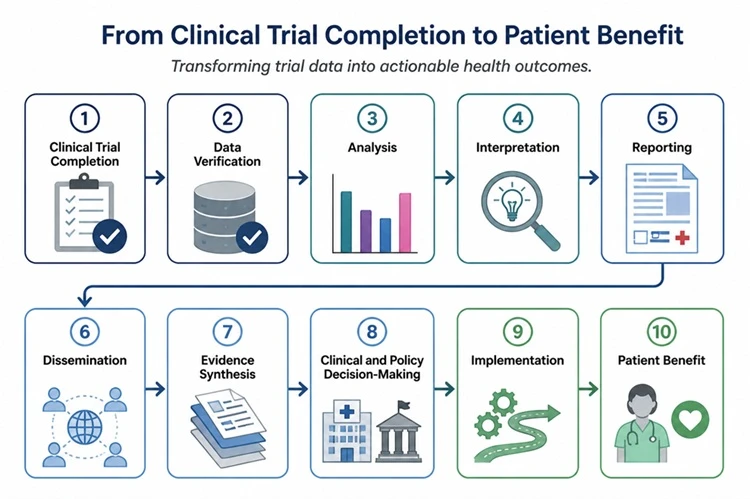
Weaknesses at any stage can diminish the impact of otherwise high-quality research. A rigorously conducted study that remains unpublished contributes little to medical knowledge. Conversely, rapid dissemination of poorly interpreted findings may generate misinformation and lead to inappropriate healthcare decisions. Therefore, post-trial strategies must balance timeliness with scientific rigor and transparency.
Evidence generation should not be viewed as a single event but as a continuum through which data become knowledge and knowledge becomes action. The scientific community increasingly recognizes that the effectiveness of this transition is a critical determinant of research value.
Results Reporting as an Ethical Obligation
Comprehensive reporting of clinical trial findings is central to research integrity. International standards emphasize that all clinically relevant findings, including positive, negative, and inconclusive results, should enter the public domain. Historically, selective publication has been a major source of bias within biomedical literature. Positive findings are more likely to be published than negative results, creating an incomplete evidence base that may exaggerate treatment benefits and underestimate risks. Such distortions affect clinicians, guideline developers, regulators, health technology assessment agencies, and policymakers who rely on published evidence for decision-making. Negative findings are scientifically valuable because they prevent unnecessary duplication of research, challenge prevailing hypotheses, identify limitations in intervention development, and redirect resources toward more promising approaches.
Accordingly, trial success should not be defined solely by demonstration of efficacy. A well-designed study that generates reliable negative results still contributes importantly to scientific knowledge. Consistent with this perspective, the WHO continues to emphasize timely registration and public disclosure of trial results as essential components of responsible clinical research.
Communication with Trial Participants
An increasingly prominent component of post-trial responsibility concerns the communication of results to participants. Historically, many participants never learned the outcomes of the studies in which they enrolled. Such practices conflict with contemporary principles of patient-centered research and respect for persons. Participants are not merely sources of data. They are stakeholders who enable the generation of evidence. Providing accessible information regarding study outcomes acknowledges their contribution and supports public trust in clinical research. The revised Declaration of Helsinki reinforces this principle by emphasizing transparency and participant engagement throughout the research lifecycle.
Communication strategies should extend beyond traditional scientific formats. Peer-reviewed articles are often inaccessible to non-specialist audiences because of technical language and statistical complexity. Plain-language summaries offer an effective alternative. These summaries should explain the rationale for the study, the interventions evaluated, key findings, major adverse events, clinical implications, and remaining uncertainties. Importantly, the objective is not to oversimplify scientific findings but to enhance understanding. Effective participant communication promotes respect, transparency, and accountability while strengthening relationships between researchers and research communities.
Publication and Scientific Interpretation
Scientific publication remains the principal mechanism through which clinical trial findings enter the scholarly literature. High-quality publications provide rigorous descriptions of study design, participant characteristics, interventions, outcome measures, statistical analyses, limitations, and clinical relevance. Nevertheless, publication should not be viewed as the final objective of clinical research. Rather, it serves as a bridge between evidence generation and evidence utilization. Researchers have a responsibility to present findings accurately and proportionately, avoiding exaggeration or selective interpretation.
A particular challenge involves distinguishing statistical significance from clinical significance. Findings may achieve statistical significance while providing only marginal clinical benefit. Conversely, clinically important trends may fail to achieve conventional significance thresholds because of sample size limitations or study design constraints. Therefore, meaningful interpretation requires consideration of effect size, confidence intervals, biological plausibility, and relevance to patient care. Furthermore, no single clinical trial constitutes definitive evidence. Individual studies must be interpreted within the broader context of existing literature, systematic reviews, and accumulated clinical experience. Evidence-based healthcare depends on integration rather than reliance on isolated findings. Consequently, the most important question following publication is not simply whether results are statistically significant, but how they modify current understanding and influence future decision-making.
Data Sharing and Research Transparency
The growing emphasis on open science has intensified discussions regarding clinical trial data sharing. Secondary access to trial datasets can facilitate independent verification, meta-analysis, methodological innovation, and exploration of novel research questions. However, unrestricted access is rarely appropriate. Clinical trial datasets often contain sensitive personal information, and re-identification risks may persist even after removal of direct identifiers. Responsible data-sharing policies therefore require robust governance structures encompassing informed consent, privacy protection, secure access environments, and oversight mechanisms. A balanced approach recognizes both scientific value and ethical responsibility. The objective is to maximize opportunities for legitimate scientific inquiry while protecting participant confidentiality. This aligns with contemporary regulatory and ethical frameworks that promote transparency without compromising individual rights.
Researchers increasingly adopt the principle that data should be "as accessible as possible and as protected as necessary." Such an approach supports reproducibility and accountability while maintaining public trust.
Post-Trial Access and Continuing Care
Certain studies involve interventions that continue to provide benefit after completion of a trial. In these circumstances, ethical considerations may extend beyond dissemination to include post-trial access arrangements. The 2024 revision of the Declaration of Helsinki highlights the importance of prospectively considering how participants may access beneficial interventions following study completion. Decisions regarding continuation depend on factors such as disease severity, evidence strength, and safety profile, availability of alternatives, regulatory status, and practical feasibility.
Planning for post-trial access should begin during protocol development rather than after study closure. Clear policies concerning eligibility, duration of access, monitoring requirements, and funding mechanisms promote transparency and equitable treatment of participants. Although a universal approach is not feasible, proactive planning demonstrates a commitment to participant welfare and ethical stewardship.
Pharmacovigilance and Real-World Evidence
The completion of a clinical trial does not signify the end of evidence generation. Certain adverse events emerge only after prolonged exposure, use in larger populations, or administration within more diverse clinical settings. Post-marketing pharmacovigilance therefore remains an essential component of therapeutic evaluation. Routine clinical practice often involves patient populations that differ substantially from those enrolled in trials. Patients may be older, have multiple comorbidities, receive concomitant medications, and exhibit varying levels of adherence. Consequently, observational evidence complements findings generated under controlled experimental conditions.
Real-world data sources, including electronic health records, disease registries, insurance claims databases, and patient-reported outcomes, provide opportunities to examine effectiveness, utilization patterns, and long-term safety. While such evidence cannot replace randomized controlled trials, it can address important questions that may be impractical or impossible to evaluate within traditional trial designs. Increasingly, healthcare systems are adopting learning-health-system models in which clinical research and routine care become interconnected. Under these models, post-trial evidence generation contributes to a dynamic and continuously evolving evidence base.
Digital Dissemination and Artificial Intelligence
Digital technologies have fundamentally transformed scientific communication. Trial registries, online journals, digital repositories, webinars, visual abstracts, and social media platforms enable rapid dissemination of findings to diverse audiences. Compared with traditional publication models, these approaches can accelerate access to evidence and broaden stakeholder engagement. However, speed introduces new challenges. Complex findings may be condensed into oversimplified messages, preliminary analyses may be disseminated before adequate peer review, and relative treatment effects may be emphasized without appropriate contextualization.
Artificial intelligence is likely to further influence post-trial activities. Potential applications include literature surveillance, automated summarization, translation, evidence synthesis, and large-scale data analysis. These capabilities may reduce the time required to communicate and interpret evidence. Yet AI also presents important limitations. Automated systems can generate inaccuracies, overlook uncertainty, or reproduce biases embedded within training data. Consequently, scientific accountability cannot be delegated to algorithms. Human expertise remains essential to ensure accurate interpretation, ethical oversight, and responsible communication. The appropriate role of AI is therefore supportive rather than substitutive. Automation may enhance efficiency, but responsibility for scientific conclusions must remain with qualified researchers.
Redefining Clinical Trial Success
Traditional assessments of trial success focus on recruitment targets, protocol compliance, endpoint achievement, database integrity, and regulatory milestones. While these metrics are important, they provide only a partial assessment of research value.
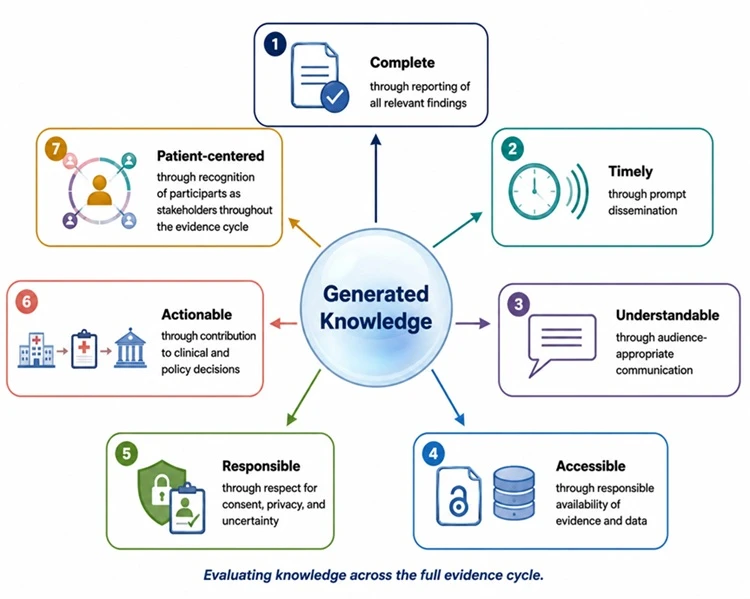
This broader perspective aligns scientific success with societal benefit and encourages a culture in which dissemination and implementation are regarded as integral research outputs.
Conclusion
Clinical trials should not be viewed as isolated scientific events that conclude with database lock or primary endpoint analysis. Rather, they are components of a broader evidence ecosystem in which knowledge is continually generated, interpreted, disseminated, and applied. Post-trial responsibilities encompass transparent reporting, participant communication, scientific publication, responsible data sharing, post-trial access planning, ongoing pharmacovigilance, generation of real-world evidence, and effective knowledge translation. Together, these activities ensure that the contributions of research participants are transformed into meaningful benefits for patients and society.
As pharmaceutical development and healthcare systems increasingly adopt learning evidence models, the distinction between "during the trials" and "after the trial" is becoming less rigid. Evidence generation continues beyond formal study completion, supported by digital technologies, real-world data, and emerging analytical tools. Nevertheless, technological innovation cannot replace scientific rigor, ethical responsibility, and human accountability. Ultimately, a clinical trial reaches its full scientific and societal value only when the knowledge generated through participant contributions is responsibly returned to healthcare systems and used to improve patient outcomes.
References
1. Chan, A.-W., Karam, G., Pymento, J., Askie, L. M., da Silva, L. R., Aymé, S., et al. (2025). Reporting summary results in clinical trial registries: Updated guidance from WHO. The Lancet Global Health, 13(4), e759-e768. https://doi.org/10.1016/S2214-109X(24)00514-X
2. ClinicalTrials.gov. (n.d.). Clinical trial reporting requirements. U.S. National Library of Medicine. Retrieved October 1, 2026, from https://clinicaltrials.gov/policy/reporting-requirements
3. International Council for Harmonisation of Technical Requirements for Pharmaceuticals for Human Use. (2025). ICH harmonised guideline E6(R3): Guideline for good clinical practice. https://database.ich.org/sites/default/files/ICH_E6%28R3%29_Step4_FinalGuideline_2025_0106.pdf
4. U.S. Food and Drug Administration. (2025). E6(R3) good clinical practice guidance for industry. https://www.fda.gov/regulatory-information/search-fda-guidance-documents/e6r3-good-clinical-practice-gcp
5. World Health Organization. (2015). WHO statement on public disclosure of clinical trial results. World Health Organization. https://cdn.who.int/media/docs/default-source/medicines/regulatory-updates/who_statement_results_reporting_clinical_trials.pdf
6. World Health Organization. (2025). Public disclosure of clinical trial results: Reporting on findings. World Health Organization International Clinical Trials Registry Platform. https://www.who.int/tools/clinical-trials-registry-platform/reporting-on-findings
7. World Medical Association. (2024). Declaration of Helsinki: Ethical principles for medical research involving human participants. https://www.wma.net/what-we-do/medical-ethics/declaration-of-helsinki/

Professor Mirza R. Baig is Professor of Pharmacy Practice and Program Director of the Master of Pharmacy (Clinical Pharmacy) programme at Dubai Medical University, UAE. With over 23 years of international experience across the UAE, Malaysia and India, he holds a PhD in Clinical Pharmacy from Universiti Sains Malaysia. His research focuses on clinical pharmacy, pharmacotherapy, medication safety and pharmaceutical care. He has published over 150 peer-reviewed papers and contributes to postgraduate supervision, research mentorship, curriculum development and international scientific conferences.