Antibody-Drug Conjugates (ADCs): Driving the Next Generation of Precision Oncology
Lakshmi, Editorial Team, Pharma Focus Europe
Antibody-drug conjugates have moved from salvage therapy to the strategic centre of precision oncology. With more than twenty ADCs approved worldwide and hundreds in development, the decisive questions facing European pharmaceutical leadership are operational rather than chemical: conjugation capacity, companion diagnostic readiness, toxicity management at scale, and evidence built for joint clinical assessment.
What Are Antibody-Drug Conjugates, and Why Do They Matter to Pharmaceutical Strategy?
An antibody-drug conjugate is a targeted cancer therapy that links a potent cytotoxic drug to a monoclonal antibody through a chemical linker, so the antibody delivers the payload directly to tumour cells expressing a chosen antigen. The design widens the therapeutic window: it concentrates cytotoxic activity where the target is expressed and limits the systemic exposure that constrains conventional chemotherapy. That is the whole precision oncology proposition, expressed in a single molecule.
For most of their history, antibody-drug conjugates were the pharmaceutical industry's most elegant disappointment. The concept dates to the 1980s and the first ADC approval arrived in 2000, yet for over a decade the field produced more withdrawn products than practice-changing ones. Linkers released their payload in circulation. Antibodies bound targets that healthy tissue also expressed. Therapeutic windows proved too narrow to dose safely.
That era has ended. Twenty-three ADCs are now approved globally across haematological malignancies and solid tumours, and the modality has become the most crowded space in oncology development. The US regulator awarded a record 63 review designations to antibody-drug conjugates in 2024, nearly double the 35 granted the previous year. More than 900 ADC clinical trials are registered worldwide, with over 200 candidates in active development. The strategic differentiator has shifted accordingly. Ten years ago the question was whether a conjugate would work. Today it is whether an organisation can manufacture it reliably, diagnose the patients who need it, manage its toxicity in routine practice, and prove its value to twenty-seven separate payers.
Antibody-Drug Conjugate Mechanism of Action: Three Design Levers That Decide Success
An ADC is not one product decision but three, and each carries distinct commercial consequences. The antibody determines where the drug goes; target selection sets tumour selectivity, internalisation efficiency and the size of the addressable population. The linker determines when the payload is released; cleavable chemistry allows the released cytotoxic to diffuse into neighbouring antigen-negative cells, the bystander effect that explains much of the modern generation's performance in heterogeneous tumours. The payload determines what the drug does, with potency class and drug-to-antibody ratio jointly defining both the efficacy ceiling and the toxicity that caps dosing.
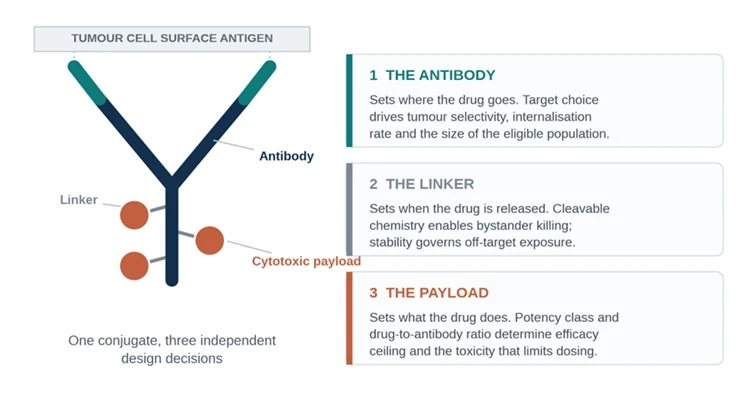
Figure 1: Antibody-drug conjugate structure and the three design levers - antibody, linker and cytotoxic payload.
The most consequential shift of the past five years sits in that third lever. Where earlier conjugates relied on microtubule inhibitors and DNA-damaging agents, topoisomerase I inhibitor payloads now dominate late-stage ADC development, precisely because their bystander activity extends benefit into tumours with patchy antigen expression. Each payload class also carries a signature toxicity profile that shapes how the conjugate can realistically be used.
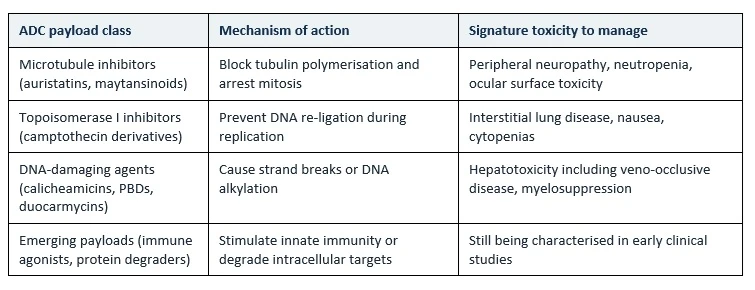
Table 1: ADC payload classes, mechanism of action and the toxicities that define their clinical management.
The ADC Pipeline in 2026: Why Antibody-Drug Conjugate Approvals Are Accelerating
More ADCs have been approved since 2019 than in the modality's first two decades combined. That acceleration is not evenly distributed. Development has concentrated around a narrow set of validated antigens, and target crowding is now a genuine commercial risk. Multiple sponsors are pursuing conjugates against the same antigens with differing linker and payload chemistry, which means late entrants can face a market where the clinical question has already been answered by a competitor's asset.
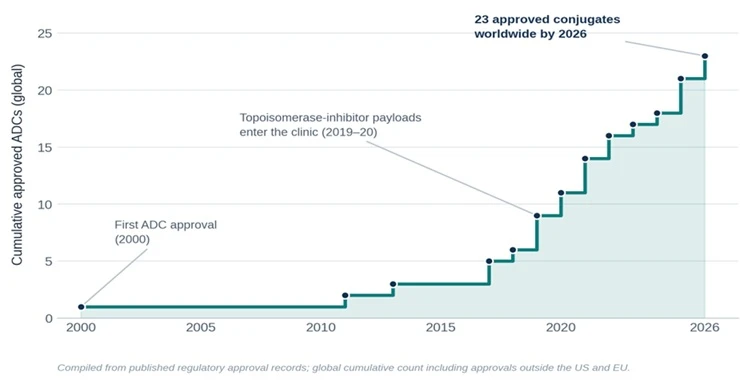
Figure 2: Cumulative global antibody-drug conjugate approvals, 2000 to 2026.
Differentiation in the ADC pipeline can therefore no longer rest on the target alone. It must come from therapeutic index, position in the treatment sequence, combination potential with checkpoint inhibitors, or the ability to serve a biologically defined population that competitors have not characterised. The programmes that succeed increasingly do so by expanding the definition of who is eligible for treatment.
ADC Case Study: How a HER2-Low Conjugate Created an Entirely New Patient Population
The clearest demonstration came from a Phase III trial in metastatic breast cancer, DESTINY-Breast04, testing a HER2-directed conjugate with a topoisomerase I inhibitor payload against physician's choice of chemotherapy. The population was unusual: 557 previously treated patients whose tumours scored HER2-low, defined as immunohistochemistry 1+, or 2+ with negative in situ hybridisation. Until that point these patients had been classified as HER2-negative and considered ineligible for HER2-targeted therapy altogether.
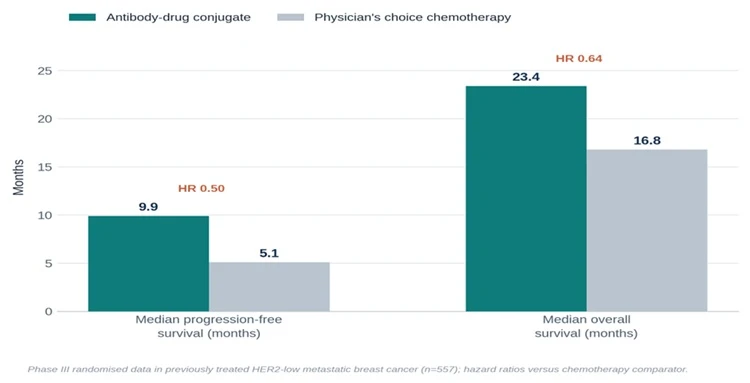
Figure 3: ADC versus chemotherapy outcomes in previously treated HER2-low metastatic breast cancer.
Median progression-free survival reached 9.9 months with the conjugate against 5.1 months with chemotherapy (hazard ratio 0.50), and median overall survival was 23.4 months against 16.8 months (hazard ratio 0.64). Extended follow-up at 32 months confirmed the durability of the survival advantage. Grade 3 or higher adverse events were less frequent with the conjugate than with chemotherapy, at 52.6 per cent versus 67.4 per cent, though adjudicated drug-related interstitial lung disease occurred in 12.1 per cent of conjugate-treated patients, with fatal events in 0.8 per cent.
The commercial lesson is not that the molecule was potent. It is that the trial created a patient population which had not previously existed as a commercial category, reclassifying roughly half of all breast cancers overnight. The asset did not compete for share within a defined market; it manufactured a new one by proving that a biomarker threshold treated as binary was in fact a continuum. The operational consequence in Europe was immediate: pathology laboratories had to be retrained to distinguish HER2-low from HER2-null, a distinction scoring practices were never designed to make reliably. Clinical value could not be realised until diagnostic infrastructure caught up.
ADC Manufacturing and CDMO Capacity: The Bottleneck Behind Every Conjugate
Producing an antibody-drug conjugate demands three industrial competencies that rarely sit under one roof: large-scale monoclonal antibody production, highly potent active pharmaceutical ingredient synthesis for the linker-payload, and cytotoxic bioconjugation under stringent containment. Few sponsors own the full chain internally, which has made conjugation capacity a genuine bottleneck and given specialist contract manufacturers unusual leverage. The dedicated ADC contract manufacturing market is forecast to grow from roughly $2 billion in 2026 to over $6 billion by 2031, and disclosed capital expenditure between 2023 and 2026 indicates a build-out cycle that has not yet stabilised.
That build-out carries documented downside. In May 2026, one of the modality's leading developers disclosed a charge of approximately $610 million tied specifically to overbuilt ADC manufacturing capacity contracted with external partners. Regulatory exposure through third-party sites is equally concrete: in a single week in June 2024, the US regulator issued complete response letters to two ADC programmes, one explicitly citing inspection findings at a contract manufacturing facility rather than any deficiency in the clinical data.
The board-level implication is that ADC manufacturing strategy must be committed far earlier than for a conventional antibody, and that vague assurances of available capacity should be treated as a warning sign. Containment classification, demonstrated conjugation scale, drug-to-antibody ratio consistency across batches and an unblemished inspection history are not procurement details in this modality. They determine whether an approval translates into supply.
ADC Market Access in Europe: Joint Clinical Assessment, IVDR and the Diagnostic Blind Spot
European ADC commercialisation faces a sequence of gates that does not exist in identical form elsewhere. Since January 2025, new oncology medicines have been subject to joint clinical assessment under the EU Health Technology Assessment Regulation, requiring a consolidated evidence dossier scoped against population, intervention, comparator and outcome parameters submitted by multiple member states. From 2026 that framework extends to high-risk medical devices and in vitro diagnostics. For a biomarker-defined antibody-drug conjugate, the medicine and the test that selects for it are moving into overlapping assessment processes on separate timelines.
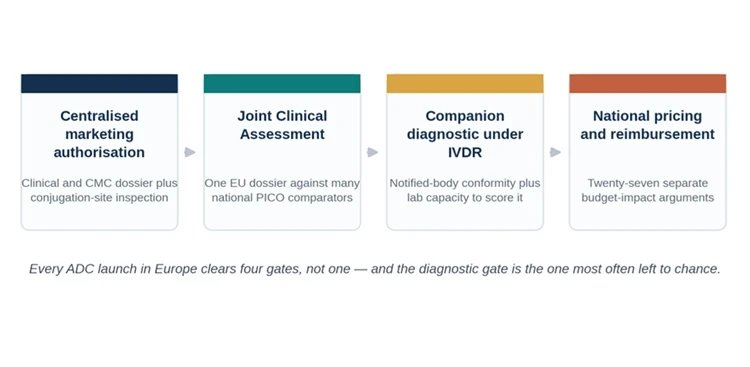
Figure 4: The four gates of European ADC market access, from marketing authorisation to national reimbursement.
The diagnostic gate is where most ADC launch plans are quietly weakest. Under the In Vitro Diagnostic Medical Devices Regulation, companion diagnostics require notified body conformity assessment with consultation of the medicines regulator on performance and safety, in a system where notified body capacity has been persistently constrained. A conjugate can hold a valid marketing authorisation across the Union while the assay identifying eligible patients remains unavailable at scale in national pathology networks. Joint clinical assessment compounds the problem, because diverse national comparator selections force sponsors into indirect treatment comparisons that a single pivotal trial was rarely designed to support. Diagnostic readiness and health technology assessment evidence generation therefore belong alongside Phase III, not downstream of it.
ADC Side Effects and Toxicity Management: A Commercial Risk, Not Only a Clinical One
Precision delivery reduces systemic exposure without eliminating it, and the toxicities characterising modern conjugates are distinctive and class-linked, as Table 1 sets out. These are commercial issues as much as clinical ones. An ADC whose safe use depends on prompt recognition of pneumonitis will underperform in centres without a defined dose-interruption pathway and timely access to imaging. Real-world outcomes that diverge from trial data damage payer confidence at exactly the moment reimbursement is being renegotiated. Investment in prescriber education, structured monitoring algorithms and pharmacovigilance infrastructure protects the asset's value rather than merely satisfying compliance.
The Future of Antibody-Drug Conjugates: Beyond Cytotoxic Payloads and Beyond Oncology
The conjugate architecture is proving more general than the cytotoxic payload that defined it. Immune-stimulating conjugates deliver innate immune agonists into the tumour microenvironment rather than killing cells directly. Degrader-antibody conjugates substitute targeted protein degradation for cytotoxicity, opening intracellular targets that resisted conventional drugging. Radioconjugates borrow the same targeting logic while replacing the chemical payload with a therapeutic isotope. Beyond oncology, early programmes are exploring conjugates delivering immunomodulatory payloads to defined immune cell populations in autoimmune disease. Each direction inherits the ADC's operational demands and adds new ones, so organisations building genuine bioconjugation competence now acquire an option on all of them.
Conclusion: The ADC Decade Will Reward Operators, Not Only Innovators
Antibody-drug conjugates have delivered what precision oncology promised: therapies that expand the definition of who can be treated rather than simply competing for existing patients. The HER2-low experience showed that a well-designed conjugate can reclassify a disease and create a market that did not previously exist, and that capability is repeatable across other tumour types and other imperfectly characterised biomarkers.
But the constraints have migrated. The scientific bottleneck has largely cleared; the bottlenecks now are conjugation capacity, containment-grade manufacturing, diagnostic infrastructure, toxicity management in routine practice, and evidence that survives assessment by many payers at once. None of these are solved in a laboratory. They are solved by executives who commit manufacturing partnerships early, fund diagnostic readiness as seriously as clinical development, and treat European market access as a design input rather than a downstream obligation. For the pharmaceutical C-suite, the question is no longer whether to participate in antibody-drug conjugates. It is whether the organisation has built the machinery to convert a conjugate that works into a conjugate that reaches patients.
Frequently Asked Questions About Antibody-Drug Conjugates
How do antibody-drug conjugates differ from conventional chemotherapy?
Conventional chemotherapy distributes cytotoxic activity throughout the body and is limited by the dose healthy tissue can tolerate. An antibody-drug conjugate attaches the same class of cytotoxic agent to an antibody that binds a tumour-associated antigen, concentrating exposure at the tumour. This widens the therapeutic window and allows the use of payloads too potent to administer systemically on their own.
How many antibody-drug conjugates are approved worldwide?
Twenty-three ADCs have been approved globally as of 2026, across haematological malignancies and solid tumours. The count varies between published sources depending on whether approvals outside the United States and European Union are included, and whether withdrawn and subsequently re-approved products are counted once or twice.
What are the main manufacturing challenges for ADCs?
ADC manufacturing combines biologics production, highly potent chemical synthesis and containment-grade bioconjugation, a combination few sponsors hold in-house. The practical challenges are securing conjugation capacity on a realistic timeline, maintaining consistent drug-to-antibody ratio across batches, and managing regulatory exposure at third-party sites, where inspection findings have delayed approvals independent of clinical data.
What does the EU HTA Regulation mean for ADC launches in Europe?
Since January 2025, new oncology medicines including antibody-drug conjugates undergo joint clinical assessment, producing a single EU-level clinical evidence review scoped against comparator questions from multiple member states. It does not replace national pricing decisions, so sponsors must satisfy a harmonised clinical assessment and then twenty-seven separate reimbursement processes, while the companion diagnostic proceeds through its own IVDR conformity route.

Lakshmi is a science writer with a foundation in the laboratory. She earned her master's in biotechnology and trained through research internships at ICGEB (JNU) and DIPAS, DRDO, with her work appearing in the Egyptian Journal of Veterinary Sciences. Now APCRM-certified and part of the editorial team at Pharma Focus America and Pharma Focus Europe, she reports on pharmaceutical technology, research, and innovation — giving complex science a clear and confident voice for industry leaders.