AI-Native R&D: Transforming Drug Discovery Through Intelligent Automation
Lakshmi, Editorial Team, Pharma Focus Europe
Artificial intelligence has moved beyond pilot projects into the architecture of pharmaceutical research itself. This article examines the shift from AI-enabled to AI-native R&D, in which closed-loop automation links design, synthesis and testing without a human hand-off at every step. It weighs the published clinical evidence, maps Europe's converging regulatory timelines, and sets out the data, capital and governance decisions that research leaders must take now.
Introduction: The Decade That Refuses to Get Shorter
For four decades, pharmaceutical research productivity has moved stubbornly in the wrong direction. A new medicine still takes ten to fifteen years to reach patients, at a capitalised cost approaching US$2.6–2.8 billion once the price of failure is properly counted. Roughly nine in ten candidates that enter clinical development never make it out. Every technological wave has promised to bend that curve. Combinatorial chemistry, high-throughput screening and the genomics revolution each dramatically expanded the number of things researchers could try, without improving the odds of choosing correctly.
Artificial intelligence now risks being read through the same lens — another instrument bolted onto a workflow designed in a different century. That reading misses what is actually under way. The organisations pulling ahead are not deploying AI to accelerate individual steps inside existing research processes. They are rebuilding research so that the steps themselves are orchestrated by machines, with scientists moving from operators to architects. The distinction between AI-enabled and AI-native is not semantic. It is where European boards should now be directing attention, capital and governance effort.
AI-Enabled Is a Tool. AI-Native Is an Operating Model.
In AI-enabled research, models sit at discrete points along an unchanged value chain: virtual screening here, toxicity prediction there, protocol optimisation somewhere downstream. Between each point, a human collects an output, interprets it, and decides what happens next. The value captured is real but bounded — typically weeks shaved from activities embedded within multi-year programmes, and easy for competitors to replicate, because it requires buying software rather than changing an organisation.
AI-native research inverts the relationship. The model does not serve the workflow; the workflow serves the model. Generative design proposes candidate structures, automated synthesis makes them, robotic assays test them, and the results return to the model as training data — without a human standing in the critical path of every cycle. Scientists set objectives, define constraints, adjudicate exceptions and retain accountability for what advances. What they give up is the role of message-carrier between systems that could speak to each other directly.
The consequence is a shift in what limits discovery. In an AI-native organisation, latency replaces accuracy as the binding constraint. A model that is five per cent more accurate but depends on a six-week experimental turnaround will be beaten by a marginally weaker model that closes its loop in four days, because the faster loop learns from its own errors more often. This is the single most important idea for executives to internalise: the compounding asset is cycle time, not model sophistication.
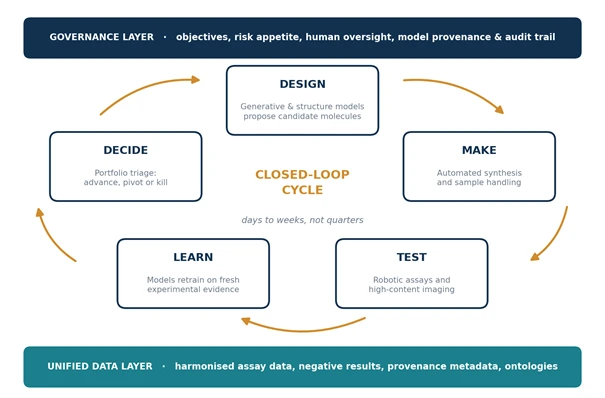
Figure 1: The AI-native closed loop. Value accrues from the speed of the full cycle, not the performance of any single component. The governance and data layers are what make the loop auditable in a regulated industry
Read the Evidence Ledger Before You Read the Press Release
The most useful published analysis of AI-discovered molecules in the clinic tells a bracingly specific story. Across the clinical pipelines of AI-native biotechnology firms, molecules discovered or designed using AI have shown Phase I success rates of roughly 80 to 90 per cent, against historical industry averages in the range of 40 to 65 per cent. In Phase II, however, success falls to approximately 40 per cent — statistically indistinguishable from the historic norm.
That pattern is not a disappointment. It is a precise diagnosis. AI has substantially solved a chemistry problem: generating molecules with drug-like properties, acceptable pharmacokinetics and manageable tolerability. It has not yet solved the biology problem: knowing whether a chosen target genuinely matters in human disease. Phase II is where value continues to be destroyed, and it is being destroyed at the same rate as before.
Two conclusions follow for anyone allocating capital. First, an investment case built on end-to-end probability-of-success uplift is not currently supported by the evidence; the case must rest on cycle time, throughput and optionality. Second, the genuine frontier is target validation rather than molecule generation — which means causal human biology, functional genomics, perturbation data and longitudinal real-world evidence are where the next tranche of value is likely to sit. Executives should also press for definitional discipline: the label "AI-discovered" spans everything from fully machine-generated molecules to conventional programmes that used a model somewhere along the way, and clinical registries rarely record AI provenance at all.
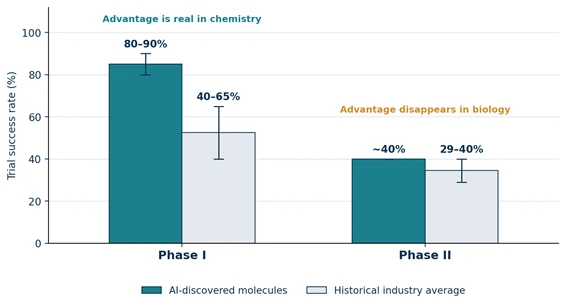
Figure 2: Clinical success rates for AI-discovered molecules against historical industry averages. The early-phase advantage is substantial; the late-phase advantage has yet to appear. Ranges reflect published analyses of a still-limited sample.
Speed Is Not the Prize — Optionality Is
Where AI-native methods have demonstrably changed the arithmetic is upstream. Programmes that once took three to four years to reach a nominated preclinical candidate have been completed in twelve to eighteen months, and widely cited analyses put time and cost savings up to the preclinical stage in the range of 25 to 50 per cent.
The strategic value, however, is not the saved months. It is what compressed cycles do to portfolio behaviour. More hypotheses can be tested per unit of capital, which raises the number of genuine shots on goal. Failure arrives earlier and more cheaply, so a kill decision lands at month eight rather than month thirty — and a programme that took eight months to build is psychologically far easier to stop, which quietly weakens the sunk-cost bias that distorts portfolio reviews everywhere. Smaller indications and rare diseases become economically viable, because the discovery cost that must be recovered has fallen. Taken together, these effects change the shape of the pipeline rather than merely its pace.
This argues for retiring a familiar metric. Cost per full-time equivalent measures the efficiency of an input. In an AI-native organisation, the meaningful figure is cost per validated hypothesis — and boards should ask to see it.
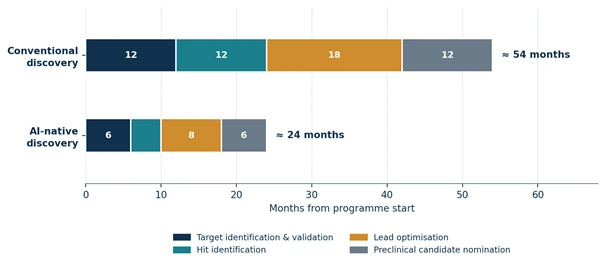
Figure 3: Illustrative discovery timelines, composited from published ranges. The compression is concentrated in the stages where iteration dominates; regulatory and manufacturing stages downstream are largely unaffected.
Europe's Regulatory Clock Is Now a Board Agenda Item
European research leaders face a regulatory calendar that no other region shares, and it cuts in two directions at once. On the AI side, the Act entered into force in August 2024, with prohibitions applying from February 2025 and general-purpose model obligations from August 2025. Amendments adopted in mid-2026 deferred the most operationally demanding tier: obligations for stand-alone high-risk systems now apply from December 2027, and for AI embedded in regulated products from August 2028. Transparency duties and enforcement powers over general-purpose models landed as scheduled in August 2026.
The nuance matters. Most discovery-stage models are unlikely to be classified as high-risk. But models that inform trial eligibility, contribute to safety signal detection, or become embedded within regulated devices and diagnostics may well be — and the practices that high-risk classification demands, including data governance, technical documentation, logging, human oversight and post-market monitoring, are precisely the practices that make an AI-native platform auditable in the first place. Treating them as compliance overhead rather than platform architecture is a false economy.
The second timeline is the more interesting one. The European Health Data Space Regulation came into force in March 2025, becomes generally applicable in March 2027, opens most secondary-use provisions in March 2029, and extends to genomic and clinical trial data in March 2031. Access will run through national health data access bodies and a cross-border infrastructure, on a permit basis, with scientific research an explicitly permitted purpose. For European R&D this is a structural asset: a harmonised, legally grounded route to population-scale clinical data of a kind that is considerably harder to assemble elsewhere in the world.
The strategic implication is uncomfortable but clear. European companies habitually frame regulation as friction. Here it is closer to a call option with a known expiry. Organisations that build permit-ready data governance and model documentation during the 2026–2028 window will be able to draw on that data pool from 2029. Those that wait will spend 2029 to 2031 building the capability their competitors will already be using.
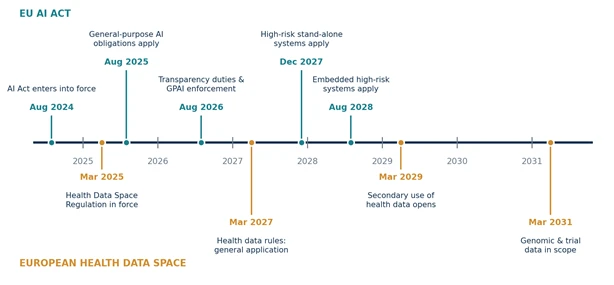
Figure 4: Europe's two converging regulatory timelines. The AI framework sets the conditions under which models may be deployed; the health data framework determines what they can learn from.
The Bottleneck Nobody Budgets For
Three constraints reliably decide whether an AI-native ambition becomes an operating reality, and none of them is computational.
The first is make-test capacity. Generative models can propose more molecules than any wet laboratory can synthesise. Unless automation of synthesis, sample handling and assay is funded on the same schedule as computation, the loop simply does not close: the organisation acquires a faster idea generator feeding an unchanged queue, and measures its progress in backlog. Capital allocation between computational and physical capability must be deliberately symmetric.
The second is data debt. Most historic assay data was never structured for machine consumption — protocols drift between sites and years, metadata is thin, and negative results were routinely discarded as uninteresting. Models learn as much from failures as from successes, and an archive that records only what worked teaches an expensively distorted view of chemical space. Retrofitting decades of legacy data is slow and costly; instrumenting new experiments for machine readability from the first day is comparatively cheap, and the gap between those two costs widens every quarter the decision is deferred.
The third is decision rights. If a model recommends terminating a programme and the therapeutic area head overrules it every time, the organisation has bought a very expensive dashboard. Governance must specify in advance which decisions are model-led, which are model-informed, who may override, on what evidence, and with what record. The associated talent question is subtler than headcount: the scarce profile is neither the machine learning researcher nor the medicinal chemist, but the person fluent enough in both to recognise when a model's confident output is chemically absurd.
Five Questions Every R&D Board Should Be Asking
1. What is our median design–make–test cycle time today, and what would halving it be worth to the portfolio?
2. What proportion of our experimental data from the past five years is machine-readable — including the negative results?
3. Is our laboratory automation capital keeping pace with our computational spend, or are we funding a longer queue?
4. Which of our models would fall within the high-risk tier under European rules, and could we produce the documentation today?
5. Are we positioned to draw on European health data access routes from 2029, or will we begin preparing in 2029?
Conclusion: The Advantage Compounds Quietly
AI-native R&D will not announce itself with a single dramatic approval. Phase II attrition will not collapse next year, and the first regulatory clearance of a fully machine-designed molecule will prove less about the technology than the headlines will suggest. The change will surface instead as organisations that run more experiments, learn from each one faster, and stop bad programmes earlier — advantages that are close to invisible quarter by quarter and decisive across a decade.
For European leadership teams, the question is no longer whether to adopt artificial intelligence. That is settled. The question is whether to adopt it as a tool, which delivers incremental gains that competitors can buy their way to within a year, or as an operating model, which demands the simultaneous rebuilding of data infrastructure, laboratory automation and decision governance — and which, once established, is extremely difficult to replicate.
The regulatory calendar has usefully clarified the timetable. Between now and 2029, Europe's frameworks for artificial intelligence and for health data will settle into their mature form. That interval is roughly the length of one discovery-to-candidate cycle under the old model, and three under the new one. Which cadence a company is running by then will largely determine whether it competes on the next decade's terms or the last one's.

Lakshmi is a science writer with a foundation in the laboratory. She earned her master's in biotechnology and trained through research internships at ICGEB (JNU) and DIPAS, DRDO, with her work appearing in the Egyptian Journal of Veterinary Sciences. Now APCRM-certified and part of the editorial team at Pharma Focus America and Pharma Focus Europe, she reports on pharmaceutical technology, research, and innovation — giving complex science a clear and confident voice for industry leaders.