AI-Native Pharmaceutical Manufacturing: Transforming the Smart Factory
Lakshmi, Editorial Team, Pharma Focus Europe
The smart factory made pharmaceutical manufacturing measurable. AI-native manufacturing makes it decisive. This article sets out what distinguishes an AI-native plant from a merely instrumented one, the architecture and data discipline it demands, and the European regulatory expectations now shaping deployment. An anonymised sterile injectables case illustrates the operating-model shift, and a staged roadmap identifies where boards should commit capital first, and what governance must travel with it.
Introduction: The Plant That Reports and the Plant That Decides
Most European manufacturing leaders have already paid for a smart factory. Sensors were installed, historians consolidated, execution systems layered over the batch record, and dashboards commissioned and mounted on shop-floor screens. The plant became visible. What it rarely became was decisive. Information now moves faster than it did a decade ago, yet the decisions that carry real cost and risk — hold or release, adjust or wait, investigate or continue — still queue behind the same sequence of human review, meeting cadence and paper-derived approval that shaped the site long before any of the instrumentation arrived.
AI-native manufacturing is the correction to that gap, and the correction is architectural rather than cosmetic. It describes a plant designed on the assumption that models are production assets, that data contextualisation is an engineering discipline rather than an IT afterthought, and that a defined class of operational decisions will be executed by systems under human oversight rather than initiated by human attention. For executives weighing capacity constraints in sterile injectables and biologics against relentless pressure on cost of goods, the distinction is not semantic. It determines whether the next tranche of capital buys a better reporting layer or a materially different cost and quality curve.
Four Tests That Separate the AI-Native Plant From the Merely Instrumented
A useful diagnostic can be applied during a single site walk-through. First: does any model hold a control action, or do all models merely advise? An AI-native plant has at least one closed or semi-closed loop in which an inferred value moves a set-point within a qualified design space. Second: is data contextualised at the point of capture? If reconciling a spectroscopic trace to a batch, an equipment train and a raw-material lot still requires manual effort, no amount of downstream modelling will scale. Third: are models under lifecycle control equivalent to that applied to equipment — versioned, qualified, monitored for drift and retired against defined criteria? Fourth: does the organisation hold a documented rule for when a human must intervene, and evidence that the rule is exercised?
Sites that fail these tests are not failing at artificial intelligence. They are running pilots. The characteristic pattern across the sector has been a proliferation of proofs of concept that demonstrate technical feasibility and then stall at the qualification boundary, because nobody defined in advance what a validated model looks like, or who owns it once the data scientist moves to the next project.
The architecture that survives that boundary has four layers and one vertical, set out in Figure 1. Sensing and control supply the signal. A contextualised data fabric gives the signal meaning — batch genealogy, equipment state, material lot, environmental condition. The model layer converts meaning into inference. The decision layer converts inference into action within pre-agreed limits. Governance runs vertically through all four, because validation, change control, drift monitoring and human oversight cannot be retrofitted to a layer designed without them.
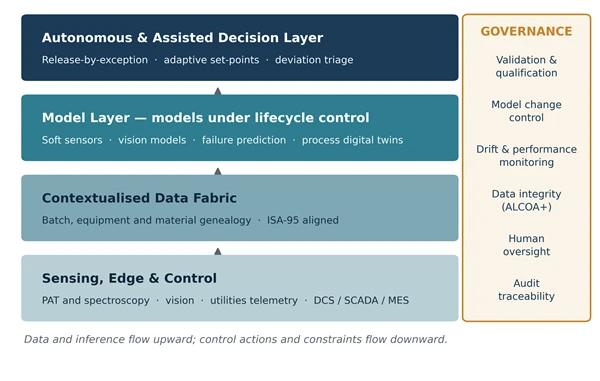
Figure 1: The four-layer AI-native manufacturing stack, with governance as a vertical control across every layer.
Where the Value Concentrates — and in What Order It Should Be Pursued
Executive attention is scarce, and the temptation is to fund the most visible use case rather than the best-sequenced one. Value accumulates along two axes: strategic contribution and qualification burden (Figure 2).
Near-term returns cluster in decisions that are frequent, repetitive and currently absorb scarce skilled labour. Deviation triage is the clearest example. A large sterile site may open several thousand records a year, most of them recurrences of known patterns; models that classify, cluster and draft an initial assessment compress cycle time without touching the product directly. Automated visual inspection support, predictive maintenance on utilities and clean-air systems, and environmental monitoring risk prediction sit in the same band — high frequency, contained regulatory exposure, measurable within two quarters.
The second horizon moves closer to the product. Soft sensors and virtual metrology infer quality attributes otherwise measured offline; adaptive control uses those inferences to hold a process nearer its optimum. Here the qualification burden rises steeply, because the model has become part of the control strategy and must be defended as such.
The third horizon — predictive quality models supporting real-time release — is where the cost structure genuinely changes, and also where a poorly sequenced programme fails. Sites that reach for it before establishing data lineage and model governance discover the gap during inspection rather than during design.
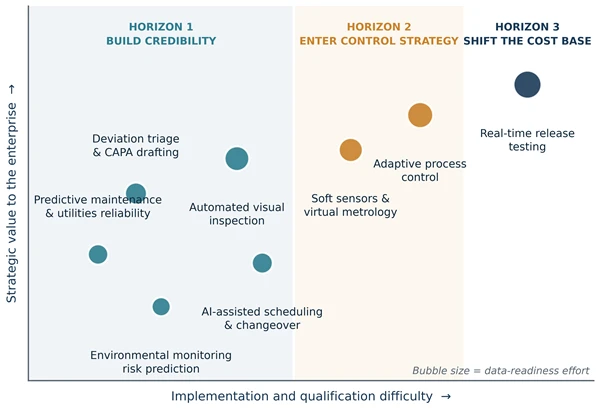
Figure 2: Sequencing use cases by strategic value against implementation and qualification difficulty; bubble size indicates the typical data-readiness effort required before deployment.
The Foundation No Algorithm Can Compensate For
Ask most executives why an earlier analytics investment underdelivered and the answer, stripped of vocabulary, is that the data was not usable. It existed. It was not usable.
Pharmaceutical manufacturing data is unusually difficult because it is fragmented across systems built for different purposes in different decades: control systems holding high-frequency process signals, execution systems holding batch context, laboratory systems holding results, quality systems holding events, and enterprise systems holding materials. A single meaningful question — did a change of raw-material supplier alter granulation behaviour, and did that alteration propagate into dissolution results — crosses all five.
An AI-native design treats contextualisation as an engineering deliverable with an owner, a specification and acceptance criteria: a common equipment and material model, time alignment across sources, batch genealogy resolved automatically, and metadata carried with the signal rather than reconstructed months later. It treats data integrity as a design property rather than a periodic audit finding. Attributable, legible, contemporaneous, original and accurate are not new requirements, but they acquire fresh weight when the record must also include the inputs to a model, the version of the model that produced an inference, and the basis on which an automated decision was taken.
The uncomfortable implication for capital planning is that most of the first year's expenditure buys no visible intelligence at all. Boards unable to tolerate that profile should not begin.
Eighteen Months on a Sterile Injectables Line: An Anonymised Case
The case that follows is a composite, assembled from patterns that recur across European fill-finish operations; outcome figures are indexed to a pre-deployment baseline. The site runs five filling lines with a mixed portfolio of own-label and contract volume. Its constraints were familiar: overall equipment effectiveness suppressed by unplanned stoppages in utilities and isolators, an inspection process rejecting a significant volume of acceptable units, and a deviation backlog that delayed disposition and consumed quality resource that the site could not replace in a tight labour market.
The programme was deliberately staged. The first seven months produced nothing an executive committee could photograph: a unified equipment and material model across all five lines, automated batch genealogy, time-aligned process and environmental data, and a written governance framework defining intended use, validation approach, drift thresholds and rollback criteria for any model entering production.
Three advisory models followed. A vision model was deployed as a second-stage classifier on machine-rejected units, with human confirmation retained for every disposition, cutting the false-reject rate without altering the rejection criteria. A failure-prediction model on clean utilities and isolator systems converted a portion of unplanned downtime into scheduled intervention. A deviation model proposed categorisation, surfaced precedent records and drafted an initial assessment, with quality assurance retaining ownership of every conclusion.
Only in the final phase did inference enter the control strategy, on one line, where a soft sensor for fill-weight variability adjusted set-points within the qualified design space. Three choices distinguished this programme from the pilots that preceded it: accountability sat with an operations leader rather than a central analytics function; the data foundation was funded before any model was commissioned; and one attractive use case was deliberately abandoned when the team could not define its validation. The visible errors were equally instructive — an initial deployment had to be rebuilt when data lineage proved insufficient for audit, and operator training was underestimated, because knowing when to override an inference turned out to be a harder skill to teach than reading its output.
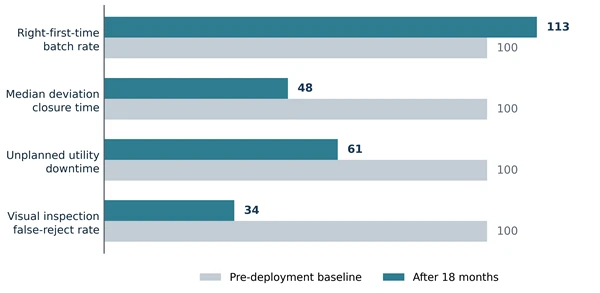
Figure 3: Illustrative outcomes at the anonymised sterile injectables site after eighteen months, indexed to a pre-deployment baseline of 100.
Regulating a Plant That Learns
European deployment sits inside a perimeter tightening from two directions at once — medicines regulation and horizontal artificial intelligence regulation — and the two do not share a vocabulary.
On the medicines side, expectations are recognisable extensions of existing quality doctrine. Risk-based qualification, defined intended use, lifecycle management and demonstrable control of change apply to a model as they apply to any computerised system. The reflection paper issued by European regulators on artificial intelligence across the medicinal product lifecycle signalled a risk-proportionate posture rather than a prohibitive one, and guidance on continuous manufacturing and revised quality risk management principles had already established that a control strategy may contain predictive elements, provided the science and the residual risk are documented.
On the horizontal side, the European Union's Artificial Intelligence Act introduces obligations organised by risk classification, with staged application dates and requirements covering risk management, data governance, technical documentation, human oversight and post-market monitoring. Most manufacturing quality models will not fall into the highest-risk categories associated with medical devices or safety components, but the compliance architecture overlaps so heavily with good manufacturing practice expectations that running the two as separate programmes wastes effort and creates contradictory documentation.
The practical instruction for the C-suite is narrower than the legal complexity suggests. Decide, in advance and in writing, which models may influence product disposition. Define the human oversight point for each. Ensure the audit trail can reconstruct any automated decision months after the event. Sites that can do this will hold their ground in an inspection. Sites that cannot will find the conversation difficult regardless of how good their models are.
The Operating Model Is the Real Constraint
Technology rarely stops these programmes. Three organisational conditions decide the outcome. The first is ownership: models belonging to a central data science function decay quietly when that function's priorities shift, so AI-native sites place model ownership in operations and quality, with central teams supplying platform, standards and scarce specialist skill. The second is a set of roles that did not previously exist — a plant running models in production needs continuous monitoring, retraining, revalidation and rollback embedded inside the site's change control system rather than operating alongside it.
The third is judgement at the line. Operators and supervisors must know when to trust an inference and when to override it, which requires exposure to model limitations that conventional training does not provide. Automation bias is a genuine risk in a regulated environment: the dangerous failure is not an obviously poor model but a competent one, trusted after conditions have drifted beyond the data on which it was built.
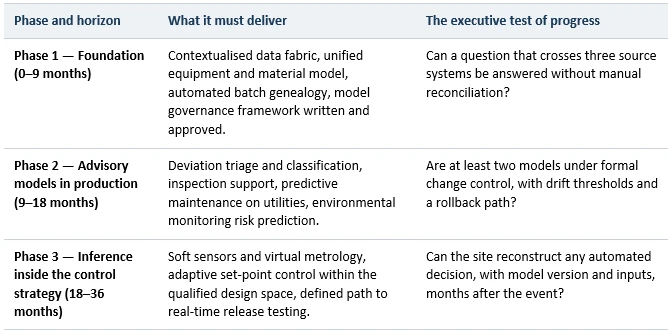
Table 1: A staged commitment — what each phase must deliver, and how progress should be tested at board level.
Conclusion: The Decision in Front of the Board
The smart factory delivered visibility, and visibility was worth having. It did not, on its own, change the economics of manufacturing a sterile product or a complex biologic, because visibility without decision velocity produces nothing more than better-documented delay. AI-native manufacturing is the attempt to close that loop, and it is a genuine transformation rather than an incremental upgrade — which is precisely why it fails when treated as a technology procurement.
The executives who succeed will make three commitments, each uncomfortable in its own way. They will fund a data foundation that yields no visible intelligence for several quarters. They will place accountability for models inside operations and quality rather than inside a centre of excellence. And they will decide deliberately, in advance, which decisions a machine may take and where a human must stand. The plant that results is not merely faster. It is one in which the distance between knowing and acting has finally been compressed — and that distance, more than any single algorithm, is where the cost, quality and capacity of European pharmaceutical manufacturing will now be decided.

Lakshmi is a science writer with a foundation in the laboratory. She earned her master's in biotechnology and trained through research internships at ICGEB (JNU) and DIPAS, DRDO, with her work appearing in the Egyptian Journal of Veterinary Sciences. Now APCRM-certified and part of the editorial team at Pharma Focus America and Pharma Focus Europe, she reports on pharmaceutical technology, research, and innovation — giving complex science a clear and confident voice for industry leaders.