AI-Native Pharma: Redefining Enterprise Strategy Beyond Drug Discovery
Lakshmi, Editorial Team, Pharma Focus Europe
Artificial intelligence has proved itself in pharmaceutical discovery, yet the larger prize sits elsewhere. This article examines how AI-native pharmaceutical companies are rebuilding manufacturing, quality, regulatory and supply operations around machine intelligence rather than bolting it on. It sets out the enterprise architecture, the scaling threshold that stalls most programs, a European case study, and the governance agenda now facing pharmaceutical leadership teams.
Introduction:
The Pharmaceutical Industry Has Been Asking AI the Wrong Question
For the better part of a decade, artificial intelligence in pharma has been discussed almost entirely as a discovery story. Boards have approved generative chemistry platforms, protein structure prediction has moved from novelty to routine, and the industry has grown comfortable describing AI as a way to find better molecules faster. That framing is not wrong. It is simply far too small.
Discovery accounts for a modest share of the pharmaceutical cost base and an even smaller share of the time between a scientific idea and a patient receiving therapy. A candidate identified twelve months earlier still enters the same tech transfer queue, the same validation programme, the same multi-market submission process and the same constrained supply network. Accelerating the front of the pipeline while leaving the enterprise untouched does not shorten time to patients. It simply moves the bottleneck downstream, where it becomes more expensive.
The companies now pulling ahead have reframed the question. Instead of asking what AI can discover, they are asking what the pharmaceutical enterprise would look like if it had been designed on the assumption that machine intelligence is available, auditable and continuously improving. That is the difference between an AI-enabled company and an AI-native one, and it is rapidly becoming the defining strategic distinction in European pharma.
What 'AI-Native Pharma' Actually Means — and What It Does Not
An AI-enabled organisation adds intelligent tools to processes that were designed without them. A forecasting model advises a planner who still runs the same spreadsheet-driven cycle. A document assistant drafts a section that follows the same authoring workflow. The process survives unchanged if the model is switched off. That is the clearest diagnostic available to any executive: if removing the algorithm changes nothing structural, the organisation has bought a tool, not built a capability.
An AI-native pharmaceutical company redesigns the process itself. Decision rights are rewritten so that a model output is the default course of action and human intervention is the documented exception. Models are registered in the quality system with validation protocols, drift monitoring and change control, exactly as any other GxP-relevant system would be. Data is captured with the context needed to train the next model, not merely to satisfy the current report. The comparison is not with digital transformation programmes of the past decade but with the shift to cloud-native architecture, where the underlying assumptions of the system were rebuilt rather than migrated.
If removing the algorithm changes nothing structural, the organisation has bought a tool, not built a capability.
Why Drug Discovery Became AI's Comfort Zone in Pharmaceutical Companies
There are good reasons discovery absorbed the industry's early AI attention. Research organisations were already computational, tolerant of high failure rates and free of GxP constraints. Benchmarks were plentiful, publication was straightforward, and a promising result required no change to how thousands of colleagues worked. The risk profile was contained and the narrative was compelling to investors.
There is also an accounting habit at work. Discovery AI is funded from research budgets that already tolerate speculative spend, whereas an equivalent investment in manufacturing or quality competes against equipment, capacity and remediation projects with hard payback expectations. The result is that the least regulated part of the enterprise attracts the most experimental capital, and the most regulated parts — which generate the recurring cost and the recurring risk — remain the least instrumented.
Those same characteristics created a ceiling. The functions where pharmaceutical value is actually locked up — process development, manufacturing, quality assurance, regulatory affairs, supply planning and market access — are validated, regulated, cross-functional and politically complex. They are harder places to deploy AI and, precisely for that reason, far more valuable ones. Figure 1 illustrates the resulting mismatch: the functions with the highest executive-rated value potential are consistently those with the lowest current deployment maturity.
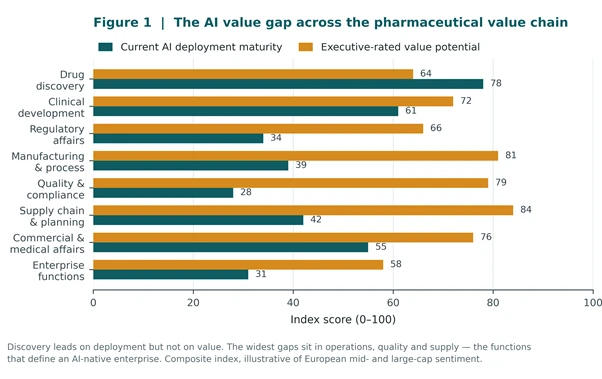
Figure 1: Deployment maturity versus executive-rated value potential across pharmaceutical functions.
Rewiring Manufacturing, Quality and Supply With Enterprise AI
Manufacturing is where AI-native thinking produces the most immediate operational return. Multivariate process models and soft sensors allow critical quality attributes to be inferred continuously rather than confirmed at the end of a batch. Yield variance that was previously attributed to inherent process noise becomes explainable and, eventually, controllable. The strategic consequence is a shift from lagging quality metrics to leading indicators, which changes how capacity, release and campaign planning are governed.
Quality functions are being reshaped just as significantly. Deviation triage, complaint classification, CAPA effectiveness prediction and document review are all high-volume, judgement-intensive activities where models trained on an organisation's own history outperform generic rules. Investigators spend their time on the small proportion of events that genuinely require expert reasoning. Supply organisations gain demand sensing, multi-echelon inventory optimisation, cold-chain excursion prediction and supplier risk scoring — capabilities that translate directly into service levels and working capital.
Regulators across Europe have signalled openness to model-informed approaches provided that lifecycle control, explainability and human accountability are demonstrable. That condition is not an obstacle to AI-native operations. It is the specification for them.
The Evidence Engine: AI in Regulatory and Medical Affairs
European pharmaceutical companies carry an evidence burden that is structurally heavier than that of single-market peers. Multi-country submissions, multilingual labelling, national reimbursement dossiers and joint clinical assessment all multiply the same underlying evidence into dozens of tailored artefacts. This is precisely the work that AI-native operating models transform.
Language models grounded in a company's controlled document repositories can assemble first-draft responses to health authority questions in hours rather than weeks, maintain labelling consistency across markets, and monitor the published literature continuously rather than in scheduled sweeps. Pharmacovigilance case intake and triage — historically a linear headcount cost — becomes a scalable process. In every instance, the regulatory professional retains accountability for the submitted content. What changes is that their expertise is spent on argument and strategy rather than on assembly.
The Scaling Threshold: Why Pharma AI Value Arrives Late, Then All at Once
The most common failure in pharmaceutical AI is not technical. It is the plateau between functional pilots and process embedding. Organisations accumulate a portfolio of successful proofs of concept, each demonstrating credible performance, none of which alters a single validated workflow or budget line. Value stays close to zero because value is created not when a model performs well but when an organisation changes what it does in response.
Figure 2 describes the curve. Progress through experimentation and pilots feels productive and delivers almost nothing. Once models are embedded in validated processes, connected to decision rights and monitored under change control, returns compound rapidly, because each new use case draws on infrastructure and governance that already exist. Executives who evaluate AI programmes on a linear expectation of return will cancel them precisely at the point where the investment is about to pay.
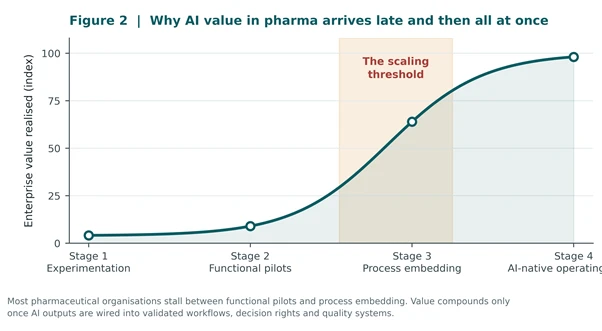
Figure 2: The value realisation curve for enterprise AI in pharmaceutical organisations.
The Data Foundation Beneath Every AI-Native Pharmaceutical Enterprise
AI-native companies invest from the bottom of the stack upward. The foundational layer is not a data lake but contextualised data: batch genealogy linked to equipment state, environmental conditions, raw material lots, analytical results and downstream outcomes, expressed through a consistent ontology. Without that context, every function rebuilds the same models from the same raw signals and none of them are reusable.
Above it sits a model and governance layer — validation, performance monitoring, explainability and an immutable audit trail — which is what makes AI outputs admissible in regulated decisions and what will satisfy the risk-classification and documentation expectations now taking shape under European AI regulation. Applications sit above that, and decisions above them. Figure 3 sets out the architecture. Organisations that purchase applications before harmonising data are not moving faster; they are simply paying for the same groundwork repeatedly, once per vendor.
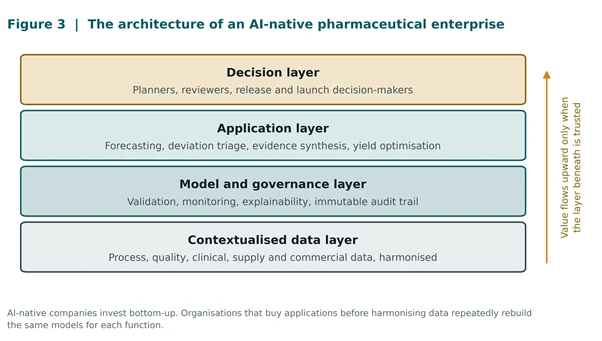
Figure 3: The four-layer architecture that distinguishes AI-native pharmaceutical enterprises.
Case Study: Rebuilding a European Biopharma Group Around AI, Not Around Algorithms
A mid-cap European biopharmaceutical group with three manufacturing sites, a sterile injectables portfolio and one commercial biologic entered its AI programme in the conventional way. Fourteen initiatives were running across research and analytics, several with encouraging technical results. After two years, the finance function could not attribute a single measurable effect to any of them. The board's conclusion was not that AI had failed but that it had been aimed at the wrong part of the company.
The reset was deliberate. Nine of the fourteen initiatives were discontinued. Investment moved to a contextualised data layer covering two of the three sites, deliberately sequenced rather than attempted enterprise-wide. Every model intended for regulated use was entered into the quality system under a purpose-written validation and monitoring standard operating procedure, developed jointly by quality assurance and the data team over five months. Crucially, decision rights were rewritten: supply planners were required to execute the model-generated plan unless they documented a rationale for overriding it, and those overrides were reviewed monthly as a source of model improvement rather than as individual performance failures.
Leadership incentives followed the strategy. A portion of the operations leadership bonus was tied to the adoption of embedded AI workflows rather than to the number of pilots launched. Figure 4 summarises the results after eighteen months. Deviation investigation time fell by 41 per cent and regulatory response authoring cycles by 37 per cent, while right-first-time batch release improved by 18 per cent and finished-goods inventory cover fell by 21 per cent without service-level erosion.
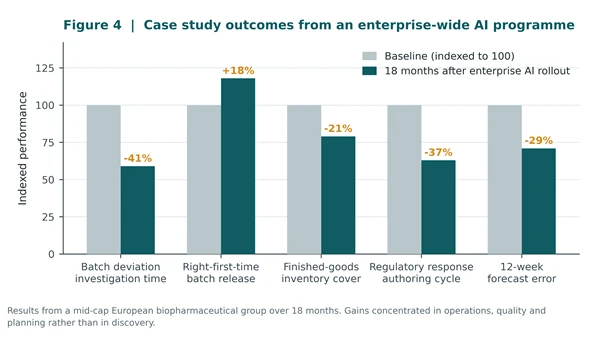
Figure 4: Eighteen-month outcomes from an enterprise-wide AI programme at a European biopharmaceutical group.
The AI-Native Leadership Agenda for European Pharma: Capital, Talent and Trust
Becoming AI-native changes what pharmaceutical leadership teams must decide. Capital allocation has to shift from project funding, where each use case carries its own business case, to platform funding, where data and governance infrastructure are financed as shared assets with a longer horizon. Conventional stage-gate discipline applied to individual models will systematically starve the foundation on which all of them depend.
Talent strategy shifts too. The scarce capability is rarely the data scientist. It is the process engineer who can specify a problem in terms a model can address, the quality professional who can validate a probabilistic system, and the regulatory lead who can defend a model-informed argument to an assessor. These people are more often developed internally than recruited, which makes deliberate capability building a board-level concern rather than a functional one.
Trust is the third pillar. Employees who suspect that AI adoption is a headcount exercise will withhold the process knowledge that makes models work. Regulators who encounter opacity will apply conservative interpretations. Transparency about intent, method and limitation is not a communications task appended to the programme; it is a condition of the programme functioning at all.
Conclusion: The Strategic Divide in Pharma Will Not Be Drawn in the Laboratory
The pharmaceutical companies that will define the coming decade are not necessarily those with the most sophisticated discovery models. They are those that have rebuilt the enterprise around machine intelligence — where quality events are anticipated rather than investigated, where supply plans are executed rather than debated, where regulatory evidence is assembled continuously rather than compiled under deadline, and where the data produced by every process is captured in a form that improves the next decision.
That transformation is slower, less visible and considerably less glamorous than a breakthrough in generative chemistry. It is also where the durable advantage lies. For European pharmaceutical leadership teams, the practical question is no longer whether to invest in artificial intelligence. It is whether the organisation is prepared to change how it decides, who decides, and what evidence it accepts — because without that, the most advanced model in the industry will remain an interesting result in search of an enterprise capable of using it.

Lakshmi is a science writer with a foundation in the laboratory. She earned her master's in biotechnology and trained through research internships at ICGEB (JNU) and DIPAS, DRDO, with her work appearing in the Egyptian Journal of Veterinary Sciences. Now APCRM-certified and part of the editorial team at Pharma Focus America and Pharma Focus Europe, she reports on pharmaceutical technology, research, and innovation — giving complex science a clear and confident voice for industry leaders.