AI Governance in Pharma: Managing Trust, Transparency, and Regulatory Expectations
Lakshmi, Editorial Team, Pharma Focus Europe
Artificial intelligence has moved from pharma's innovation agenda into its compliance perimeter. Europe's rewritten AI timeline, the first GMP annex written specifically for AI, and the first enforcement action naming AI misuse have changed the executive question from what AI can do to who answers for it when it fails. This article sets out how pharmaceutical leaders can govern AI in ways that satisfy regulators, protect patients and preserve speed.
When Pharma AI Stops Being a Pilot and Becomes a Liability
Most large pharmaceutical organisations no longer have an AI strategy problem. They have an AI accountability problem. Models now sit inside pharmacovigilance case intake, deviation triage, visual inspection, trial feasibility, medical information and commercial targeting — deployed by different functions, on different platforms, under different assumptions about who signs off. Few executive teams could produce on demand a complete list of the AI systems influencing decisions in their regulated processes, together with the named individual accountable for each one.
That gap stopped being theoretical in 2026. European legislators rewrote the AI compliance calendar without softening the underlying expectation. Regulators published the first GMP text dedicated to artificial intelligence, with unusually specific technical demands. And an inspection on the other side of the Atlantic produced the first enforcement action in which AI misuse was named as a deficiency in its own right. Taken together, these developments mark the point at which AI governance in pharma became a supervisory board matter rather than a data science one.
The strategic question for the C-suite is no longer whether to adopt AI. It is whether the company can demonstrate, under inspection and under litigation, that it understood what its models were doing, who was responsible, and why the outputs could be trusted.
The Pharma AI Deadline That Moved — and the Ones That Did Not
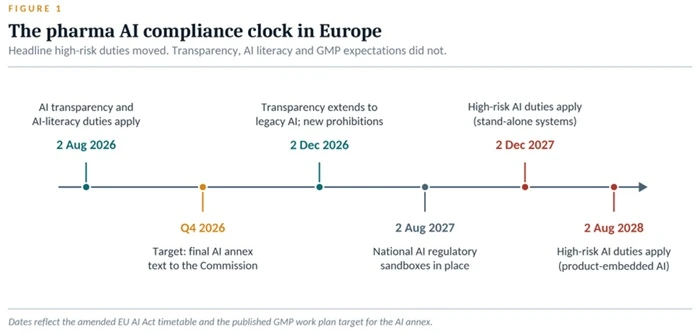
The most commonly repeated line in European boardrooms this year is that the AI rules have been delayed. That reading is half right and commercially dangerous. Under the amending regulation that entered into force on 27 July 2026, obligations for stand-alone high-risk AI systems shift to 2 December 2027, and for AI embedded in regulated products to 2 August 2028. Sixteen months of relief on the heaviest conformity regime is genuine and welcome.
What did not move matters more for day-to-day operations. Transparency duties took effect on 2 August 2026 and extend to legacy systems from 2 December 2026, alongside a set of new prohibitions. The AI literacy obligation, which requires organisations to ensure that staff deploying AI actually understand it, was untouched. For pharmaceutical companies running patient-facing chatbots, AI-assisted medical information services or AI-generated commercial content, the live compliance dates are now, not in 2027.
There is a second, less discussed consequence of the deferral. The revised regime rewards systems that are placed on the market before the new dates, but that protection resets the moment a system is substantially modified. In a portfolio where models are retrained routinely, an organisation with no change-control discipline can inadvertently convert a grandfathered system into a fully regulated one. The clock was restructured, not stopped, and the extra time is best understood as capacity to build documentation rather than permission to pause.
Annex 22: The First GMP Rulebook Written Specifically for AI
Alongside the horizontal AI regulation, European regulators have been drafting something far more consequential for manufacturing leadership: a dedicated GMP annex for artificial intelligence, released for consultation in July 2025 together with a heavily revised annex on computerised systems and a rewritten documentation chapter. The consultation closed in October 2025; the current regulatory work plan targets delivery of a final text to the Commission in the fourth quarter of 2026, a target rather than a confirmed publication date.
Its scope is deliberately narrow and its consequences are wide. The draft applies where AI models are used in critical applications with direct impact on product quality, patient safety or data integrity, and in those applications it permits only static, deterministic models — locked after training, producing repeatable outputs. Models that continue learning in production, along with generative systems and large language models, are excluded from critical use. They may support non-critical work, but only under documented human oversight.
The technical expectations are unusually prescriptive for a GMP text: independent test data, independence between the people who build and the people who test, performance measured at subgroup level rather than in aggregate, feature attribution so that outputs can be interpreted, defined confidence thresholds, and monitoring for drift in the input space. Read commercially, this is a design-time constraint, not a documentation exercise. The architecture chosen for a batch-release-adjacent model in 2026 determines whether it can be validated at all.
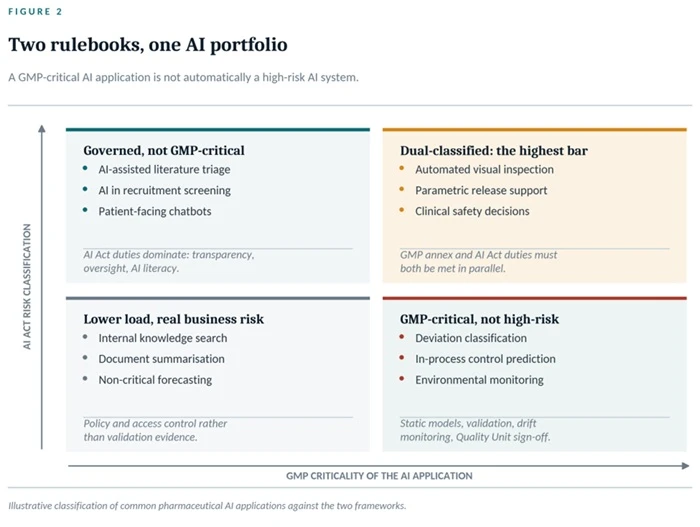
One distinction repays executive attention. A critical application under the GMP annex is not automatically a high-risk system under the horizontal AI regulation, and the reverse is equally true. The two classifications carry different obligations and must be assessed separately for every model in the portfolio — a governance requirement that quietly doubles the classification workload.
Case Study: The Inspection Where AI Became the Finding
In April 2026, a US regulator issued a warning letter to a small Michigan-based manufacturer of homeopathic drug products following an inspection the previous autumn. The letter documented an extensive collapse of quality systems. But one section carried a heading that had never appeared in an enforcement letter before: inappropriate use of artificial intelligence in pharmaceutical manufacturing.
The facts are instructive precisely because they are mundane. The firm had used AI agents to generate drug product specifications, procedures and master production and control records, intending to comply with regulatory requirements. Those documents were not reviewed by the quality unit before use. The regulator's position was blunt: AI may be used as an aid in document creation, but the resulting documents must be reviewed for accuracy and compliance, and failure to do so breaches the rule that makes the quality unit responsible for approving procedures and specifications.
The most quoted detail is the most revealing. Asked why process validation had not been performed before distribution, the firm replied that it had not known the requirement existed, because the AI agent it relied on had never mentioned it. The company subsequently ceased drug production.
It is tempting to dismiss this as a story about a marginal operator. Three lessons survive that dismissal. First, accountability cannot be delegated to a model; regulators will locate a human signatory or record a violation. Second, the risk was not a wrong answer but a missing one — governance frameworks built to catch hallucinated content will not catch silence. Third, the AI use surfaced because inspectors asked. European inspectors preparing to work against a dedicated AI annex will ask the same questions, and undocumented AI in a GMP process is now a discoverable finding rather than an internal efficiency.
Transparency in Pharma AI: How Much Explanation Is Enough?
Transparency in this context is not a single obligation but three distinct audiences. Internally, it means model documentation, data lineage and a record of why a system was considered fit for its purpose. Towards regulators, it means an evidence trail robust enough that an AI-influenced result in a dossier can be reconstructed years later. Towards patients and healthcare professionals, it means disclosure that a system is AI-driven where interaction or generated content requires it.
European medicines regulators have already set the tone through their reflection paper on AI across the medicinal product lifecycle, which applies a risk-based logic tied to regulatory impact and patient safety. Its emphasis on documented data provenance, traceability aligned with GxP requirements, and representativeness — with explicit concern for bias affecting small populations such as children and rare disease patients — translates directly into obligations that data science teams rarely budget for at project initiation.
The hardest transparency problem is contractual rather than technical. Much of the AI entering pharmaceutical operations arrives inside vendor platforms, and suppliers protect their models as intellectual property. If a company cannot obtain validation evidence, training data characteristics, performance-monitoring records and audit rights from a supplier, it cannot meet its own obligations, however mature its internal framework. AI model risk has become supplier quality management, and the leverage to fix it exists at contract negotiation, not at inspection.
Who Owns the Algorithm? Building the Pharma AI Governance Operating Model
Effective AI governance in pharma rests on a small number of structural choices. The first is an inventory: a controlled register of AI systems, their use context, criticality, regulatory classification and accountable owner, maintained as a quality record rather than a project tracker. Organisations that cannot answer how many models influence GxP decisions cannot govern them, and the inventory is invariably the item that takes longest to build.
The second is meaningful human oversight. An approver who cannot see why a model produced a given recommendation is not exercising oversight; they are absorbing liability. This is precisely why the draft annex asks for feature attribution and defined confidence thresholds — they are the mechanisms that make a reviewer's judgement possible. Oversight design should specify what the reviewer sees, what they can override, and what happens when they disagree with the model.
The third is lifecycle discipline. Validation is the entry point, not the endpoint: performance monitoring, drift detection, retraining criteria, change control and decommissioning all need owners and triggers. A model whose input distribution has shifted is not a technical curiosity but a potential product quality risk, and the ability to demonstrate that it was being watched is what separates a controlled deviation from a systemic failure.
Finally, governance needs a decision forum with real authority — quality, regulatory affairs, data science, legal, privacy and medical represented together, with the quality unit retaining an unambiguous veto over deployment in regulated processes. Where AI literacy obligations already apply, the training records generated by that forum become evidence, not overhead.
The Executive Price of Weak Pharma AI Governance
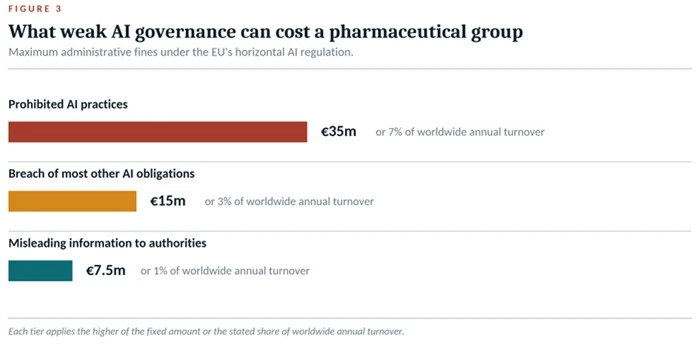
The financial exposure is now quantified in the horizontal regulation, with ceilings scaled to global turnover. But for a pharmaceutical group, the regulatory fine is rarely the largest number. A dossier in which an AI-derived analysis cannot be reconstructed puts an approval timeline at risk. An AI finding in an inspection report invites re-inspection of every adjacent system. And in a sector whose social licence depends on the credibility of its evidence, a public failure of AI oversight in a safety-relevant process damages something no balance sheet records.
Conclusion: AI Governance Is the Licence to Scale Pharma AI
The deferral of Europe's high-risk AI obligations has created an unusual and temporary asymmetry. Companies that spend the next eighteen months building inventories, classification logic, oversight design and validation evidence will move into 2027 and 2028 able to deploy AI in regulated processes at speed. Companies that read the delay as a reprieve will begin conformity work cold, against harmonised standards they had no hand in preparing, while competitors are already operating.
The lesson from this year's enforcement is that regulators are not hostile to AI in pharmaceutical operations. They are hostile to AI without an accountable human, a documented rationale and a traceable record. That is a standard the industry already knows how to meet; it is the same standard applied to every analytical method, every computerised system and every batch record for the past three decades.
Executives who treat AI governance as a compliance cost will spend the money and gain nothing. Those who treat it as the operating system that makes AI deployable in regulated environments will find it does what good quality systems have always done: convert a promising technology into a defensible one, and a defensible one into a durable advantage.

Lakshmi is a science writer with a foundation in the laboratory. She earned her master's in biotechnology and trained through research internships at ICGEB (JNU) and DIPAS, DRDO, with her work appearing in the Egyptian Journal of Veterinary Sciences. Now APCRM-certified and part of the editorial team at Pharma Focus America and Pharma Focus Europe, she reports on pharmaceutical technology, research, and innovation — giving complex science a clear and confident voice for industry leaders.