

Advancing Sterile API Manufacturing: Innovations in Next-Generation
Lakshmi, Editorial Team, Pharma Focus Europe
Sterile active pharmaceutical ingredients have moved from a niche production step to a strategic pillar of Europe's injectable economy. As biologics, high-potency molecules, long-acting suspensions and complex parenterals reshape pharmaceutical pipelines, manufacturers are re-engineering how sterility is achieved at the API stage itself. This article traces that evolution, from open handling and terminal sterilisation to closed, isolator-based and data-driven operations shaped by the revised EU GMP Annex 1, and examines the commercial, technological and governance choices European leaders must make to secure resilient, compliant sterile API supply.
Why Sterile API Manufacturing Has Become a Boardroom Issue
For most of the industry's history, sterility was a finished-product concern. Active ingredients were synthesised under conventional good manufacturing practice, shipped as bulk powders, and rendered sterile only when they reached the fill-finish line, usually through filtration or terminal heat. That model served simple, water-soluble injectables well. It serves today's portfolio poorly.
The modern injectable pipeline is dominated by molecules that cannot be filtered, cannot tolerate heat and cannot be exposed to operators: crystalline suspensions for long-acting depots, highly potent cytotoxics, payloads destined for antibody-drug conjugates, and micronised powders for reconstitution. For these products, sterility has to be built into the API itself, upstream, under aseptic conditions. That shift has turned sterile API manufacturing from an engineering specialism into a strategic capability that determines launch timelines, supply security and regulatory exposure. For European pharmaceutical boards, it now sits alongside biologics capacity and digital quality as a defining investment question of the decade.
From Open Rooms to Closed Systems: Four Decades of Sterile API Evolution
The first generation of sterile API production relied on classified cleanrooms, gowned operators and manual transfers between crystallisers, filter-dryers and packaging. Sterility assurance rested heavily on people: their gowning discipline, their aseptic technique and the environmental monitoring that tracked them. Contamination risk was managed largely after the fact, through end-product testing.
The second generation introduced restricted access barrier systems and the first isolators, separating the operator from the open product zone. Sterilisation-in-place and cleaning-in-place reduced manual intervention on process equipment, and vaporised hydrogen peroxide made decontamination of enclosures repeatable and validatable.
Today's third generation is defined by fully closed processing. Aseptic crystallisation, filtration and drying now occur within interconnected, sterilisable equipment trains, with split-butterfly valves and rapid-transfer ports replacing open transfers. Milling and micronisation, once among the riskiest aseptic steps, increasingly take place inside isolators. The operator's role has shifted from handling product to supervising a sealed process, and the evidence of sterility has moved from the batch record to continuous process data.
The Market Signal: Injectable Demand Rewrites the Sterile API Business Case
The commercial pull behind this evolution is substantial. The global sterile injectables market is estimated at roughly USD 632 billion in 2025 and is projected to exceed USD 1 trillion by 2032, a compound annual growth rate of about 7.9 per cent. Oncology, diabetes, autoimmune disease and anti-infectives continue to anchor demand, while biosimilars and long-acting formulations widen it.
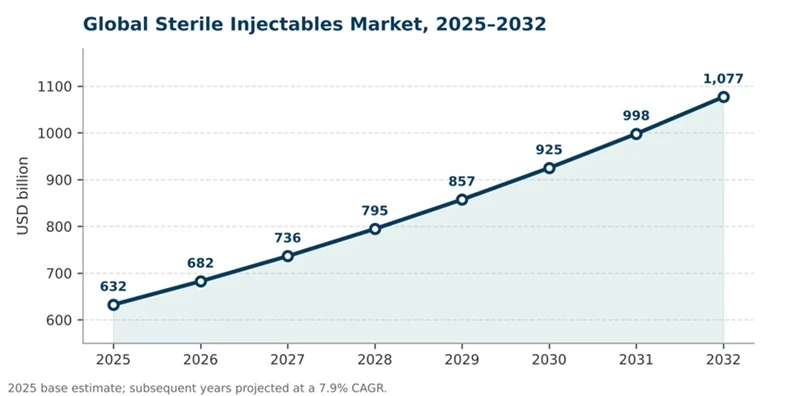
Figure 1: Global sterile injectables market outlook, 2025–2032 (USD billion). Values after 2025 are projected at a 7.9% CAGR from industry market estimates.
Every additional injectable product that cannot be terminally sterilised or sterile-filtered places new demand on upstream sterile API capacity. That capacity is scarce, expensive to build and slow to qualify, typically requiring several years from investment decision to commercial release. For European companies, the arithmetic is clear: injectable growth is outpacing the expansion of qualified sterile API infrastructure, and the gap is becoming a constraint on portfolio strategy rather than a manufacturing detail.
Annex 1 and the New Regulatory Architecture of Sterile API Production
No single factor has reshaped European sterile API manufacturing more than the revised EU GMP Annex 1. First issued in 1971, the guideline was comprehensively rewritten in 2022 and became mandatory in August 2023. Its central innovation is the contamination control strategy, a facility-wide, risk-based framework that must identify every critical control point and demonstrate how design, procedural, technical and organisational controls work together.
For sterile API producers, the implications are profound. Annex 1 favours barrier technology over reliance on cleanroom classification alone, expects quality risk management to be embedded across the product lifecycle, and treats contamination control as a living strategy rather than a static dossier. Regulators have made clear that the strategy must connect to environmental monitoring data, deviation handling and routine decision-making on the shop floor.
Inspection experience reinforces the urgency. Industry analyses suggest that between 30 and 50 per cent of critical deviations in sterile production can be traced to contamination-related gaps and weaknesses in aseptic processing. For executives, Annex 1 is therefore not merely a compliance milestone already passed; it is a continuing test of whether sterile API operations are designed for control rather than retrofitted for it.
High Potency Meets Sterility: The Dual-Containment Challenge in Pharmaceutical Manufacturing
The most demanding frontier in sterile API manufacturing lies where sterility and high potency intersect. Highly potent molecules now account for more than 30 per cent of the global development pipeline, with over 1,000 candidates in progress. Many of them, from cytotoxic payloads to potent peptides, are destined for injectable delivery.
These products create an engineering paradox. Aseptic processing traditionally relies on positive pressure to keep contaminants out of the product zone, while potent-compound handling depends on negative pressure to keep the molecule away from people and the environment. Reconciling the two requires isolators engineered for simultaneous product protection and operator containment, often to occupational exposure band 5, together with closed transfer systems and decontamination cycles validated against both microbial and chemical residues.
European investment is following this convergence. Recent expansions in Italy have added OEB 5 high-potency capacity co-located with research, quality control and microbiology, explicitly to shorten technology transfer. In France, new lyophilisation capacity for antibody-drug conjugate manufacturing is due to come online by early 2027. The direction is unmistakable: dual-containment sterile API capability is becoming a prerequisite for participating in the most valuable segments of the injectable market.
Case Study: Scaling Aseptic Sterile API Capacity for Complex Injectable Suspensions
A recent expansion in northern Spain illustrates how these forces translate into capital decisions. A global contract development and manufacturing organisation announced in October 2026 a USD 28 million investment to extend sterile API production for both steroid and non-steroid molecules, with completion scheduled for the fourth quarter of 2028.
The project is designed around the needs of injectable suspensions and other complex sterile formulations, where particle size and crystal form determine clinical performance. It combines aseptic crystallisation with sterile milling and micronisation, allowing solid-state properties to be engineered without compromising sterility. Closed processing within barrier isolators provides primary containment, while integrated service panels reduce direct operator interaction with the product zone.
Two design choices stand out for executive audiences. First, the facility is planned to operate across a scale range from grams to metric tons, enabling a single qualified asset to support early clinical supply through to commercial volumes and avoiding costly site changes during development. Second, configurable aseptic packaging formats are intended to preserve sterility through storage and transfer, reducing hand-offs that historically introduced contamination risk between API and drug-product sites.
The lesson is strategic rather than technical. Sterile API capacity is increasingly built around specific product archetypes, such as suspensions, potent compounds and conjugate payloads, rather than generic multipurpose suites. Companies that align sourcing and development decisions with such specialised capacity early gain both speed and regulatory confidence.
Digital Sterility Assurance: Data as the New Cleanroom in Sterile API Operations
As physical processes close, sterility assurance is increasingly demonstrated through data. Continuous particle counting, rapid microbiological methods, isolator glove-integrity testing and real-time monitoring of pressure, temperature and decontamination cycles generate dense, time-stamped evidence of control. Connected to manufacturing execution systems, this data allows quality teams to detect drift before it becomes a deviation and to support real-time review and release.
Digital twins of sterile API equipment trains are beginning to support cycle development and operator training without exposing live process zones, while advanced analytics help correlate environmental trends with process events. For boards, the value lies less in the technology itself than in the shift it enables: from reactive investigation to predictive control, and from inspection anxiety to inspection readiness built into everyday operations.
Strategic Imperatives for Europe's Pharmaceutical Leadership in Sterile API Supply
Three strategic themes emerge for European C-suite leaders. The first is supply resilience. Persistent shortages of injectable medicines have exposed how concentrated sterile manufacturing capability remains. Securing diversified, qualified sterile API sources within Europe, whether through internal investment or long-term partnerships, is becoming a matter of both commercial continuity and public-health credibility.
The second is portfolio-led capacity planning. Because sterile API assets take years to design, build and qualify, capacity decisions must anticipate the molecular profile of the pipeline five to seven years ahead. Leaders who treat sterile API strategy as a downstream manufacturing matter risk discovering bottlenecks only when a high-value asset reaches late-stage development.
The third is talent and culture. Closed, automated systems reduce the number of operators in aseptic zones, but they raise the bar for those who remain. Engineers and quality professionals who understand containment, aseptic science, data integrity and risk management in combination are scarce across Europe, and organisations that build that expertise deliberately will hold a durable advantage.
Conclusion:
Sterile API Manufacturing as a Competitive Advantage
The evolution of sterile API manufacturing mirrors the evolution of injectable therapies themselves: from simple solutions toward complex, potent and highly engineered medicines. What began as a cleanroom discipline has become an integrated system of closed processing, dual containment, regulatory strategy and data-driven assurance.
For Europe's pharmaceutical industry, the opportunity is significant. The region combines deep regulatory leadership through Annex 1, a strong base of specialised manufacturing expertise and growing investment in high-potency and aseptic capability. Converting those strengths into lasting advantage will depend on decisions taken now in boardrooms, not later on the shop floor. In the next generation of injectable therapies, sterility will not be the final step in manufacturing. It will be the foundation on which the entire value chain is built.

Lakshmi is a science writer with a foundation in the laboratory. She earned her master's in biotechnology and trained through research internships at ICGEB (JNU) and DIPAS, DRDO, with her work appearing in the Egyptian Journal of Veterinary Sciences. Now APCRM-certified and part of the editorial team at Pharma Focus America and Pharma Focus Europe, she reports on pharmaceutical technology, research, and innovation — giving complex science a clear and confident voice for industry leaders.