

Advancing Pharmaceutical Manufacturing with Robotics and Automation
Kate Williamson, Editorial Team, Pharma Focus Europe
Robotics and smart automation are improving to change the pharmaceutical manufacturing industry to further increase precision, quality, and efficiency. These systems make drug manufacturing straightforward, enhance quality control, and reduce the cost of production, characterizing safer, faster, and infinitely scaled production of drugs in the pharmaceutical industry of the world, as AI-driven production systems and innovative technology employ robotic process technologies.
Introduction:
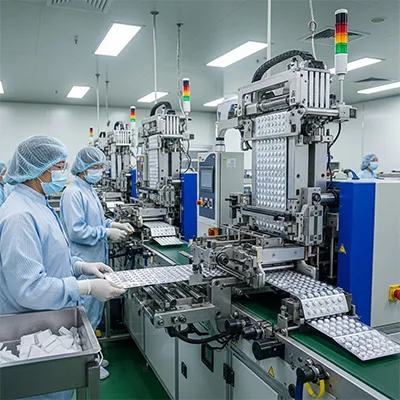
The pharmaceutical sector is experiencing one of the most fundamental changes ever in its history, triggered by the booming growth of robotics, intelligent automation, and AI-driven manufacturing systems. Developing new and improved drugs and with increased demands on the globe, the old processes based on manual labor and fragmentation are no longer able to produce drugs as quickly, precisely, and in large quantities as modern healthcare demands. This change has made the automation of pharmaceutical manufacturing a core part of operational excellence, and robotics and data-driven systems are now an essential part of possession and not a luxury.
In the current day and age, pharmaceutical facilities are working in conditions where regulatory demands are more and more heightened, product complexity is on the rise, and the demand to generate high-volume production regularly is more urgent than ever before. Automation is not merely the direct application of a mechanical process anymore; it has become a broad area of highly sophisticated robots, machine vision systems, intelligent scheduling applications, and AI-assisted automation in drug discovery and production. These technologies are giving rise to a new age of automated drug production, which is more productive, quality assured, time-to-market faster, and with high compliance.
The Evolving Role of Robotics in Pharmaceutical Manufacturing
In the discussion of the question of what the role of robotics in pharmaceutical manufacturing is, one realizes that robotics has gone a long way beyond material handling in its simplest form. The new generation technology of pharmaceutical robotics is to control the activities, which were very risky and precise, and in which the human experience was very important. Robots are now able to perform aseptic work, fill and finish tasks, capping vials and loading syringes, with high precision, much higher than that of humans working in sterile manufacturing facilities. These systems can work without becoming tired, and the repeatability is outstanding, thus minimizing the chances of contamination- this is one of the main issues in sterile drug production.
Inspection is also done using robotic arms that are fitted with machine vision systems. They identify small-scale flaws in packaging, labelling, and product image, enhancing the automation of pharmaceutical manufacturing on the quality control level. Moreover, collaborative robots or cobots are also being used more and more to work alongside a human operator, especially in jobs that need dexterity, though not necessarily the exposure and tediousness that is often part of human error.
Robotics also has an effect also in drug synthesis. Robotic dispensing systems and automated reactors can be used to handle reagents and provide them with great accuracy so that the conditions of the reaction remain unchanged, and the quality of products is directly determined by them. Such automation in drug production guarantees that each batch is produced to the needed specifications and hence better predictability regarding the production results.
How Robotics Improves Pharmaceutical Manufacturing Efficiency
The optimization of the industry is one of the major factors that contributed to the implementation of automation. The goal of every pharmaceutical company is to improve throughput without jeopardizing safety and compliance. The advantages of robotics in enhancing the productivity of pharmaceutical production can be explained through evaluation of the critical points that can hardly be addressed using manual systems. Conventional processes can be characterized by extended lead times and numerous human interfaces, all of which add delays or error potential. Robotics optimizes these processes by developing continuous and coupled production lines that can operate with a minimum of intervention.
The robots in automated formulation regions enhance activities such as weighing, dispensing, and sample preparation. AGVs move products on the factory floor to maintain the alignment of activities within the upstream and downstream processes. The outcome is an extreme lowdown of idle time and flow of manufacturing without interruption, which increases the effectiveness of the equipment in general.
Also, the efficiency of pharmaceutical manufacturing is enhanced as robots assume the control of the resource-intensive compounds like sterile compounding or fill-finish tasks. These are processes in which any microscopic variation will result in rejection of batches at a cost of millions. Via robotics, every one of the units is made precise, allowing companies to maximize yields and reduce rework, which is subsequently used to save a lot of money.
Automation as a Catalyst for Quality, Safety, and Consistency
The most important parameter is quality in the case of a pharmaceutical company. The quality of drug manufacturing through automation is seen in the uniformity of each production stage. Programming rules and machine logic are inherent to automated systems, and this makes them devoid of subjectivity. This makes the work replicated with the same degree of accuracy in each cycle. Automation is certain to ensure that the documentation, electronic batch records, and audit trails are kept correct and complete in regulated environments where Good Manufacturing Practices have to be adhered to.
Occupational risk is also mitigated through automation, where the human being is not exposed to highly active pharmaceutical ingredients, toxic solvents, or biological hazards. These substances are handled by robots in closed enclosures with increased safety, contributing to the protection of employees and the quality of the product. Quality assurance automation in pharma implies that inspection processes, such as visual inspection or particle identification, are carried out with machine accuracy, increasing the level of overall product.
Analytics with the use of AI has also become increasingly important. Once the variations or deviations are detected by the vision systems, the data can be transmitted to the AI models that can determine the root causes in a real-time manner. This makes it a proactive environment and not a reactive environment and allows the companies to avert problems before they become compliance challenges.
AI and Robotics: A New Frontier for Pharmaceutical Production
Following the dilemma on AI and robotics can reduce the cost of pharmaceutical manufacturing, the response changes to a resounding yes. Robots powered by AI can currently optimize the working process, anticipate faults in machines, and suggest active changes in parameters depending on the environment, such as temperature levels, dosing amount, or use of solvents.
Where automated bioprocessing systems exist, the AI-based algorithms are used to keep the culture conditions optimal by examining the real-time data collected by sensors. These adjustments are dynamic and reduce the number of failures with batches and enhance yields. Equally, in packaging and distribution, AI models can provide insights into demand patterns and assist manufacturers in changing the production schedule accordingly.
The merging of AI, machine learning, and robotics is also changing the process in which drug discovery and early-stage development occur. With AI and automated synthesis platforms, researchers can screen thousands of compounds in a short time, evaluate molecular interactions, and model formulation behavior. This shortens the conventional time spans in the processes of discovery, making the new treatments enter the commercialization cycle much sooner.
Trends Shaping the Future of Pharmaceutical Manufacturing Automation
The knowledge of the recent tendencies in the automation of the pharmaceutical production process is a clear image of the direction the industry is moving.
Among the most noticeable advances is the adoption of robotic process automation in pharma to administer and perform administrative and operational tasks like compliance documentation, scheduling, and inventory management. The paperwork and manual records-keeping bottlenecks are also removed by RPA, and data moves smoothly between the quality, production, and regulatory departments.
The other trend that is developing is the use of modular, flexible robots. The current robots can be reconfigured flexibly, unlike in the earlier systems, which were inflexible and had limitations; hence, they are applicable in contract manufacturing organizations that embrace a diverse product portfolio.
The growing trend of personalized medicine also requires equipment that could be able to deal with small batches or even batch-of-one production. Robotics will give the flexibility needed in these workflows so that the results will remain consistent even at smaller scales without compromising on quality.
Another characteristic advancement is the emergence of digital twins. Simulations in digital form of manufacturing systems help pharmaceutical firms to replicate manufacturing processes, optimize layouts, and predict difficulties without halting operations. Combined with robotics, these twins are used to optimize equipment calibration, visionary maintenance programs, and long-term equipment performance.
Implementation: How to Bring Robotic Process Automation into Pharma
Pharma companies looking at the way of introducing robotic process automation should proceed step by step. Although the move to automation will require upgrades in the infrastructure, the strategic path will start with the identification of workflows that bring the most value upon automation. Tedious jobs, paperwork, time wastage, and jobs that are highly prone to mistakes are all the best candidates for RPA.
RPA is compatible with the existing systems, e.g., ERP systems, manufacturing execution systems, and quality management tools, once installed. The current progress made on AI also upgrades the intelligence of these bots so that they are in a position to handle exceptions, data interpretation, and make decisions that contribute to the continuity of the process.
Automation across the Pharmaceutical Supply Chain
Robotics and AI are not only applicable on manufacturing floors. Pharmaceutical supply chain processes are quickly adopting the integration of robotics and AI in the industry to improve traceability, eliminate stockouts, and streamline warehouse operations. The autonomous mobile robots are used to coordinate the movement of inventory, whereas the AI models predict the demand more accurately. Automated systems in the face of automated compliance, anti-counterfeiting, cold-chain, and serialization ensure real-time control of pharmaceutical logistics.
These innovations ensure that medicines are received by patients in the best possible state and within the shortest duration, thereby enhancing the overall level of healthcare delivery.
Selecting the Right Automation and Robotics Partners
During the process of acquiring pharmaceutical manufacturing automation firms, there is a need to have a partner that has a profound knowledge of regulatory compliance, approved equipment, and pharmaceutical engineering. Pharmaceutical automation technology providers are plentiful in the market with robotic arms, sterile-processing robots, automated visual inspection systems, and end-to-end manufacturing platforms. The selected automation partner helps to match solutions to the workplace needs of a company, its scalability objectives, and its long-term digital transformation strategies.
The knowledge of case studies in pharma manufacturing automation assists organizations in benchmarking best practices and predicting difficulties. Whether it is robotics in aseptic filling, AI-based predictive maintenance, or automated synthesis laboratories, these real-life applications show the real value of automation, in the number of contaminations prevented, or first-pass yield and cost of operation savings.
The Road Ahead: The Future of Robotics in the Pharmaceutical Industry
It is a fact that the future of robotics in the pharmaceutical industry is dynamic due to the emerging technologies that keep pushing the limit of what can be accomplished. Whole autonomous manufacturing facilities, in which robots, artificial intelligence, and sophisticated analytics combine as a system to oversee all parts of the production process, are already starting to emerge. The movement of robotics will be made more intuitive and AI models more predictive, which means that pharmaceutical manufacturing will be more resilient and agile than ever before.
The long-term vision entails hyper-efficient facilities that respond immediately when the demand changes, optimize themselves in the course of operation, and have almost zero error rates. Humans in such plants will become supervisors and strategists, whose attention is given to innovation, and the implementation is regulated by the automated system.
.webp)
Kate, Editorial Team at Pharma Focus Europe, leverages her extensive background in pharmaceutical communication to craft insightful and accessible content. With a passion for translating complex pharmaceutical concepts, Kate contributes to the team's mission of delivering up-to-date and impactful information to the global Pharmaceutical community.