Advanced Robotics and Autonomous Operations in Pharma Production
Lakshmi, Editorial Team, Pharma Focus Europe
European pharmaceutical plants are not short of robots. What they lack is autonomy — machines trusted to decide. This feature examines the shift from supervised automation to conditional autonomy across aseptic processing, quality control and material flow, the validation problem posed by systems that choose their own path, and the compliance runway created by the EU Machinery Regulation and the amended AI Act.
Introduction: The Robot Was Never the Hard Part
Walk the production floor of almost any modern European pharmaceutical site and you will find robots already at work. Six-axis arms de-nest syringe tubs. Gantries load and unload lyophilisers. Autonomous mobile units ferry pallets between the warehouse and the dispensary. Robotics arrived in pharmaceutical manufacturing more than two decades ago and, in the purely mechanical sense, the argument was won long ago.
What has not been settled is autonomy. A robot executes; an autonomous system decides. The distinction sounds academic until it reaches the batch record, at which point it stops being an engineering question and becomes a governance one. On what basis does a machine judge that a deviation sits within limits, that a line should be re-sequenced around a failed component, that a sample is fit to progress — and who carries that judgement when an inspector asks?
The question has become urgent for European manufacturers for reasons that have surprisingly little to do with robotics itself. The revised sterile manufacturing annex has made human presence in the aseptic core an explicit risk to be designed out rather than gowned around. Product mix has shifted decisively toward small, high-value, high-mix batches that punish manual changeover. Experienced operators are scarce, ageing and expensive across most of the continent. And from January 2027, the law governing the machines themselves changes.
From Automation to Autonomy: Five Levels of Robotic Operation in Pharma Production
Much of the strategic confusion in pharmaceutical robotics comes from treating “automated” as a single state. It is not. Figure 1 sets out a five-level ladder that distinguishes what a machine does from what a machine is permitted to decide — a framing that maps far more usefully onto capital allocation than any equipment category.
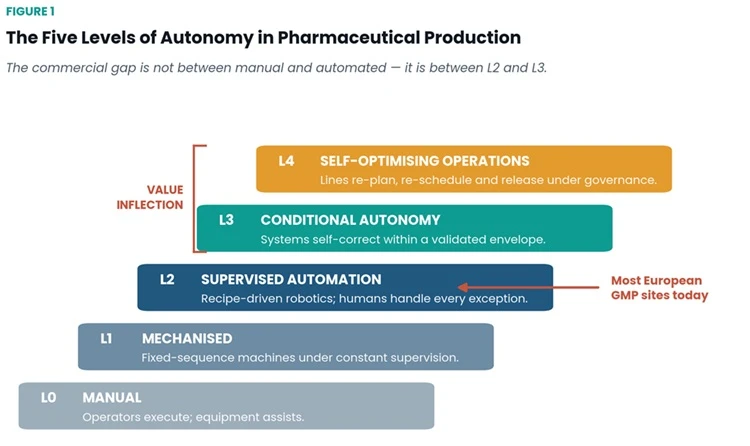
Figure 1: Autonomy levels in pharmaceutical production, from manual execution to self-optimising operations.
The great majority of European GMP sites sit at Level 2. Recipe-driven equipment executes a validated sequence flawlessly, and then stops the moment reality departs from the recipe. Every exception — a mis-seated stopper, an out-of-tolerance fill weight, an unexpected particle signature — escalates to a gowned human. The machine is fast; the plant is not, because the plant runs at the speed of its exception queue.
Level 3, conditional autonomy, is the commercially interesting step. Here the system is permitted to detect, classify and correct a defined class of deviations inside an envelope agreed in advance and qualified like any other critical parameter. Level 4 extends that logic to planning: lines that re-sequence campaigns around a late material delivery or a failed component, under governance rather than under instruction.
A plant that automates execution but escalates every exception has bought speed without buying resilience. In high-mix manufacturing, exceptions — not throughput — are the constraint.
Reading the Value Map: Where Pharmaceutical Robotics Actually Pays
Not every operation rewards autonomy equally, and the difference is rarely technical. Figure 2 positions ten production and quality operations against operational value and against readiness — technical maturity combined with regulatory clarity.
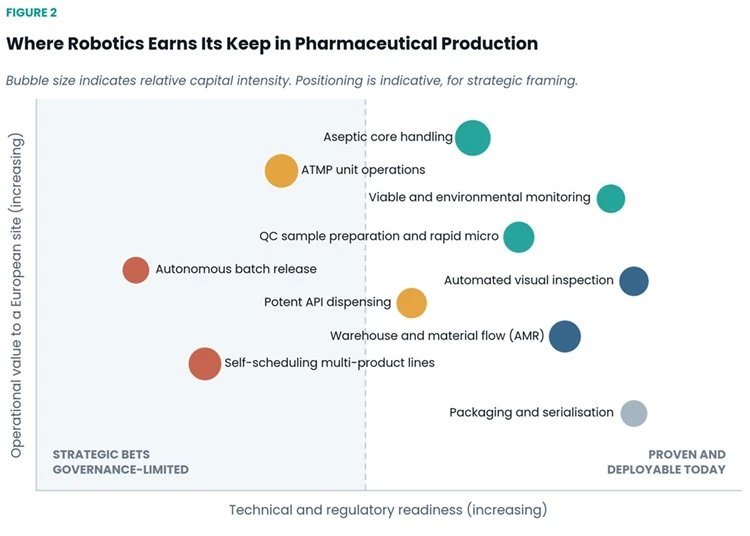
Figure 2: Value against readiness for robotic and autonomous operations across a European pharmaceutical site.
The right-hand field is settled territory. Packaging and serialisation, warehouse material flow, automated visual inspection: proven, financeable, and largely uninteresting to a board because the business case has been made a thousand times. Aseptic core handling, viable and environmental monitoring, and QC sample preparation are more consequential — high value, and mature enough to specify today rather than pilot.
Advanced therapy unit operations are the outlier. When a batch is a single patient, manual variability is not an efficiency problem but a product-quality one, which puts the value very high. Yet these processes are young and change frequently, which is precisely the condition robotics handles worst. The left-hand column — autonomous batch release, self-scheduling multi-product lines — is limited by governance rather than by engineering. The robots are ready. The quality systems that would have to authorise them are not.
The Autonomous Quality Laboratory: Robotics' Least Glamorous, Highest-Return Frontier
Boards fund robots on the production floor because that is where the product is. The faster payback is frequently two doors away, in quality control, and it is being driven by the sterile manufacturing annex more than by any automation strategy.
Contemporary contamination control expectations generate a substantial and continuous monitoring burden: viable and non-viable sampling throughout operations, settle plates with limited exposure windows, and the routine interventions needed to change them. Each intervention is a gowned human entering a clean zone to solve a problem created by the need to demonstrate that the zone is clean. Robotic plate handling, automated incubation and rapid microbiological methods break that circularity directly, and they do so in an area where the labour is skilled, repetitive and increasingly hard to recruit.
There is a quieter argument that lands better with quality leadership than with engineering. A robotic system produces records that are attributable, legible, contemporaneous and complete by construction. It does not transcribe a reading, round a figure, or reconstruct a timestamp at the end of a shift. At sites where a meaningful share of deviations are documentation failures rather than process failures, autonomous sample handling is a data-integrity investment that happens to also cut turnaround time.
Case in Point: An Autonomous Quality and Material-Flow Programme
What follows is an illustrative composite, assembled from the pattern of outcomes European multi-product sites typically report. The figures indicate direction and order of magnitude rather than any single facility's audited results.
A mid-sized European site running both sterile and solid-dose lines found its constraint was not filling capacity but quality throughput. Environmental monitoring results took roughly two days to return, campaign changeovers waited on release decisions, and analysis of a year of deviations showed that documentation and transcription errors, not equipment failures, were the largest single category. The board approved an eighteen-month programme in three tranches: robotic plate handling with automated incubation and reading; an autonomous mobile fleet for sample, consumable and component transport; and, last, a conditional-autonomy layer permitted to classify a defined set of in-process excursions and dispatch re-tests without waiting for a supervisor.
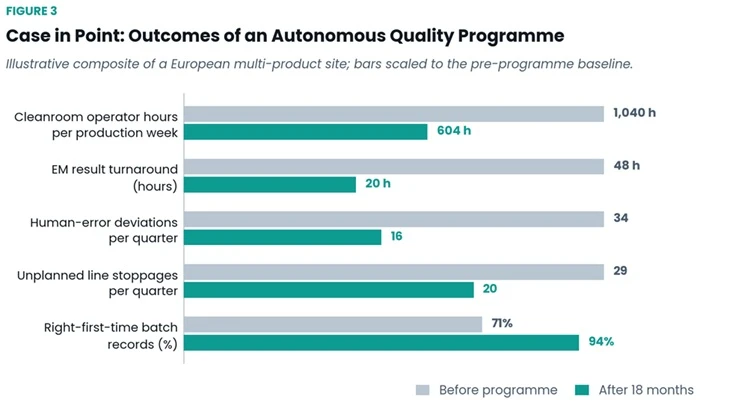
Figure 3: Indicative eighteen-month outcomes of a phased autonomous quality and material-flow programme.
Two results deserve executive attention more than the headline numbers. First, headcount did not fall. Roles migrated from execution to exception handling, robot supervision and corrective action — a shift the site's works council supported precisely because it was framed and funded that way. Second, unplanned stoppages improved far less than the other measures, because once quality ceased to be the bottleneck the constraint moved upstream into material supply. That is the standard finding, and a useful corrective to lights-out rhetoric: autonomy relocates constraints before it removes them.
The Regulatory Pincer: Robotics Meets the Machinery Regulation and the AI Act
For European manufacturers, the compliance calendar has become the binding constraint on robotics design, and two instruments are closing at once.
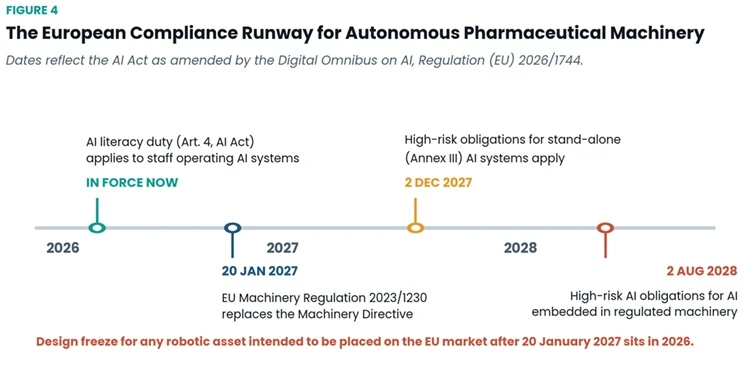
Figure 4: Key European compliance dates shaping autonomous machinery specification and procurement.
From 20 January 2027, Regulation (EU) 2023/1230 replaces the long-standing Machinery Directive, with no period in which both regimes run in parallel. Machinery placed on the EU market from that date must meet the new requirements, which for the first time address autonomous mobile machinery, self-evolving behaviour, software updates and cybersecurity alongside conventional mechanical safety, and which route certain high-risk machinery through third-party conformity assessment. The practical consequence is uncomfortable: a robotic cell specified in 2026 for installation in 2027 has to be designed against the new regulation now, not retrofitted to it later.
The second instrument is the AI Act. The Digital Omnibus on AI, Regulation (EU) 2026/1744, deferred the heaviest obligations — to 2 December 2027 for stand-alone high-risk systems, and to 2 August 2028 for AI embedded in products already covered by EU product-safety law, machinery included. That is relief on timing, not exemption on substance, and the AI literacy duty on staff operating such systems has applied since February 2025 irrespective of the deferral. None of it displaces GMP. An autonomous cell must satisfy machinery law, AI law and the pharmaceutical annexes on sterile manufacturing and computerised systems simultaneously — three regimes describing the same equipment in three different vocabularies.
Validating a Machine That Chooses Its Own Path
Pharmaceutical validation was built on determinism: identical inputs produce identical outputs, demonstrated three times and locked. An autonomous mobile robot that re-plans its route around an obstruction, or a vision system that adapts a rejection boundary as it accumulates data, cannot offer that guarantee and should not be asked to.
The workable answer is to stop validating the path and start validating the envelope. Qualification defines the permissible action space — routes, speeds, tolerances, the classes of decision the system may take — and demonstrates that the system cannot leave it, with an auditable record of every decision taken inside it. Continuous verification in production then does the work that periodic requalification used to do. Conceptually this is nothing exotic; it is the logic of a contamination control strategy applied to machine behaviour. Operationally it demands that quality organisations write specifications about behaviour rather than about output, and most are not yet staffed to do so. That capability gap, far more often than capital cost, is what delays European autonomy programmes.
The Brownfield Reality: Why European Robotics Programmes Stall
Most European pharmaceutical capacity is not new, and robotic ambition collides with cleanroom geometry designed in the 1980s: ceiling heights, floor loading, airflow patterns qualified around human movement, and airlock layouts that assume people rather than vehicles. Retrofit feasibility, not robot capability, sets the ceiling on what a legacy site can reach.
Integration debt is the second obstacle. A typical site carries equipment from many vendors and several technology generations, each with its own interfaces. Whether a plant can reach conditional autonomy without a rebuild is largely determined by procurement decisions taken years earlier — open, vendor-neutral interface standards and modular equipment description are cheap to require at purchase and extremely expensive to retrofit.
The third obstacle is social, and distinctively European. In several jurisdictions, material changes to work organisation require formal consultation with employee representatives. Programmes presented as headcount reduction stall or arrive years late. Programmes presented as removing gowned hours, night shifts and repetitive interventions generally do not. The framing is not public relations; it determines the schedule, and it should be settled before the capital request, not after.
Conclusion: Autonomy Is a Governance Decision, Not a Procurement One
The technology needed to run substantial parts of pharmaceutical production at conditional autonomy exists and is commercially available today. What remains scarce is the organisational apparatus to authorise it: quality systems able to specify machine behaviour, validation approaches that accommodate adaptive systems, and a settled leadership view on which decisions a machine may take unsupervised.
European manufacturers meet this earlier and more sharply than their peers elsewhere, because the regulatory calendar is fixed and close. Assets being specified now will be qualified under a new machinery regime and, before the decade is out, under an AI regime as well. Sites that continue to treat robotics as a capital line item will buy Level 2 equipment at Level 4 prices and then wonder why the payback never materialised.
The more useful question for the board is not which robot to buy. It is which decisions the organisation is prepared to delegate, on what evidence, and with what recourse when the machine turns out to be wrong. Answer that, and the equipment specification very largely writes itself.

Lakshmi is a science writer with a foundation in the laboratory. She earned her master's in biotechnology and trained through research internships at ICGEB (JNU) and DIPAS, DRDO, with her work appearing in the Egyptian Journal of Veterinary Sciences. Now APCRM-certified and part of the editorial team at Pharma Focus America and Pharma Focus Europe, she reports on pharmaceutical technology, research, and innovation — giving complex science a clear and confident voice for industry leaders.